
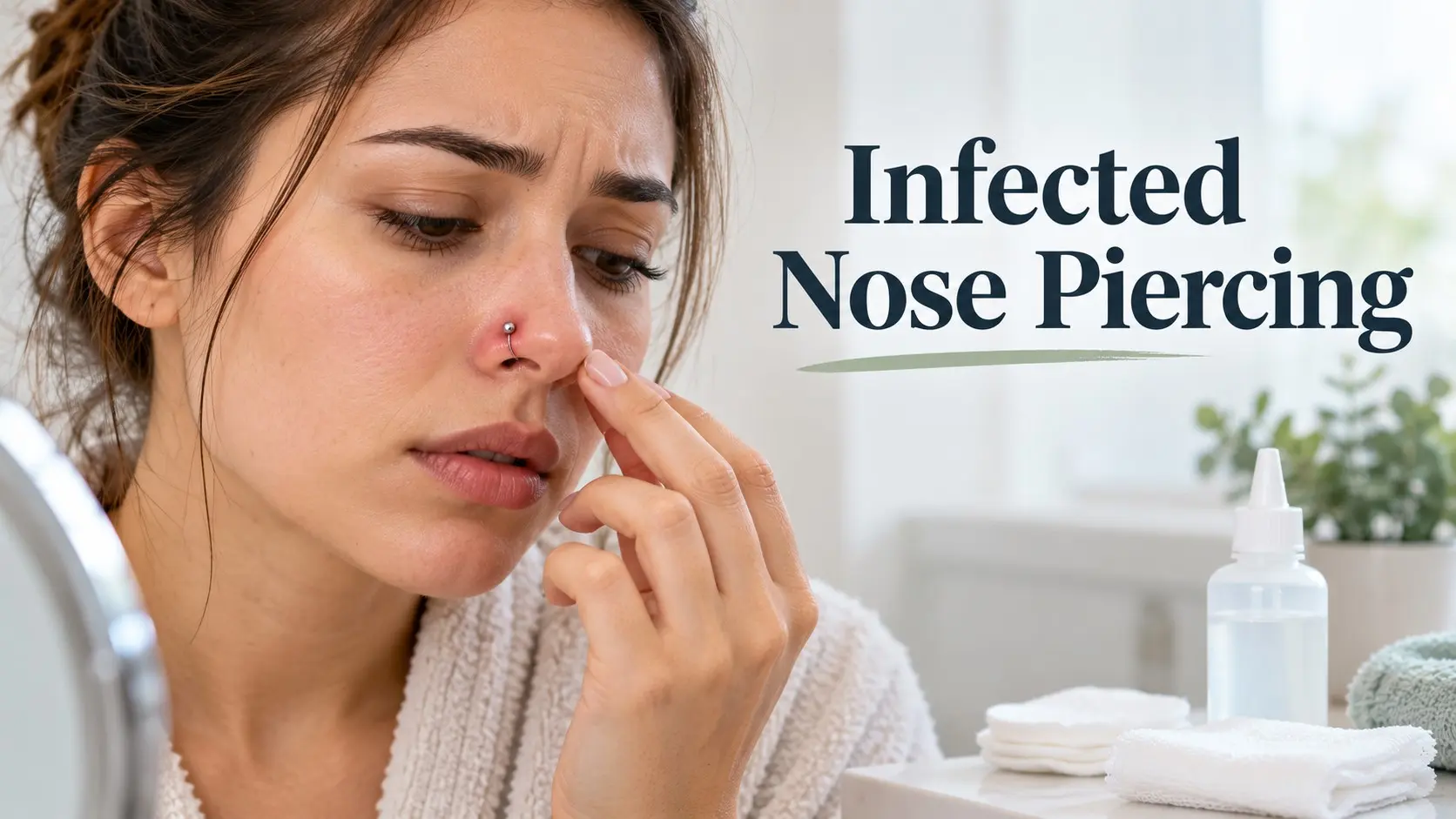
Published: Jul 4, 2023
Last updated: October 3, 2026
Written and source checked by: Adel Galal, Founder and Lead Writer at NextFitLife
Medical review status: This article has not been medically reviewed by a doctor, dermatologist, nurse, pharmacist, or other licensed healthcare professional.
A new nose piercing can be sore, a little red, and slightly swollen while it heals. That does not always mean infection.
What matters is the direction of the symptoms. Pain that gets worse, increasing heat, growing swelling, thick pus, or spreading redness is more concerning than mild symptoms that slowly settle.
Quick answer: An infected nose piercing may become hotter, more painful, and more swollen instead of slowly improving. Thick white, yellow, or green pus, bad smell, spreading redness or darker skin change, a painful lump, fever, or feeling unwell are warning signs. Leave the jewelry in unless a qualified healthcare professional tells you to remove it, clean gently, and get medical advice when infection is suspected.
For broader skin and wound care guidance, visit the NextFitLife Skin Health Guide and the Skincare Basics and Routines Hub.
Medical note: This content is for general educational purposes and does not replace professional medical advice, diagnosis, or treatment. Consult an appropriately qualified healthcare professional for personal medical concerns. This article explains published guidance and does not provide a personal clinical assessment. Always consult qualified medical professionals for diagnosis and treatment of any health condition.
A suspected piercing infection may need prescription treatment. Seek urgent medical care for severe pain, fast spreading redness or darker discoloration, fever, facial swelling, eye swelling, trouble breathing, trouble swallowing, confusion, fainting, or rapidly worsening symptoms.
Table of Contents
- Normal healing versus infection
- 9 warning signs of infection
- Worsening pain
- Growing swelling
- Increasing warmth
- Spreading redness or darker skin change
- Thick pus
- Bad smell
- Repeated bleeding
- Painful fluid filled lump
- Fever, chills, or feeling unwell
- Why nose piercings become infected
- Infection versus irritation, allergy, and piercing bumps
- Safe care while you arrange medical help
- What not to put on the piercing
- Should you remove the jewelry?
- How infection is treated
- Tetanus and piercing wounds
- Who has a higher risk of complications
- How to prevent another infection
- When to get urgent help
- References and Sources
- Related NextFitLife guides
- About the author
- Frequently asked questions
Is Your Nose Piercing Infected or Just Healing?
This is the first question to answer.
A fresh piercing is a wound, so a small amount of irritation can be normal at first.
Normal early nose piercing healing may include:
- Mild tenderness
- A little swelling
- Light itching
- Slight redness or darker skin around the hole
- A small amount of pale fluid
- A thin crust around the jewelry
These symptoms should become calmer with time.
They should not become hotter, more painful, more swollen, or begin spreading across the nose or face.
Skin color also matters. On darker skin, infection may not look bright red. The affected skin may look darker, purple, gray, or simply different from the nearby skin.
Look at the whole pattern: pain, heat, swelling, discharge, smell, and whether the area is getting better or worse.
9 Critical Signs of an Infected Nose Piercing
One mild symptom alone does not prove infection.
The combination and the trend matter more.
1. Pain Is Getting Worse
A new piercing can feel tender.
What concerns me more is pain that becomes stronger instead of fading.
Increasing throbbing, burning, or deep tenderness can be a sign of a nose piercing infection, especially when it appears with swelling, heat, or pus.
Do not keep pressing the area to check whether it hurts.
Repeated touching adds more irritation and can move germs into the healing channel.
2. Swelling Keeps Growing
A little swelling can happen after piercing.
Swelling that keeps increasing is different.
Watch the fit of the jewelry too.
If the stud or ring begins pressing tightly into swollen tissue, or the jewelry looks as if it is sinking into the skin, get professional help.
Jewelry that becomes trapped or embedded may need careful medical or professional management.
3. The Skin Feels Hot
Warmth is part of inflammation.
If the skin around the piercing becomes clearly hotter than the nearby nose, especially with growing pain or swelling, infection becomes more likely.
This is different from a brief warm feeling after a shower or exercise.
4. Redness or Darker Discoloration Is Spreading
Small local color changes can happen after a new piercing.
Color that spreads outward deserves more attention.
On light skin, this may look red.
On darker skin, spreading inflammation may look darker, purple, gray, or different from the normal surrounding tone.
Fast spreading skin inflammation can be a sign of cellulitis, which needs medical treatment.
5. Thick White, Yellow, or Green Pus Appears
Do not confuse a little pale healing fluid with thick pus.
Small amounts of clear or pale fluid can dry into a light crust during healing.
Piercing pus is thicker and may be white, yellow, or green.
Pus becomes more concerning when it appears with heat, swelling, worsening pain, or spreading skin changes.
Do not squeeze it out.
6. The Piercing Smells Bad
A strong bad smell from thick drainage can be another infection clue.
Normal healing crust should not turn into increasingly foul smelling discharge.
If odor appears with worsening pain, heat, or pus, seek medical advice.
7. Bleeding Keeps Returning
A little bleeding can occur when a new piercing is first made or if it is accidentally snagged.
Repeated bleeding later in healing deserves a closer look.
It may come from trauma, jewelry that does not fit well, repeated twisting, irritated tissue, or infection.
Stop manipulating the jewelry and get advice if bleeding keeps coming back.
8. A Painful Fluid Filled Lump Develops
Not every nose piercing bump is infected.
But a painful lump that feels full of fluid or contains pus can be an abscess.
Do not pop it.
Do not pierce it with a needle.
Do not try to drain it yourself.
An abscess may need professional drainage and antibiotics.
9. You Have Fever, Chills, or Feel Unwell
A small local piercing problem should not make your whole body feel sick.
Fever, chills, weakness, or feeling generally unwell can mean the infection is becoming more serious.
Get prompt medical care.
If symptoms are rapidly worsening or you also have facial swelling, eye swelling, confusion, fainting, trouble breathing, or trouble swallowing, seek urgent or emergency care.
Infection, Irritation, Allergy, or Piercing Bump?
This is where many people get stuck.
A red bump does not automatically mean bacteria are causing an infection.
| Problem | Common Clues | Best Next Step |
|---|---|---|
| Infection | Increasing pain, heat, swelling, pus, bad smell, spreading color change | Seek medical advice promptly |
| Irritation | Mild soreness, dryness, crust, or redness after snagging or rubbing | Stop the source of friction and use gentle care |
| Metal allergy | Strong itching, rash, dry skin, repeated irritation around jewelry | Ask a clinician or experienced piercer about jewelry material |
| Irritation bump | Small raised bump after pressure, snagging, movement, or poor jewelry fit | Do not squeeze. Reduce irritation and seek advice if persistent |
| Granuloma | Small raised tissue or fluid related bump near a healing piercing | Get professional assessment if it persists or changes |
| Keloid scar | Firm raised scar that grows beyond the original wound | Dermatology assessment may be useful |
| Abscess | Painful swollen pocket that may contain pus | Medical care. Do not drain it yourself |
The table is not a diagnostic test.
Its job is to stop every piercing bump from being treated as if it were the same problem.
For general gentle skin care principles, see the Healthy Skin 101 Guide.
Could It Be a Nickel Allergy Instead of Infection?
Yes.
Nickel is a common cause of allergic contact dermatitis.
A nickel allergy is more likely to cause:
- Strong itching
- A rash around the jewelry
- Dry or scaly skin
- Small irritated bumps
- Repeated symptoms whenever the same metal is used
Infection is more likely when you see worsening pain, heat, pus, spreading inflammation, or fever.
Sometimes irritation and infection can occur at the same time.
Do not replace jewelry by yourself during a suspected infection just because you think nickel may be involved. Ask a qualified clinician or experienced professional piercer what should be done.
What Causes a Nose Piercing Infection?
A piercing creates an opening through the skin.
Bacteria can enter while the channel is still healing.
Touching With Unwashed Hands
Hands pick up germs from phones, door handles, keyboards, towels, makeup containers, and many other surfaces.
Touch the piercing only when needed, and wash your hands first.
Poor Sterile Technique During Piercing
A safe piercer should use appropriate hand hygiene, fresh gloves, sterile equipment, and a sterile single use needle.
Reusable equipment needs proper sterilization.
Do not pierce your own nose with household tools.
Cleaning Too Little or Too Aggressively
Skipping basic piercing aftercare can allow crust and debris to build up.
But cleaning all day, scrubbing, or repeatedly applying harsh products can damage healing tissue too.
Clean gently.
Do not attack the wound.
Jewelry That Is Too Tight
New tissue needs enough room for normal swelling.
Jewelry that presses into the nose can create pain, damage, and poor drainage.
If the jewelry looks embedded or is being swallowed by swollen skin, get prompt professional care.
Repeated Trauma
Towels, pillowcases, masks, glasses, clothing, fingernails, and hair can catch a nose piercing.
A sharp pull can reopen tissue that was trying to heal.
Swimming and Contaminated Water
Pools, hot tubs, lakes, rivers, and other bodies of water can expose a healing piercing to microorganisms.
A healing or infected piercing should not be repeatedly soaked.
Cosmetics and Skin Products
Foundation, powder, sunscreen, cream, and hair products can collect around the opening.
Keep products off the healing channel as much as practical.
What Should You Do if the Piercing Might Be Infected?
If you think you have a true piercing infection, contact a healthcare professional promptly.
While you arrange care, keep the routine simple.
Step 1: Wash Your Hands
Wash with soap and clean water before touching the nose or jewelry.
Dry your hands.
Step 2: Leave the Jewelry in Place
Do not pull the jewelry out on your own when infection is suspected.
The piercing channel can begin closing, and a clinician may want the opening left available for drainage.
There are exceptions.
If the jewelry is trapped, embedded, too tight, or damaging the tissue, a healthcare professional may decide it should be changed or removed.
Step 3: Clean Gently
A practical option is sterile saline made for wound care.
Another option supported by dermatology guidance is gentle washing with a mild fragrance free cleanser and clean water.
Rinse soap away completely.
Do not scrub the hole.
Step 4: Dry Without Rubbing
Pat the outer area gently with clean disposable material.
Avoid rough cloth towels that can snag the jewelry.
Step 5: Use a Warm Compress for Comfort
A clean warm compress can help soften crust and ease discomfort.
Use warm water, not water hot enough to burn the skin.
A warm compress does not replace antibiotics or medical treatment when those are needed.
Step 6: Stop Twisting the Jewelry
Repeated rotation can tear healing tissue.
Leave the jewelry alone except when necessary for proper cleaning or when a professional is assessing it.
Step 7: Keep Makeup and Skin Products Off the Area
Do not cover infection signs with concealer.
Keep foundation, sunscreen, creams, acids, retinoids, and other face products away from the hole until the area has recovered.
Step 8: Avoid Swimming
Stay out of pools, hot tubs, lakes, and rivers while the piercing is infected or actively healing.
Step 9: Get Medical Advice
This is the step that home remedy articles too often bury.
A suspected infection can require prescription treatment.
If you have pus, spreading redness, worsening pain, increasing heat, or swelling, arrange an assessment rather than trying stronger household products.
What Should You Never Put on an Infected Nose Piercing?
More sting does not mean more healing.
Avoid these products unless a qualified healthcare professional has specifically told you to use them:
- Rubbing alcohol
- Hydrogen peroxide
- Iodine
- Strong antibacterial soaps
- Tea tree oil
- Other undiluted essential oils
- Toothpaste
- Lemon juice
- Apple cider vinegar
- Baking soda
- Strong homemade salt mixtures
- Harsh acne acids
These products can burn, dry, or irritate healing skin.
The American Academy of Dermatology specifically advises against hydrogen peroxide and antibacterial soaps on new piercings because they can damage healing skin.
Our Skincare Basics Guide explains why stronger products are not automatically safer for irritated skin.
Should You Use Antibiotic Ointment Yourself?
I would not make antibiotic ointment the automatic first step for every red nose piercing.
First, redness can come from irritation or allergy rather than infection.
Second, some topical antibiotic ingredients can cause contact dermatitis.
Third, a real infection may need a prescription oral antibiotic, drainage, jewelry management, or another treatment that ointment alone cannot provide.
If a clinician recommends a topical or oral antibiotic, use it exactly as directed.
Do not use leftover antibiotics.
Do not share antibiotics.
Should You Remove an Infected Nose Piercing?
Usually, not on your own.
NHS guidance advises leaving jewelry in unless a doctor tells you to remove it.
The reason is practical: removing jewelry can allow the opening to begin closing.
That can make management harder.
But “never remove it” is too absolute.
A healthcare professional may recommend removal or replacement if:
- The jewelry is embedded
- The jewelry is too tight
- The jewelry is damaging tissue
- The metal is causing a serious reaction
- Drainage or treatment requires a different approach
Let the person examining the wound make that decision.
How Is an Infected Nose Piercing Treated?
A clinician may look at the skin, swelling, jewelry fit, drainage, and surrounding tissue.
They may also ask:
- When the piercing was done
- When symptoms started
- Whether symptoms are improving or getting worse
- What products you used
- Whether the piercing was recently pulled or hit
- Whether you have been swimming
- What metal the jewelry contains
- Whether you have fever or chills
- Whether you have diabetes or reduced immune function
Treatment depends on the problem.
It may include:
- Prescription topical treatment
- Oral antibiotics
- Professional drainage of an abscess
- Changing or removing trapped jewelry
- Treatment for allergic dermatitis
- Treatment for excessive scar tissue
- Reviewing tetanus vaccination status
The correct treatment depends on what is actually wrong.
Why Does Tetanus Matter With a Piercing?
A piercing is a puncture wound.
The CDC recommends checking tetanus vaccination history as part of wound care.
The correct timing depends on the type of wound and your vaccination history.
For people who completed the primary vaccine series, CDC guidance says a booster is usually considered after 10 years for clean minor wounds and after 5 years for dirty or major wounds.
People with an unknown or incomplete vaccination history may need different management.
Do not take antibiotics simply to prevent tetanus. CDC guidance states that antibiotics are not used as tetanus prevention.
If you are unsure when your last tetanus vaccine was given, ask a healthcare professional.
Who Has a Higher Risk of Complications?
Any piercing can become infected.
Some people deserve a lower threshold for medical care.
This includes people with:
- Diabetes
- A weakened immune system
- Medicine that suppresses immune function
- Poor wound healing
- Repeated skin infections
- Jewelry embedded in swollen tissue
Do not wait for a mild problem to become severe if you already know healing is harder for you.
How Long Does a Nose Piercing Take to Heal?
Healing is not instant, and the outside can look better before the inside of the channel is strong.
Nose piercings can take several months to heal fully.
Exact timing varies with the piercing location, jewelry, aftercare, health, repeated trauma, and individual healing.
Do not change the starter jewelry simply because the skin looks calm after a few weeks.
Ask an experienced piercer if you are unsure whether the channel has healed enough for a jewelry change.
How Can You Prevent Another Nose Piercing Infection?
Choose a Skilled Piercer
Use a trained professional working in a clean studio.
They should use appropriate hand hygiene and fresh gloves.
Ask About Sterile Equipment
A fresh sterile single use needle should be used for the piercing.
Reusable equipment needs correct sterilization.
Choose Suitable Jewelry
Jewelry should fit without burying itself in swollen tissue.
Materials with a lower allergy risk include appropriate implant grade titanium and other suitable piercing metals.
Nickel containing jewelry can cause allergic reactions in sensitive people.
Keep Hands Away
Do not touch the piercing every time you pass a mirror.
Wash your hands before necessary contact.
Avoid Snagging
Be careful with towels, pillowcases, masks, glasses, clothing, and fingernails.
Do Not Overclean
Clean as directed, then let the tissue heal.
Constant cleaning is still irritation.
Common Nose Piercing Care Mistakes
| Mistake | Why It Can Be a Problem | Safer Approach |
|---|---|---|
| Removing jewelry at the first sign of redness | The channel may begin closing | Ask a clinician when infection is suspected |
| Squeezing a bump | Can injure tissue and spread infection | Leave it alone and get advice if painful or persistent |
| Using peroxide or alcohol daily | Can damage healing tissue | Use gentle wound care |
| Using tea tree oil | Can irritate sensitive healing skin | Use sterile saline or clinician directed care |
| Twisting the jewelry repeatedly | Creates friction and small tissue injuries | Leave the jewelry alone |
| Swimming during healing | Exposes the wound to more microorganisms | Avoid pools, hot tubs, lakes, and rivers while healing |
| Covering symptoms with makeup | Can add irritation and hide progression | Keep cosmetics off the wound |
| Using leftover antibiotics | May be the wrong treatment | Use prescribed medicine only as directed |
A Simple Checklist Before You Call a Clinician
Write down these details:
- When the piercing was done
- When symptoms started
- Whether pain is improving or worsening
- Whether swelling is spreading
- Whether the skin feels hot
- Whether there is pus
- Whether there is a bad smell
- Whether you have fever or chills
- Whether the jewelry is too tight
- Whether the jewelry is sinking into the skin
- What metal the jewelry contains
- What cleaning products you used
- Whether you recently swam
- Whether the piercing was snagged
- When you last had a tetanus vaccine
This gives the healthcare professional a much clearer picture than simply saying, “My piercing looks infected.”
When Should You See a Doctor?
Get medical advice promptly if:
- You think the piercing is infected
- Pain is getting worse
- Swelling keeps increasing
- The area is hot
- Thick pus is draining
- Redness or darker discoloration is spreading
- The jewelry is becoming embedded
- The jewelry is too tight
- A painful lump is growing
- Symptoms are not improving
- You have diabetes
- You have a weakened immune system
- You take medicine that suppresses immune function
When Is an Infected Nose Piercing Urgent?
Seek urgent or emergency medical care for:
- Fever with worsening piercing symptoms
- Rapidly spreading redness or dark discoloration
- Severe or rapidly increasing pain
- Major facial swelling
- Swelling around the eye
- Red or dark streaks spreading from the wound
- Confusion
- Fainting
- Trouble swallowing
- Trouble breathing
- Any rapidly worsening severe reaction
Do not wait for essential oils, homemade salt solutions, or stronger cleaners to fix these signs.
Conclusion
An infected nose piercing is more likely when pain, heat, swelling, pus, smell, or skin discoloration gets worse rather than slowly settling.
Your next step is simple: stop squeezing and twisting the piercing, use gentle care, leave the jewelry in unless a clinician tells you otherwise, and contact a qualified healthcare professional if infection is suspected.
If symptoms are spreading, you have fever, severe pain, facial swelling, or feel unwell, get medical help sooner rather than later.
References and Sources
- NHS. Infected Piercings.
Guidance on normal healing, infection signs, antibiotics, and leaving jewelry in unless a doctor advises removal.
https://www.nhs.uk/conditions/infected-piercings/ - American Academy of Dermatology. How to Care for a New Piercing.
Dermatologist guidance on hand hygiene, gentle cleansing, jewelry, and avoiding hydrogen peroxide and harsh antibacterial soaps.
https://www.aad.org/news/how-to-care-for-a-new-piercing - Mayo Clinic. Piercings: How to Prevent Complications.
Guidance on infection, allergic reactions, keloids, jewelry, sterile piercing practice, and aftercare.
https://www.mayoclinic.org/healthy-lifestyle/adult-health/in-depth/piercings/art-20047317 - Mayo Clinic. Puncture Wounds: First Aid.
Guidance on worsening pain, pus, swelling, fever, spreading skin changes, and puncture wound care.
https://www.mayoclinic.org/first-aid/first-aid-puncture-wounds/basics/art-20056665 - Centers for Disease Control and Prevention. Clinical Guidance for Wound Management to Prevent Tetanus.
Current guidance on puncture wounds, tetanus vaccination status, wound care, and when tetanus immune globulin may be needed.
https://www.cdc.gov/tetanus/hcp/clinical-guidance/index.html
Continue Reading on NextFitLife
Use these related NextFitLife guides for skin care, piercing care, and signs of infection:
- Skin Health Complete Guide
- Skincare Basics and Routines Hub
- Healthy Skin 101
- Infected Ear Piercing: Signs, Safe Care and When to Get Help
About the Author
Adel Galal is the founder and lead writer of NextFitLife. His personal study and practical interest in health, fitness, nutrition, wellness, skin care, and healthy aging spans more than 30 years.
His work focuses on comparing health claims with recognized medical, government, and professional sources, then explaining the practical points in simple language.
This content is for general educational purposes and does not replace professional medical advice, diagnosis, or treatment. Consult an appropriately qualified healthcare professional for personal medical concerns. This article explains published guidance and does not provide a personal clinical assessment. Always consult qualified medical professionals for diagnosis and treatment of any health condition.
Learn more about Adel Galal, NextFitLife, and the site's editorial approach on the About Us page.
Frequently Asked Questions
How do I know if my nose piercing is infected?
Worsening pain, increasing heat, growing swelling, thick white, yellow, or green pus, bad smell, spreading redness or darker discoloration, a painful fluid filled lump, fever, or feeling unwell can suggest infection.
What does normal nose piercing discharge look like?
A small amount of pale or clear fluid that dries into a thin crust can occur during normal healing. Thick pus, strong odor, worsening pain, heat, or spreading inflammation is more concerning.
Should I remove an infected nose piercing?
Do not remove the jewelry on your own when infection is suspected. NHS guidance advises leaving it in unless a doctor tells you to remove it. A clinician may change or remove jewelry if it is embedded, too tight, or damaging the tissue.
Can I treat an infected nose piercing at home?
Gentle cleaning and a warm compress can support comfort while you arrange care, but a suspected infection should be assessed by a healthcare professional because antibiotics or another treatment may be needed.
Can I use saline on an infected nose piercing?
Sterile saline made for wound care is a gentle cleaning option. It does not replace medical treatment when signs of infection are worsening or spreading.
Can I use hydrogen peroxide on a nose piercing?
No. Dermatology guidance advises avoiding hydrogen peroxide on healing piercings because it can damage healing skin.
Can I use rubbing alcohol on an infected nose piercing?
It is better to avoid harsh alcohol based cleaning on a healing piercing unless a healthcare professional specifically directs otherwise. Strong products can irritate and damage the tissue.
Can I use tea tree oil on a nose piercing?
Tea tree oil can irritate healing skin and should not be relied on to treat a piercing infection. Gentle wound care and medical assessment are safer when infection is suspected.
Is a nose piercing bump always an infection?
No. A bump can come from irritation, jewelry pressure, allergy, a granuloma, scar tissue, a keloid, or an abscess. Heat, worsening pain, pus, spreading skin changes, or fever make infection more concerning.
What is the difference between a piercing bump and a keloid?
An irritation bump usually stays close to the piercing and can change as irritation improves. A keloid is raised scar tissue that grows beyond the original wound boundary.
Can nickel jewelry cause a nose piercing rash?
Yes. Nickel can trigger allergic contact dermatitis, which tends to cause itching, rash, dryness, and repeated irritation rather than thick pus and spreading heat.
Can a nose piercing infection spread?
Yes. Infection can spread into nearby skin and soft tissue. Fast spreading redness or darker discoloration, fever, facial swelling, severe pain, or feeling very unwell needs prompt medical care.
How long does an infected nose piercing take to heal?
There is no fixed recovery time. It depends on the severity, jewelry fit, location, treatment, health, and whether an abscess or spreading infection is present. Symptoms should begin improving after effective treatment.
Do I need a tetanus shot after a nose piercing?
It depends on your vaccination history and the wound. CDC guidance treats puncture wounds differently from minor clean wounds. Ask a healthcare professional if your vaccination history is incomplete or uncertain.
When should I seek urgent help for an infected nose piercing?
Seek urgent care for rapidly spreading inflammation, severe pain, fever with worsening symptoms, facial or eye swelling, red or dark streaks, trouble breathing, trouble swallowing, confusion, fainting, or another rapidly worsening severe symptom.

Health & wellness writer with 30+ years of experience in nutrition, fitness, and healthy aging. Founder of NextFitLife.com — evidence-based health guidance.