
Published: Jul 5, 2023
Last updated: October 3, 2026
Written and source checked by: Adel Galal, Founder and Lead Writer at NextFitLife
Medical review status: This article has not been medically reviewed by a doctor, emergency physician, ENT specialist, facial surgeon, or other licensed healthcare professional.
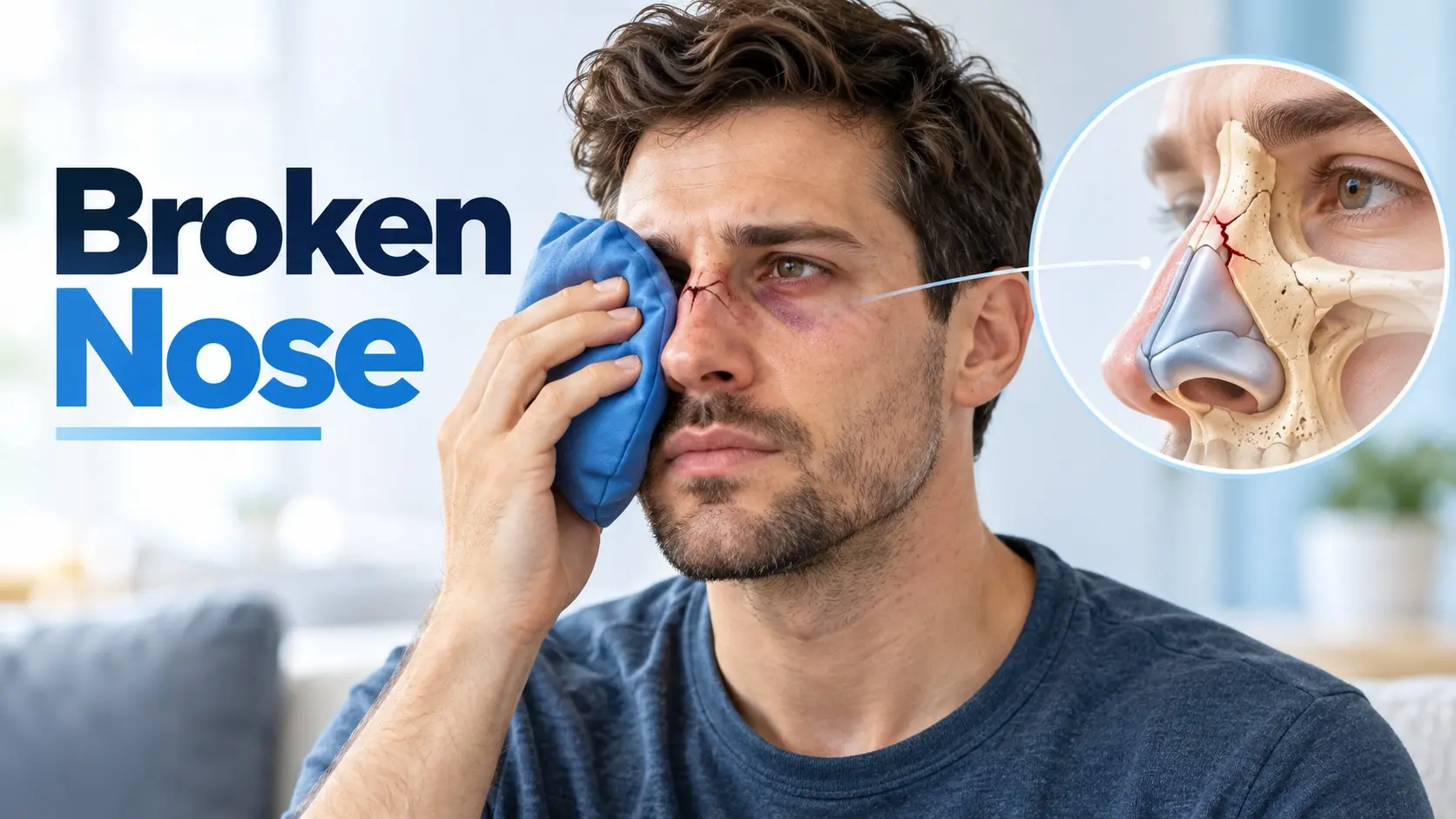
A broken nose can look obvious, but not every fracture makes the nose crooked. Pain, swelling, bleeding, bruising, blocked breathing, or a strange crunching feeling after a blow can all point to a nasal fracture.
The hidden problem is what matters most.
A blood collection inside the septum can damage nasal cartilage if it is not treated quickly, while clear watery drainage after a major injury can signal a more serious head injury.
Quick answer: A broken nose may cause pain, swelling, bruising, a nosebleed, a crooked shape, blocked breathing, crackling, or unusual movement after facial trauma. Do not try to straighten the nose yourself. Use gentle cold compresses, control bleeding, keep your head raised, and get medical care if the nose looks deformed, breathing stays blocked, or you see swelling inside the septum.
For more breathing and nasal health topics, visit the NextFitLife Lung and Respiratory Health Hub. If the injury also involved the ear or head, see our Ear Bleeding and Head Injury Safety Guide.
Medical note: This content is for general educational purposes and does not replace professional medical advice, diagnosis, or treatment. Consult an appropriately qualified healthcare professional for personal medical concerns. This article explains published guidance and does not provide a personal clinical assessment. Always consult qualified medical professionals for diagnosis and treatment of any health condition.
Facial trauma can involve the nose, eyes, jaw, neck, skull, or brain. Seek emergency care for severe headache, vomiting, loss of consciousness, clear watery fluid from the nose, severe vision changes, uncontrolled bleeding, neck symptoms, or trouble breathing.
Table of Contents
- What a broken nose means
- 9 signs of a broken nose
- Pain and tenderness
- Swelling
- Bruising
- Nosebleed
- Changed shape
- Breathing trouble
- Blocked feeling
- Crackling or unusual movement
- Nasal discharge
- Broken nose versus bruised nose
- Septal hematoma warning
- Emergency red flags
- First aid in the first 48 hours
- How doctors diagnose a nasal fracture
- Why an X ray may not be needed
- Treatment and nasal reduction
- When surgery may be needed
- Recovery and sleep
- Exercise and return to sport
- Broken nose in children
- Possible complications
- Prevention
- References and Sources
- Related NextFitLife guides
- About the author
- Frequently asked questions
What Is a Broken Nose?
A broken nose, also called a nasal fracture, is a crack or break in the nasal bones or damage to the cartilage that helps form the nose.
The bridge is exposed and has little protection, so a direct blow can injure it easily.
Common causes include:
- Falls
- Contact sports
- Ball sports
- Fights or assaults
- Car crashes
- Motorcycle crashes
- Bicycle falls
- Electric scooter injuries
- Workplace accidents
- Other direct blows to the face
The nose can also be injured along with the eyes, cheekbones, jaw, teeth, neck, or skull.
That is why the story of how the injury happened matters just as much as how the nose looks.
9 Signs That May Mean Your Nose Is Broken
Swelling can make a simple bruise look dramatic, while a real fracture can sometimes look surprisingly normal.
Look at the whole pattern.
1. Pain and Tenderness
Pain after a blow to the nose is common with both bruises and fractures.
A fracture becomes more likely when the bridge is very tender, especially if the pain sits exactly over the nasal bones.
Do not keep pressing or testing the nose.
Repeated pressure adds pain and can disturb injured tissue.
2. Swelling Around the Nose
Nasal swelling can appear quickly after an injury.
The bridge, tip, and tissue around the nose may become puffy.
Swelling can hide the true shape of the nose for several days.
This is why an early photo does not always tell you whether the bones have moved.
3. Bruising Around the Nose or Eyes
Nasal bruising may stay close to the nose or spread under the eyes.
Dark bruising after facial trauma is common, but severe bruising around both eyes after a strong impact can also occur with other facial or skull injuries.
Look for other warning symptoms rather than judging the injury from color alone.
4. A Nosebleed
A nosebleed is common because the lining inside the nose contains many small blood vessels.
Sit or stand upright and lean forward.
Do not lean the head backward, because blood can run into the throat.
If bleeding will not stop, get urgent medical care.
5. The Nose Looks Crooked or Different
A new bend, twist, dent, flattening, or sideways shift after trauma can suggest displaced bone or cartilage.
Compare your appearance with an older photo if you are unsure.
Swelling can make the nose look uneven at first, so shape is often easier to judge after some swelling settles.
Do not try to push a crooked nose straight yourself.
6. Trouble Breathing Through the Nose
Difficulty breathing through the nose can come from swelling, blood clots, a shifted septum, or a fracture that has narrowed the nasal airway.
Some blockage is common during the first few days.
Persistent blockage after swelling starts to settle needs assessment.
7. One or Both Nostrils Feel Blocked
A blocked feeling is not always just swelling.
Blood inside the nose, a displaced septum, or a septal hematoma can block airflow.
A nose that looks straight can still have a serious septal injury inside.
This is why breathing problems after nasal trauma should not be judged from appearance alone.
8. Crackling, Crunching, Clicking, or Unusual Movement
A broken nasal bone can produce a crackling or crunching sensation called crepitus.
The nose may also feel unstable or move in an unusual way.
Do not keep checking for the sensation.
A clinician can examine the nose more safely.
9. Nasal Discharge After the Injury
Mucus and a small amount of bloody discharge can occur after trauma.
Clear watery fluid is different.
If clear fluid repeatedly drips from the nose after a significant head or facial injury, especially with a severe headache or other neurological symptoms, seek emergency medical care.
Rarely, clear drainage after serious trauma can represent cerebrospinal fluid leaking from around the brain.
Broken Nose or Just a Bruised Nose?
You cannot always tell at home.
| Clue | Bruised Nose | Broken Nose |
|---|---|---|
| Pain | Common | Common |
| Swelling | Common | Common |
| Bruising | Common | Common |
| Changed shape | Less likely once swelling settles | More concerning for displacement |
| Blocked breathing | May happen from swelling | May persist because of septal or structural injury |
| Crepitus or unusual movement | Less typical | Supports fracture suspicion |
You do not need to prove the fracture yourself.
A healthcare professional can examine alignment, tenderness, movement, airflow, and the inside of the nose.
The Hidden Emergency: Septal Hematoma
This is the complication I would not bury at the bottom of the page.
The nasal septum is the wall that separates your nostrils.
After trauma, blood can collect beneath the tissue covering its cartilage. This is called a septal hematoma.
It may look like a soft, purple, red, or swollen bulge inside the nose.
Symptoms can include:
- Blocked breathing through one or both nostrils
- Increasing pressure
- Pain
- Swelling inside the septum
- A blocked nose even when the outside still looks straight
A septal hematoma needs urgent treatment.
The trapped blood can cut off the cartilage's blood supply. Without treatment, cartilage can die and the bridge may later collapse into a saddle shaped deformity.
Infection is another risk.
Urgent warning: After a nose injury, seek urgent medical care if both nostrils feel increasingly blocked, you see swelling on the septum, or nasal pain and blockage are getting worse.
When Is a Broken Nose an Emergency?
A simple nasal fracture is painful, but it is not always an emergency.
Other symptoms can change that.
Seek emergency care now for:
- Bleeding that will not stop
- Severe trouble breathing
- Clear watery fluid draining from the nose after major trauma
- Loss of consciousness
- Repeated vomiting
- Severe or worsening headache
- Blurred or double vision
- Eye pain with vision change
- New confusion
- Trouble speaking
- Seizure
- Severe neck pain
- Numbness or tingling in the arms
- A large open wound
- Glass or another object stuck in the wound
- Major facial deformity after severe trauma
A blow strong enough to break the nose can also injure the skull, eyes, jaw, cheekbones, or neck.
Do not focus only on the nose when the whole injury was severe.
What Should You Do Right After a Nose Injury?
Your goal is to control bleeding, limit swelling, protect the nose, and watch for warning signs.
1. Sit Upright and Lean Forward
If your nose is bleeding, sit or stand upright.
Lean forward so blood does not run down the throat.
Breathe through your mouth.
2. Control the Nosebleed
Use steady pressure as advised for a normal nosebleed.
Do not keep releasing pressure every few seconds to check.
Get urgent help if bleeding remains heavy or will not stop.
3. Use a Cold Compress
Wrap ice or a cold pack in a thin cloth.
Place it gently over the nose and nearby swollen areas.
Mayo Clinic advises using cold for about 10 to 15 minutes at a time during the first 24 to 48 hours.
Do not press hard on the nose.
Direct pressure over displaced bones can hurt and may worsen discomfort.
4. Keep Your Head Raised
Keep the head above the heart when resting.
Use extra pillows when sleeping if this is comfortable and safe for you.
This can help reduce swelling and throbbing.
5. Use Pain Medicine Safely
Simple over the counter pain relief can help many uncomplicated fractures.
Which medicine is best depends on your health, allergies, kidney or stomach problems, blood thinner use, pregnancy, and other medicines.
Ask a pharmacist or healthcare professional if you are unsure.
6. Do Not Blow or Pick Your Nose
Blowing can restart bleeding and put pressure through injured tissue.
NHS guidance advises avoiding nose blowing while the injury heals.
7. Do Not Try to Straighten It
This is one of the most important rules.
Do not push a crooked nose back into place at home.
You cannot see the septum, cartilage, or other facial injuries underneath.
Reduction is a medical procedure.
A Simple First 48 Hour Plan
| Time | What to Do | What to Watch |
|---|---|---|
| First hour | Sit upright, lean forward if bleeding, apply gentle cold | Heavy bleeding, fainting, breathing trouble, severe head symptoms |
| First day | Protect the nose, use cold compresses, rest with head raised | Septal swelling, growing blockage, severe pain |
| 24 to 48 hours | Continue gentle care and avoid further impact | Worsening swelling, fever, repeated bleeding |
| After swelling begins to settle | Look at alignment and nasal breathing | Crooked shape or persistent obstruction |
How Do Doctors Diagnose a Broken Nose?
Diagnosis is usually clinical.
A healthcare professional will ask how the nose injury happened and may examine:
- The shape of the nose
- Swelling and bruising
- Tender areas
- Movement of the nasal bones
- Airflow through each nostril
- The nasal septum
- Bleeding or blood clots
- The eyes
- The jaw and teeth
- Other facial injuries
They may use a light to look inside the nose for a septal hematoma or obstruction.
If possible, take an older photo that clearly shows how your nose looked before the injury.
Do You Need an X Ray for a Broken Nose?
Usually, no.
This surprises many people.
Mayo Clinic and Merck Manual both explain that uncomplicated nasal fractures are usually diagnosed from the history and physical examination.
Plain nasal X rays often do not change treatment and may not show the injury clearly enough to be useful.
A CT scan may be used when the injury is severe or a clinician suspects fractures involving other parts of the face or skull.
So not receiving an X ray does not mean your injury was ignored.
Does Every Broken Nose Need to Be Straightened?
No.
If the fracture is small, the nose remains in its normal position, and breathing is good, treatment may only involve symptom care and protection while it heals.
Realignment is more likely when:
- The nose is clearly crooked
- Bone or cartilage has moved
- The airway is blocked
- The septum has been displaced
- The appearance changed significantly
What Is Nasal Reduction?
Nasal reduction is a procedure that moves displaced nasal bones or cartilage back toward their normal position.
A healthcare professional first numbs the area or uses another form of anesthesia.
The bones and cartilage are then carefully repositioned.
A splint, dressing, or packing may be used afterward.
This is not something to attempt at home.
Timing Matters if the Nose Has Moved
A displaced fracture has a limited window for easier realignment before the bones begin to set.
Mayo Clinic states that reduction should be performed within about 14 days and preferably sooner.
Merck Manual notes that clinicians often wait about 3 to 5 days for swelling to fall before reduction, but aim to complete it within about 2 weeks.
ENT Health likewise advises prompt specialist review.
This creates a useful balance.
You do not need to judge the final shape while the nose is massively swollen, but you also should not wait several weeks if it remains clearly crooked or blocked.
When Might Surgery Be Needed?
Some injuries are too complex for simple manual realignment.
Surgery may be considered when:
- The fracture is severe
- Several areas are broken
- The septum is badly damaged
- Breathing remains blocked
- The injury was not treated during the early reduction window
- There is lasting deformity
A septoplasty may be used to repair a damaged or displaced septum.
Reconstructive nasal surgery may be needed when both breathing and appearance are affected.
What Is a Deviated Septum After a Nose Injury?
The septum divides the two nasal passages.
A strong impact can shift it to one side.
A traumatic deviated septum can cause:
- One sided blockage
- Reduced airflow
- Persistent stuffiness
- Breathing problems during sleep or exercise
Swelling can cause temporary blockage too.
The distinction becomes clearer after the early swelling falls.
If your nose stays blocked after the injury has settled, ask for an ENT assessment.
How Long Does a Broken Nose Take to Heal?
The answer depends on what we mean by heal.
NHS guidance says many simple broken noses are largely healed within about three weeks.
Cleveland Clinic notes that overall fracture healing can take about six to eight weeks.
These statements are not really contradictory.
Pain, swelling, and daily function may improve earlier, while bone healing and safe return to impact take longer.
Your own recovery depends on the fracture, treatment, age, health, and whether there were other facial injuries.
How Should You Sleep With a Broken Nose?
Sleep with your head and shoulders raised if comfortable.
This may help with swelling and throbbing.
Try to sleep on your back rather than pressing the injured side of your face into the pillow.
Keep objects away from your face if you tend to move a lot during sleep.
Can You Exercise With a Broken Nose?
Do not rush back to activity where another hit could move the healing bones.
Mayo Clinic advises avoiding sports during the first two weeks and avoiding contact sports for at least six weeks after the injury.
NHS guidance also advises avoiding strenuous exercise for the first two weeks and sports where the face may be hit for at least six weeks.
Your clinician may give different advice based on your fracture and sport.
Walking may be fine sooner for many people if they otherwise feel well and have no head injury, but avoid anything that raises the chance of falling or being hit.
When Can You Wear Glasses?
Glasses can press directly on the nasal bridge.
NHS guidance advises avoiding them while significant swelling remains unless you need them.
If you depend on glasses, ask your clinician how to reduce pressure on the healing bridge.
Broken Nose in Children
Children need extra care because facial structures are still developing.
A child with a suspected nasal fracture should be assessed, especially if the nose looks crooked, breathing is blocked, or there is swelling inside the septum.
A septal hematoma is urgent in children too.
Do not try to straighten a child's nose at home.
Seek emergency care after significant facial trauma if the child has repeated vomiting, severe headache, unusual sleepiness, confusion, vision problems, loss of consciousness, neck pain, or clear fluid drainage.
Possible Complications of a Broken Nose
Septal Hematoma
Blood collects around the septal cartilage and can cut off its blood supply.
This requires urgent drainage.
Persistent Nasal Obstruction
Bone, cartilage, or a displaced septum can narrow the airway.
Septal Perforation
Damage to septal tissue can rarely lead to a hole in the septum.
Saddle Nose Deformity
If septal cartilage loses its blood supply and dies, the bridge can collapse.
Permanent Shape Change
A displaced fracture can heal in a new position when not corrected during the appropriate time window.
Ongoing Nosebleeds
Repeated bleeding after the initial injury deserves reassessment.
Associated Facial Injury
The same impact can injure the eyes, jaw, cheekbones, teeth, neck, or skull.
What Not to Do With a Suspected Broken Nose
A few simple mistakes can make recovery harder.
- Do not straighten the nose yourself.
- Do not press hard to test whether the bones move.
- Do not blow your nose while it is healing.
- Do not pick inside the nose.
- Do not return to contact sport too early.
- Do not ignore blocked breathing after swelling settles.
- Do not ignore swelling inside the septum.
- Do not dismiss clear watery drainage after serious head trauma.
- Do not assume every severe facial injury is only a nose problem.
What Should You Tell the ENT Specialist?
Bring useful details rather than trying to remember everything during the visit.
- When the injury happened
- How it happened
- Whether you lost consciousness
- Whether the nose bled
- Whether breathing changed
- Whether the nose looked crooked immediately
- Whether swelling is improving
- Whether you have double vision or eye pain
- Whether clear fluid has leaked from the nose
- Whether you take blood thinners
- Any previous nasal surgery or fracture
Bring a clear photo of your face from before the accident if you have one.
It can help show whether the shape has changed.
How Can You Lower the Risk of Breaking Your Nose?
You cannot prevent every accident.
You can lower risk.
- Wear the right helmet for cycling and motor sports.
- Use face protection for sports where it is recommended.
- Wear your seat belt in a vehicle.
- Use safe technique and a spotter when needed during lifting.
- Reduce fall hazards at home.
- Follow return to play rules after facial injury.
- Do not return to contact sport before the nose is ready for impact.
Conclusion
A broken nose is not just a cosmetic injury. Pain, swelling, bruising, bleeding, blocked breathing, crackling, or a changed shape can point to a fracture, while a septal hematoma can threaten the nasal cartilage even if the outside still looks straight.
Your next step is simple: protect the nose, use gentle cold compresses, do not straighten it yourself, and check both breathing and shape as swelling begins to settle.
If you see septal swelling, cannot breathe well, have uncontrolled bleeding, clear watery drainage, severe head symptoms, or a nose that remains crooked, get medical care promptly.
References and Sources
- Mayo Clinic. Broken Nose: Diagnosis and Treatment.
Updated June 6, 2025.
https://www.mayoclinic.org/diseases-conditions/broken-nose/diagnosis-treatment/drc-20370444 - NHS. Broken Nose.
Guidance on symptoms, self care, urgent signs, treatment timing, exercise, and emergency symptoms.
https://www.nhs.uk/conditions/broken-nose/ - Cleveland Clinic. Broken Nose, Nasal Fracture.
Medically reviewed and updated August 18, 2026.
https://my.clevelandclinic.org/health/diseases/17772-broken-nose - Merck Manual. Broken Nose.
Full review April 2026.
https://www.merckmanuals.com/home/injuries-and-poisoning/facial-injuries/broken-nose - ENT Health, American Academy of Otolaryngology Head and Neck Surgery Foundation. Nasal Fractures.
https://www.enthealth.org/conditions/nasal-fractures/
Continue Reading on NextFitLife
Use these related guides for nasal symptoms, trauma, bleeding, and broader health information:
- Lung and Respiratory Health Hub
- Ear Bleeding: Causes, First Aid and When to Worry
- Cold Sores in Nose: Causes and Relief
- General Wellness and Lifestyle Hub
About the Author
Adel Galal is the founder and lead writer of NextFitLife. He researches consumer health, fitness, nutrition, beauty, and healthy aging topics using recognized medical, public health, and scientific sources.
His goal is to explain complicated health information in plain language, show where uncertainty remains, and make safety warnings easy to find instead of hiding them at the bottom of an article.
This content is for general educational purposes and does not replace professional medical advice, diagnosis, or treatment. Consult an appropriately qualified healthcare professional for personal medical concerns. This article explains published guidance and does not provide a personal clinical assessment. Always consult qualified medical professionals for diagnosis and treatment of any health condition.
Learn more about Adel Galal, NextFitLife, and the site's editorial standards on the About Us page.
Frequently Asked Questions
How can I tell if my nose is broken?
A broken nose may cause pain, swelling, bruising, bleeding, a crooked appearance, blocked breathing, tenderness, or a crunching feeling after an injury. A healthcare professional can examine the nose and septum to confirm the likely diagnosis.
Can my nose be broken if it still looks straight?
Yes. Some fractures do not cause obvious displacement. A straight looking nose can also have swelling, cartilage injury, septal damage, or a septal hematoma inside.
Do I need an X ray for a broken nose?
Usually not for an uncomplicated nasal fracture. Diagnosis is often based on the history and physical examination. CT may be used when another facial or skull injury is suspected.
Should I try to straighten a broken nose myself?
No. Do not push or pull a crooked nose into place yourself. A clinician needs to check the septum and other facial structures before deciding whether reduction is needed.
What is a septal hematoma?
A septal hematoma is blood trapped around the cartilage in the wall between the nostrils. It can block breathing and damage the cartilage if it is not drained quickly.
What does a septal hematoma look like?
It may appear as a soft purple, red, or swollen bulge inside the nose. Symptoms can include increasing blockage, pressure, pain, or trouble breathing through one or both nostrils.
How long does a broken nose take to heal?
Many simple fractures improve greatly within about three weeks, while bone healing can continue for around six to eight weeks. The exact recovery time depends on the injury and treatment.
How soon should a crooked broken nose be fixed?
Timing matters. Clinicians may wait several days for swelling to fall, but displaced nasal fractures are usually reduced within about two weeks before the bones become harder to move.
Can I sleep on my side with a broken nose?
Sleeping on your back with the head raised is usually safer early in recovery because it avoids direct pressure on the injured nose and may reduce swelling.
Can I blow my nose after breaking it?
Avoid blowing or picking your nose while it heals unless your healthcare professional tells you otherwise. Pressure can restart bleeding and irritate injured tissue.
Can I exercise with a broken nose?
Light activity may return sooner in selected people, but strenuous exercise is commonly avoided during the first two weeks. Contact sports and activities where the face may be hit are usually avoided for at least six weeks.
When is a broken nose an emergency?
Seek emergency care for uncontrolled bleeding, severe breathing trouble, clear watery drainage after major trauma, loss of consciousness, repeated vomiting, severe headache, vision changes, major facial injury, severe neck symptoms, or signs of serious head injury.
Can a broken nose cause permanent breathing problems?
Yes. A displaced septum, untreated septal hematoma, scar tissue, or a fracture that heals out of position can cause lasting nasal obstruction.
Can a broken nose heal without surgery?
Yes. Many nasal fractures heal without surgery when the nose remains aligned and breathing is not blocked. Displaced or more complex injuries may need reduction or surgery.

Health & wellness writer with 30+ years of experience in nutrition, fitness, and healthy aging. Founder of NextFitLife.com — evidence-based health guidance.