
Published: Jul 6, 2023
Last updated: October 4, 2026
Written by: Adel Galal, Founder and Lead Writer at NextFitLife
Medical review status: This article has not been medically reviewed by a doctor, dermatologist, infectious disease specialist, ophthalmologist, pharmacist, or other licensed healthcare professional.
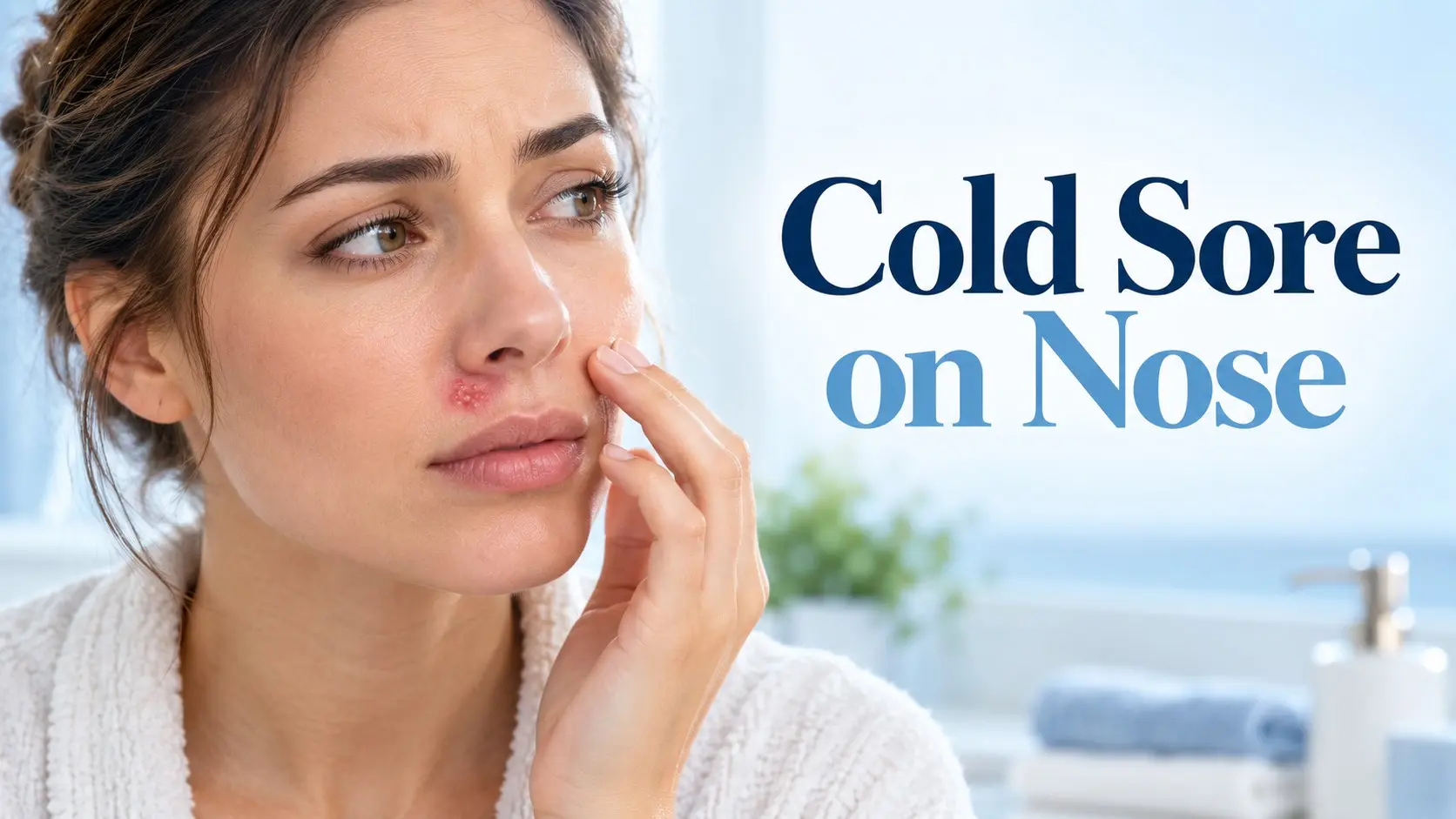
A cold sore on nose is usually caused by herpes simplex virus. It may start with tingling, burning, itching, or tenderness before small painful blisters appear around the nostril, under the nose, or on nearby facial skin.
The location matters.
A cold sore on the outer skin of the nose can often be managed like other facial cold sores. A sore deep inside the nostril needs more caution because common cold sore creams are made for external skin and should not automatically be placed inside the nose.
Quick answer: A cold sore on nose usually begins with tingling, burning, or itching, followed by grouped fluid filled blisters that open, crust, and heal. Most are caused by HSV 1. Start appropriate antiviral treatment early when advised, avoid picking or squeezing, wash your hands after touching the area, and seek prompt care for eye pain, eye redness, light sensitivity, blurred vision, severe symptoms, or a weakened immune system.
For a wider guide to HSV symptoms and treatment, read the NextFitLife Herpes Skin Rash Guide. You can also visit the Skin Health Hub for evidence based skin care and infection guidance.
Medical note: This content is for general educational purposes and does not replace professional medical advice, diagnosis, or treatment. Consult an appropriately qualified healthcare professional for personal medical concerns. This article explains published guidance and does not provide a personal clinical assessment. Always consult qualified medical professionals for diagnosis and treatment of any health condition.
Get prompt medical care if a sore near the nose is spreading toward an eye or you develop eye pain, redness, watering, light sensitivity, or blurred vision. Herpes simplex can infect the cornea and threaten vision if it is not treated.
Table of Contents
- What a cold sore on the nose is
- What it looks and feels like
- The usual stages
- Why cold sores come back
- Common triggers
- Cold sore versus other nose sores
- 9 safer care tips
- Medicine for nasal cold sores
- What not to put inside your nose
- How contagious cold sores are
- How to prevent spreading HSV
- Eye herpes warning signs
- Newborn and eczema safety
- When to see a doctor
- References and Sources
- Related NextFitLife guides
- About the author
- Frequently asked questions
What Is a Cold Sore on the Nose?
A cold sore is a small blister or group of blisters caused by herpes simplex virus.
Most oral and facial cold sores are caused by HSV 1. HSV 2 can also infect the mouth or face, but it is a less common cause of oral herpes.
Cold sores are also called fever blisters.
They most often appear on or around the lips, but they can also develop on the cheeks, around the nostrils, under the nose, or elsewhere on the face.
Once HSV enters the body, it stays in nerve cells.
The virus can become quiet for months or years, then reactivate and cause another outbreak.
This is why a person can suddenly develop a nasal cold sore even if the original HSV infection happened long ago.
What Does a Cold Sore on the Nose Look Like?
The classic pattern is more useful than one photo.
A cold sore often begins before you can see much.
You may notice:
- Tingling
- Burning
- Itching
- Stinging
- Throbbing
- Tenderness
Small fluid filled blisters then appear, often grouped together.
The blisters can break open and release clear fluid. A shallow sore forms, then dries and develops a light crust.
Healthy skin usually grows underneath as the outbreak clears.
A cold sore is more likely when several small painful blisters form together after a familiar tingling or burning feeling.
What Are the Stages of a Nasal Cold Sore?
| Stage | What You May Notice | What Matters |
|---|---|---|
| Early warning | Tingling, burning, itching, or pain | Antiviral treatment works best when started early |
| Blister | Small grouped fluid filled bumps | Avoid touching and squeezing |
| Open sore | Blisters break and may ooze | HSV spreads easily from active sores |
| Crusting | The sore begins to dry | Do not pick the crust |
| Healing | Crust falls away and new skin appears | Continue good hand hygiene |
The timing is not identical for everyone.
The American Academy of Dermatology says many healthy people clear a cold sore within about 5 to 15 days. Mayo Clinic notes that full healing can sometimes take 2 to 3 weeks.
That difference is normal because first outbreaks, repeat outbreaks, health status, and treatment timing vary.
Why Do Cold Sores Keep Coming Back?
Antiviral medicine can control an outbreak, but it does not remove HSV from the body.
After the first infection, the virus remains inactive in nerve tissue.
Later, it can reactivate.
A recurrence does not mean you caught HSV again.
It means the virus already in your body became active.
What Can Trigger a Cold Sore on the Nose?
Not every outbreak has an obvious trigger.
When triggers do occur, they differ from person to person.
Illness and Fever
Cold sores are sometimes called fever blisters because infections and fever can trigger HSV reactivation in some people.
Emotional or Physical Stress
Some people notice outbreaks during stressful periods.
That does not mean stress is the cause of HSV. It is a possible trigger in someone who already carries the virus.
Sun Exposure
Bright sunlight can trigger repeat outbreaks in some people.
Protecting exposed facial skin from excessive sun may help if sunlight is one of your known triggers.
Dry or Damaged Skin
Cracks, rubbing, and other skin damage around the nose can act as a trigger for some people.
Repeated nose blowing during a cold may also irritate the area.
Cold or Hot Weather
Extreme weather can dry and irritate facial skin.
Some people notice more outbreaks during these periods.
Lack of Sleep
Poor sleep is another reported trigger for some people with recurrent cold sores.
Hormonal Changes
Some people notice outbreaks around menstruation or other periods of hormonal change.
Is a Cold Sore on the Nose the Same as a Pimple?
No, although they can look similar at first.
| Feature | Cold Sore | Pimple |
|---|---|---|
| Early feeling | Tingling, burning, itching, or pain may come first | Often tender as the bump forms |
| Appearance | Often several small grouped blisters | Often one blocked pore or inflamed bump |
| Fluid | Clear blister fluid | May contain white or yellow material |
| Pattern | Can recur in the same area | Depends on blocked pores and follicles |
| Cause | Herpes simplex virus | Blocked and inflamed hair follicle |
A picture cannot always separate them.
If this is your first unexplained blistering eruption, a healthcare professional can examine it and, when needed, swab a fresh lesion for HSV testing.
What Else Can Look Like a Cold Sore Near the Nose?
Nasal Vestibulitis
Nasal vestibulitis is a bacterial infection near the opening of a nostril.
It can cause a painful pimple or sore, swelling, bleeding, and yellow crusting.
It is often linked with nose picking, repeated blowing, plucking nasal hairs, or other local irritation.
Treatment can require an antibiotic rather than antiviral medicine.
Impetigo
Impetigo is a contagious bacterial skin infection.
It commonly affects skin around the nose and mouth and often leaves golden brown or honey colored crusts after the sores break.
It can spread across nearby skin.
Irritation or Cracked Skin
Frequent wiping, allergies, dry air, strong skin products, and a runny nose can cause painful cracks.
Cracked skin does not usually produce the classic group of small HSV blisters.
Ingrown Hair or Folliculitis
A sore around a nasal hair follicle may form a single tender bump.
Do not squeeze bumps inside the nose.
Serious bacterial infections around the nostril need proper treatment.
9 Safer Care Tips for a Cold Sore on Nose
1. Act at the First Tingling or Burning
If you already know you get recurrent cold sores, the early warning stage is the best time to start the treatment your clinician or product label recommends.
Antiviral treatment works best when started early.
2. Ask Whether an Antiviral Is Right for You
Antiviral medicines used for facial cold sores include acyclovir, valacyclovir, famciclovir, and penciclovir.
Some products go on the skin, while others are tablets.
Prescription oral antiviral medicine may be considered for a severe first outbreak, large or painful outbreaks, frequent recurrences, or people at greater risk of complications.
The medicine and schedule depend on your age, health, pregnancy status, kidney function, medicines, and the location of the sore.
3. Do Not Put External Acyclovir Cream Inside Your Nostril
This is a major correction to older nasal cold sore advice.
Standard acyclovir cold sore cream is intended for the external skin of the lips and face.
Its prescribing information states that it should not be used inside the nose, inside the mouth, or in the eye.
If the sore is inside your nostril, ask a doctor or pharmacist which treatment is suitable for that location.
Do not assume a cream that is safe beside the nostril is also safe deep inside it.
For sores that are mainly inside the nasal opening, see the NextFitLife Cold Sores in Nose Guide.
4. Use a Cool Compress for Comfort
A clean cool damp cloth placed gently over the outside of the nose can ease soreness.
Do not press hard.
Use a clean cloth each time and wash your hands afterward.
5. Keep the Area Clean and Stop Picking
Wash your hands before and after touching the area.
Clean surrounding skin gently.
Do not scrub the blister, peel the crust, or squeeze the sore.
Picking delays healing and can spread HSV to your fingers or other skin.
It can also create a second bacterial infection.
6. Use Pain Relief Safely if Needed
Cold sores can sting or throb.
Simple over the counter pain medicine can help some people.
The right choice depends on your age, allergies, pregnancy status, kidney or liver disease, stomach problems, blood thinner use, and other medicines.
Ask a pharmacist or clinician if you are unsure.
7. Protect Other People and Other Parts of Your Body
HSV spreads through direct contact.
During an active outbreak:
- Do not kiss other people.
- Do not perform oral sex.
- Do not share towels.
- Do not share razors.
- Do not share lip balm or cosmetics.
- Do not touch the sore and then touch your eye.
- Wash your hands after applying treatment.
Using a clean cotton tipped applicator for medicine can reduce direct finger contact.
8. Track Your Personal Triggers
If cold sores recur, note what happened in the days before each outbreak.
Look for repeat patterns such as:
- Strong sun exposure
- Illness or fever
- Very dry skin
- Cold weather
- Major stress
- Poor sleep
- Skin irritation
- Hormonal changes
You may not find one trigger.
That is normal.
HSV can reactivate without an obvious reason.
9. Know When Home Care Is No Longer Enough
Get medical advice if:
- This is your first significant outbreak and you are unsure what it is.
- The sore is very large or painful.
- It has not started healing after about 10 days.
- It lasts longer than about two weeks.
- You get repeated outbreaks.
- You have eczema.
- You have a weakened immune system.
- You are taking medicine that suppresses immunity.
- The sore looks infected with bacteria.
- The eruption is close to the eye.
Frequent outbreaks can sometimes be managed with prescription suppressive antiviral therapy.
Can You Use Cold Sore Cream on the Outside of the Nose?
Some topical antiviral products are intended for external facial cold sores.
Read the exact product instructions.
A cream that is approved for external facial skin may be suitable for a cold sore beside or under the nostril.
That does not mean it should be pushed into the nasal cavity.
Product labeling for acyclovir cream specifically says not to use it inside the nose.
If you are unsure whether the sore sits on external skin or nasal lining, ask a pharmacist.
Are Oral Antiviral Tablets Better Than Creams?
They can be.
Mayo Clinic notes that oral antiviral tablets are generally more effective than topical creams for cold sores.
A doctor may consider oral treatment when the outbreak is severe, painful, frequent, widespread, or occurring in someone at increased risk.
Starting treatment early usually gives the best result.
Do not use someone else's antiviral prescription.
What Home Remedies Should You Avoid?
The old version of this article recommended several remedies with weak or mixed evidence.
I would keep the routine simpler.
Do not put these directly on a nasal cold sore:
- Undiluted tea tree oil
- Lemon juice
- Apple cider vinegar
- Toothpaste
- Rubbing alcohol
- Hydrogen peroxide
- Strong essential oils
- Harsh exfoliating acids
Open blistered skin is easy to irritate.
A burning product is not proof that HSV is being killed.
Does Lysine Prevent Cold Sores?
Lysine supplements are commonly promoted for cold sores.
The evidence is mixed, and they are not a cure for HSV.
Do not replace proven antiviral treatment with lysine when medical treatment is needed.
If you want to take a supplement, check for medicine interactions and health conditions first.
Can Honey, Aloe, or Lemon Balm Cure a Nasal Cold Sore?
No home product removes HSV from the body.
Some alternative products have been studied for symptom relief, but evidence is inconsistent and formulations differ.
Products can also irritate sensitive skin around the nostril.
If a simple soothing product makes the skin sting, burn, swell, or blister more, stop using it.
How Contagious Is a Cold Sore on the Nose?
Cold sores are contagious.
HSV spreads through direct skin and mucosal contact.
Transmission risk is high when blisters and open sores are present, but HSV can sometimes spread when the skin looks normal too.
This is called asymptomatic viral shedding.
So visible healing lowers risk but does not mean HSV has disappeared from the body.
Can You Spread a Nose Cold Sore to Your Eye?
Yes.
This is one reason hand washing matters.
HSV can infect the cornea, the clear front surface of the eye. This is called HSV keratitis or eye herpes.
Warning signs include:
- Eye pain
- A red eye
- Watery eye
- Blurred vision
- Light sensitivity
- A gritty feeling
- Swollen eyelid
Eye warning: If you have a cold sore around the nose or face and develop eye pain, redness, sensitivity to light, watering, or vision changes, contact an eye care professional promptly. HSV keratitis can scar the cornea and threaten sight.
Do not put ordinary cold sore cream or steroid eye drops into an eye.
Eye herpes needs specialist treatment.
Why Are Newborn Babies a Special Concern?
HSV can be much more serious in a newborn than in a healthy adult.
If you have an active cold sore:
- Do not kiss a newborn.
- Wash your hands before touching the baby.
- Keep the active sore away from the baby's skin.
- Do not share items that touched the sore.
If you believe a newborn has been exposed to an active herpes sore, contact the baby's healthcare professional promptly.
Why Does Eczema Change the Risk?
HSV can spread widely across damaged skin in someone with eczema.
This complication is called eczema herpeticum.
It can become serious and needs urgent medical care.
If someone with eczema develops a sudden painful blistering rash, many similar sores, fever, or feels unwell after contact with a person who has a cold sore, get medical help promptly.
What Does a Secondary Bacterial Infection Look Like?
A cold sore is viral.
Antibiotics do not treat HSV itself.
But broken skin can sometimes become infected by bacteria.
Watch for:
- Rapidly increasing redness or darker skin change
- Growing warmth
- Increasing swelling
- Thick pus
- Bad smell
- Worsening pain
- Fever
A bacterial infection needs a different treatment plan.
If the problem is mainly a painful crusted sore inside the nostril rather than grouped herpes blisters, nasal vestibulitis should also be considered.
How Can You Reduce Future Cold Sore Outbreaks?
Protect Your Face From Strong Sun
If sunlight is one of your triggers, use appropriate facial sun protection and seek shade during intense sun exposure.
Protect Dry Skin
Be gentle with irritated skin around the nose during colds and allergy seasons.
Avoid harsh rubbing with tissues.
Prioritize Sleep
Poor sleep can be a trigger for some people.
A regular sleep routine supports general health even if it does not stop every outbreak.
Manage Stress in a Realistic Way
Exercise, breathing exercises, time outdoors, relaxation, and adequate recovery can help manage stress.
They do not cure HSV.
Talk to a Doctor About Frequent Outbreaks
If outbreaks are frequent or very disruptive, ask whether preventive antiviral medicine is appropriate.
The American Academy of Dermatology notes that daily antiviral medicine may be considered for people who have frequent cold sores.
How Is a Cold Sore on the Nose Diagnosed?
A clinician can often recognize a typical cold sore from its appearance and history.
Testing can help when the diagnosis is unclear.
A fresh blister or sore may be swabbed to look for HSV.
Testing becomes more useful when:
- It is your first unusual outbreak.
- The sore does not look typical.
- It keeps coming back in an unusual location.
- The diagnosis will change treatment.
- You have reduced immune function.
When Should You See a Doctor?
Arrange medical care if:
- The diagnosis is unclear.
- The cold sore is very painful.
- There are many sores.
- The outbreak is unusually large.
- It has not started healing after about 10 days.
- It lasts longer than two weeks.
- You get frequent outbreaks.
- You have eczema.
- You have a weakened immune system.
- You take immune suppressing medicine.
- You develop signs of bacterial infection.
- The sores are deep inside the nostril and difficult to treat safely.
When Does a Cold Sore Need Urgent Care?
Get prompt or urgent medical care for:
- Eye pain
- A red painful eye
- Light sensitivity
- Blurred or changed vision
- Significant swelling around the eye
- Rapidly spreading facial redness or swelling
- Severe widespread blistering
- High fever with worsening sores
- Confusion or severe neurological symptoms
- A widespread painful eruption in someone with eczema
- HSV symptoms in a newborn
- Severe disease in someone with a weakened immune system
Conclusion
A cold sore on nose is usually a facial herpes simplex outbreak that starts with tingling, burning, or itching and then develops into grouped painful blisters.
Your next step should depend on the location. External facial skin may be suitable for an approved cold sore product, but do not push standard acyclovir cream inside your nostril because it is intended for external skin.
Start appropriate antiviral treatment early, keep your hands away from the sore, protect other people from direct contact, and get prompt medical care if symptoms involve the eye, become severe, spread widely, or do not heal as expected.
References and Sources
- American Academy of Dermatology. Cold Sores: Diagnosis and Treatment.
https://www.aad.org/public/diseases/a-z/cold-sores-treatment - Mayo Clinic. Cold Sore: Symptoms, Causes, Diagnosis and Treatment.
https://www.mayoclinic.org/diseases-conditions/cold-sore/symptoms-causes/syc-20371017 - NHS. Cold Sores.
https://www.nhs.uk/conditions/cold-sores/ - Centers for Disease Control and Prevention. HSV Keratitis.
Updated May 27, 2025.
https://www.cdc.gov/contact-lenses/causes/what-causes-hsv-herpes-simplex-virus-keratitis.html - DailyMed, U.S. National Library of Medicine. Acyclovir Cream Prescribing Information.
Current labeling states that acyclovir cream is for external facial skin and should not be used inside the nose, mouth, or eye.
https://dailymed.nlm.nih.gov/dailymed/drugInfo.cfm?setid=63fadf54-e8a3-4512-8a05-d64b998f5a08
Continue Reading on NextFitLife
Use these related guides for HSV, skin health, and nose care:
- Skin Health Complete Guide
- Herpes Skin Rash: Symptoms, Causes and Treatment
- Cold Sores in Nose: Causes and Relief
- Healthy Skin 101
- Infected Nose Piercing: Signs and Safe Care
- Broken Nose: Signs, First Aid and Recovery
About the Author
Adel Galal is the founder and lead writer of NextFitLife. His personal study and practical interest in health, fitness, nutrition, wellness, skin care, and healthy aging spans more than 30 years.
His work focuses on checking health claims against recognized medical and public health guidance, removing unsafe home remedies, and turning complex information into clear steps readers can use.
This content is for general educational purposes and does not replace professional medical advice, diagnosis, or treatment. Consult an appropriately qualified healthcare professional for personal medical concerns. This article explains published guidance and does not provide a personal clinical assessment. Always consult qualified medical professionals for diagnosis and treatment of any health condition.
Learn more about Adel Galal, NextFitLife, and the site's editorial approach on the About Us page.
Frequently Asked Questions
Can you get a cold sore on your nose?
Yes. Herpes simplex cold sores can appear around the nostrils, under the nose, or elsewhere on facial skin. They may also occur near the opening of a nostril.
What causes a cold sore on nose?
Most facial cold sores are caused by HSV 1. After infection, the virus stays in the body and can reactivate later. Illness, stress, strong sun, skin irritation, weather changes, poor sleep, or hormonal changes can trigger some outbreaks.
What does a cold sore on the nose look like?
It often starts with tingling, burning, itching, or pain. Small grouped fluid filled blisters then form, open, crust, and gradually heal.
How can I tell a cold sore from a pimple?
A cold sore more often starts with tingling or burning and develops several small grouped blisters. A pimple is more often one inflamed pore or hair follicle. A healthcare professional can help when the appearance is unclear.
Can I put acyclovir cream inside my nose?
No. Standard acyclovir cold sore cream is intended for external skin. Current prescribing information states that it should not be used inside the nose, mouth, or eye. Ask a healthcare professional about treatment for a sore inside a nostril.
Can I use cold sore cream under my nose?
Some products are intended for cold sores on external facial skin. Follow the exact product label and keep the medicine out of the nostril unless a healthcare professional tells you otherwise.
How long does a cold sore on the nose last?
Many cold sores clear within about one to two weeks, although full healing can sometimes take two to three weeks. First outbreaks can be more severe than later recurrences.
Is a cold sore on the nose contagious?
Yes. HSV spreads through direct contact. The risk is greatest around active tingling, blistering, and open sores, although the virus can sometimes spread even when no sore is visible.
Should I pop a cold sore on my nose?
No. Squeezing or popping can injure the skin, spread HSV to another body site, and increase the chance of bacterial infection.
Can a cold sore spread from the nose to the eye?
HSV can infect the eye and cornea. Wash your hands after touching a cold sore and avoid touching your eyes. Eye pain, redness, watering, light sensitivity, or blurred vision needs prompt eye care.
Can stress cause a cold sore on the nose?
Stress does not create HSV infection, but it can trigger a recurrent outbreak in some people who already carry the virus.
Can cold weather cause a cold sore?
Cold weather does not cause HSV itself. Extreme weather and dry cracked skin can trigger outbreaks in some people who already have HSV.
Is a sore inside my nostril always herpes?
No. Bacterial nasal vestibulitis, folliculitis, an ingrown hair, irritation, cracked skin, and other conditions can cause nostril sores. Yellow crusting, a painful single pimple, or spreading swelling may suggest another cause.
When should I see a doctor for a cold sore on my nose?
Seek medical advice if the diagnosis is unclear, symptoms are severe, the sore is very large, it does not begin healing after about 10 days, outbreaks keep returning, you have eczema or reduced immunity, or the sore is deep inside the nostril.
When is a nasal cold sore urgent?
Get prompt medical care for eye pain, eye redness, light sensitivity, blurred vision, widespread blistering, rapidly spreading facial swelling, severe illness, symptoms in a newborn, or a widespread painful rash in someone with eczema.

Health & wellness writer with 30+ years of experience in nutrition, fitness, and healthy aging. Founder of NextFitLife.com — evidence-based health guidance.