
Published on: Aug 30, 2023
Last updated: October 5, 2026
Next review: October 2027, or sooner if major blood clot or vascular guidance changes.
Written and source checked by: Adel Galal, Founder and Lead Writer at NextFitLife
Medical review status: This article has not been medically reviewed by a hematologist, vascular specialist, doctor, pharmacist, or other licensed healthcare professional.
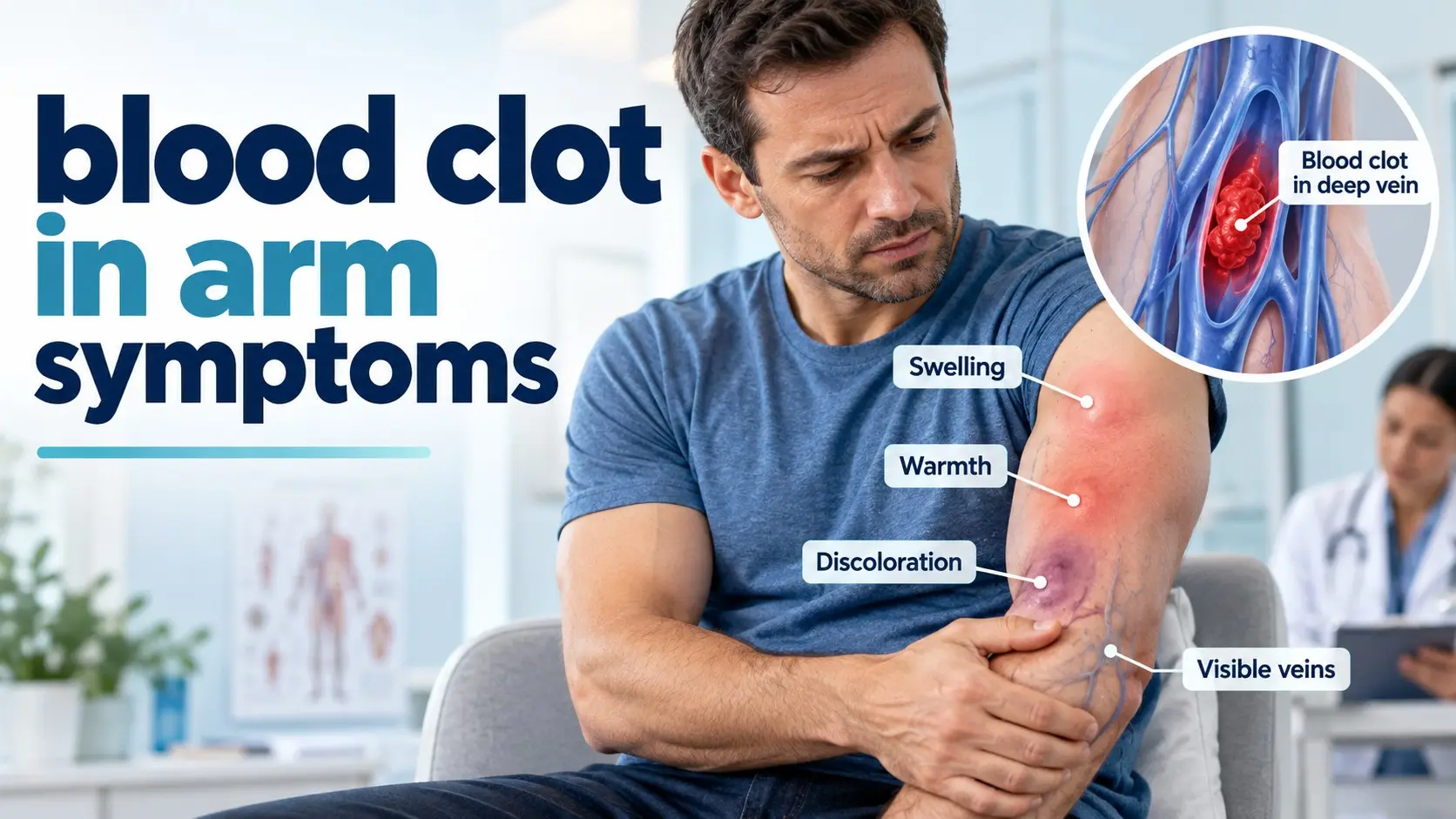
Blood clot in arm symptoms can include sudden swelling, unexplained pain or tenderness, warmth, red or blue skin, arm heaviness, and enlarged surface veins. These signs can come from upper extremity deep vein thrombosis. If arm symptoms occur with sudden breathing trouble, chest pain, coughing blood, fainting, or a rapid heartbeat, seek emergency care for possible pulmonary embolism.
A sore arm after exercise is common.
A suddenly swollen, warm, discolored arm without a clear injury is different.
The goal of this guide is to help you recognize that difference without making every arm ache feel dangerous.
Medical Notice: This content is for general educational purposes and does not replace professional medical advice, diagnosis, or treatment. Consult an appropriately qualified healthcare professional for personal medical concerns.
Seek emergency medical care for sudden shortness of breath, chest pain, coughing blood, fainting, severe dizziness, or a fast or irregular heartbeat with possible clot symptoms. A pulmonary embolism can be life threatening.
Table of Contents
- Quick Answer
- What an arm DVT is
- Why symptoms can be easy to miss
- 11 Urgent Warning Signs
- One sided arm swelling
- Unexplained pain
- Tenderness
- Warm skin
- Red or blue discoloration
- Arm heaviness
- Prominent surface veins
- Hand swelling
- Symptoms after a catheter
- Symptoms after overhead activity
- Pulmonary embolism warning signs
- Main Causes
- PICC lines and central catheters
- Cancer
- Thoracic outlet compression
- Surgery and trauma
- Clotting disorders
- Diagnosis
- Treatment
- What Not to Do
- Prevention
- Frequently Asked Questions
What is a blood clot in the arm?
A deep blood clot in the arm is called an upper extremity deep vein thrombosis, or UEDVT.
The clot forms inside one of the deeper veins that carry blood from the arm back toward the heart.
These veins include the:
- Brachial veins
- Axillary vein
- Subclavian vein
- Brachiocephalic vein
- Internal jugular vein in some classifications of upper extremity thrombosis
A UEDVT can partly or fully block blood flow.
Pressure then builds behind the blockage, which can make the arm swell, feel heavy, or develop visible veins.
Deep vein thrombosis is more common in the legs, but CDC confirms that DVT also occurs in the arms.
For a broader overview of clotting problems, read Blood Clotting Disorder: 11 Critical Red Flags.
Can an arm blood clot cause a pulmonary embolism?
Yes.
This is the most important complication to understand.
A piece of a deep vein clot can break away, travel through the bloodstream, and reach the lungs.
This is called a pulmonary embolism, or PE.
PE can be life threatening.
It can also occur without obvious DVT symptoms first.
Can an arm DVT cause a stroke?
Not in the usual way.
Venous and arterial clots follow different routes through the circulation.
A clot from an arm vein normally travels toward the right side of the heart and then the lungs.
Its major embolic complication is therefore pulmonary embolism.
CDC specifically distinguishes venous clots such as DVT from arterial clots that cause most heart attacks and strokes.
Do not describe a routine arm DVT as a clot that is expected to travel directly to the brain.
Can you have an arm blood clot without symptoms?
Yes.
CDC notes that about half of people with DVT have no symptoms.
This figure includes DVT more broadly rather than only arm clots, but it makes an important point:
Symptoms alone cannot safely rule a clot in or out.
That becomes especially important if you have a central venous catheter, active cancer, previous VTE, or another strong risk factor.
1. One sided arm swelling is a major clue
Sudden swelling in one arm is one of the classic blood clot in arm symptoms.
The swelling can affect:
- The upper arm
- The forearm
- The hand
- The fingers
- The whole limb
The affected arm may look noticeably larger than the other side.
Arm swelling can also come from injury, infection, lymphatic problems, heart disease, or other causes.
That is why a new unexplained swollen arm should be assessed rather than diagnosed from appearance alone.
2. Unexplained arm pain can occur with UEDVT
A deep arm clot can cause aching or pain.
Some people describe:
- A deep ache
- Pressure
- Soreness
- Tightness
- Pain that feels different from their normal muscle soreness
Pain by itself is not specific.
A strained muscle is far more common than UEDVT in many healthy people.
The concern rises when pain appears with swelling, warmth, color change, a catheter, cancer, or another major clot risk factor.
3. Tenderness without an obvious injury can be a warning sign
CDC includes unexplained tenderness among common DVT symptoms.
You may notice discomfort when touching part of the arm even though you did not injure it.
Do not repeatedly press, knead, or deeply massage a suspicious swollen arm to see whether the tenderness changes.
Get it checked.
4. The skin can feel warmer than the other arm
Affected skin can feel warm.
This is another classic DVT clue.
Warmth also occurs with:
- Cellulitis
- Inflammation
- Injury
- Superficial thrombophlebitis
Again, the combination matters more than one symptom.
5. Red, blue, or purple discoloration can occur
Blocked venous drainage can change skin color.
The arm or hand may look:
- Red
- Blue
- Purple
- Darker than the other side
A blue or purple swollen arm after strenuous overhead use is particularly relevant to venous thoracic outlet syndrome.
6. The arm can feel unusually heavy or tight
Some people do not describe strong pain.
They describe heaviness.
The arm may feel full, congested, or tight, especially during activity.
This can happen because blood has difficulty leaving the limb through the blocked vein.
7. Surface veins may suddenly become more visible
When a major deep vein is blocked, blood can try to return through other veins.
This can make veins more obvious over the:
- Arm
- Shoulder
- Upper chest
- Neck
Johns Hopkins lists prominent veins around the shoulder, neck, and hand among possible signs of venous thoracic outlet syndrome.
New prominent veins together with arm swelling deserve medical attention.
8. The hand or fingers can swell too
An upper arm clot can affect drainage from everything below it.
That means swelling is not always limited to the site of the clot.
The hand may look puffy.
Rings can suddenly feel tight.
Fingers may feel stiff because of swelling.
A swollen hand plus arm discoloration or prominent veins is worth reporting.
9. Symptoms after a PICC line or central catheter need attention
This is one of the biggest differences between arm DVT and leg DVT.
PICC lines and other central venous catheters are major causes of secondary UEDVT.
Other devices can include:
- Central venous ports
- Pacemaker wires
- Implantable defibrillator leads
- Other intravascular devices
The American Venous Forum identifies catheter associated UEDVT as a major subgroup of upper extremity clots.
If you have a catheter or implanted device and develop new arm swelling, pain, discoloration, heaviness, or visible veins, contact your healthcare team promptly.
Do not pull out a PICC line yourself.
10. Sudden swelling after repeated overhead activity can mean effort thrombosis
A young, fit person can still develop an arm DVT.
One special cause is Paget Schroetter syndrome, also called effort thrombosis.
This is a form of venous thoracic outlet syndrome.
The subclavian vein becomes compressed near the collarbone and first rib.
Repeated overhead activity can add stress to the vein.
This pattern is seen in some:
- Baseball players
- Swimmers
- Rowers
- Weightlifters
- People whose work requires frequent overhead arm movement
Possible symptoms include sudden arm swelling, heaviness, blue discoloration, pain, and prominent veins.
Do not assume those symptoms are simply muscle pump or post workout swelling.
11. Breathing symptoms can mean the clot reached the lungs
Call emergency services for possible pulmonary embolism if you develop:
- Sudden difficulty breathing
- Chest pain that becomes worse with a deep breath or cough
- Coughing up blood
- A faster than normal heartbeat
- An irregular heartbeat
- Severe lightheadedness
- Very low blood pressure
- Fainting or collapse
You can have a pulmonary embolism without obvious arm swelling first.
Do not wait for every symptom to appear.
For more on emergency chest symptoms, read Chest Pain Left Side: What It Means and What to Do.
What causes a deep blood clot in the arm?
Arm DVT causes fall into a few main groups.
Catheter and device related UEDVT
This is a major cause, especially in hospitalized patients and people receiving long term medical treatment.
A catheter sits inside the vein and can change blood flow or irritate the vessel wall.
Risk can be higher with:
- PICC lines
- Central venous catheters
- Implanted ports
- Pacemaker leads
- Defibrillator leads
Cancer
Active cancer increases the risk of venous blood clots.
Some cancer treatments increase risk too.
Cancer patients are also more likely to have central venous catheters, which adds another arm specific risk factor.
Venous thoracic outlet syndrome
Compression of the subclavian vein between structures near the collarbone and first rib can injure the vein and reduce blood flow.
This can lead to Paget Schroetter syndrome.
Surgery or trauma
Surgery, injury to an arm vein, or significant trauma can increase clot risk.
Previous VTE
A previous DVT or pulmonary embolism increases the chance of future VTE.
Clotting disorders
Inherited or acquired blood clotting disorders can raise clot risk.
Examples include Factor V Leiden and antiphospholipid syndrome.
A clotting disorder is more likely to be considered when UEDVT occurs without an obvious catheter, cancer, surgery, or anatomical trigger.
Estrogen, pregnancy, and other general VTE risks
Estrogen containing medicine, pregnancy, postpartum changes, obesity, older age, smoking, and long immobility can also contribute to overall VTE risk.
They are not uniquely arm clot risk factors.
How is an arm blood clot different from superficial thrombophlebitis?
This is an important distinction.
Superficial thrombophlebitis affects a vein closer to the skin.
It can occur after an IV cannula or other local vein irritation.
You may notice:
- A tender vein
- Local redness
- Warmth
- A firm cord like vein under the skin
Deep UEDVT involves veins farther inside the arm and has a clearer risk of pulmonary embolism.
| Feature | Possible Deep Arm DVT | Possible Superficial Thrombophlebitis |
|---|---|---|
| Swelling | Can affect much of the arm or hand | Often more local |
| Pain | Deep ache, pressure, or tenderness | Tenderness along a visible or palpable vein |
| Vein appearance | Collateral surface veins can become prominent | Tender firm cord can be felt near the skin |
| PE risk | Recognized complication | Usually lower, but extension toward deep veins can matter |
| Best next step | Prompt medical assessment and imaging | Assessment when extensive, progressive, proximal, or high risk |
Physical examination cannot always distinguish the two.
Ultrasound may be needed.
How is an arm DVT diagnosed?
You cannot reliably diagnose one by squeezing your arm or comparing photos online.
Several other conditions can mimic DVT.
These include:
- Muscle strain
- Cellulitis
- Lymphedema
- Superficial thrombophlebitis
- Shoulder injury
- Thoracic outlet disorders without DVT
Duplex ultrasound is the first test
Current American Venous Forum guidance recommends duplex ultrasound as the first imaging examination when UEDVT is suspected.
The test uses sound waves to look for:
- A clot inside the vein
- Failure of the vein to compress normally
- Abnormal blood flow
It is noninvasive and widely available.
Can ultrasound miss a subclavian clot?
Sometimes.
The collarbone can make parts of the proximal subclavian vein difficult to see clearly.
If clinical suspicion remains high despite a nondiagnostic ultrasound, further imaging may be needed.
This can include:
- CT venography
- MR venography
- Contrast venography in selected situations
Suspected venous thoracic outlet syndrome may also require specialized imaging and vascular assessment.
Is D dimer useful for an arm clot?
A D dimer blood test can be part of VTE evaluation in selected patients.
However, arm DVT is different from the more common leg DVT, and clinical prediction tools are less well validated for UEDVT.
A positive D dimer does not prove a clot.
Cancer, infection, pregnancy, surgery, age, and other conditions can raise it.
When arm DVT is strongly suspected, imaging is central to diagnosis.
How is an upper extremity DVT treated?
Anticoagulants, commonly called blood thinners, are the main treatment for most UEDVT.
These medicines reduce the chance that the clot grows or that another clot forms.
The body gradually deals with the existing clot.
The 2025 American Venous Forum guideline recommends anticoagulation for at least three months for most proximal UEDVT when bleeding risk is acceptable.
Current guidance favors oral factor Xa inhibitors over vitamin K antagonists for many suitable patients.
The exact medicine depends on:
- Bleeding risk
- Kidney function
- Cancer
- Pregnancy
- Other medicines
- The cause of the clot
Do not choose or stop an anticoagulant without professional guidance.
What happens if the clot was caused by a PICC line?
The catheter does not always need immediate removal.
This corrects another common oversimplification.
Current American Venous Forum guidance recommends anticoagulation for catheter associated UEDVT.
If the catheter is no longer needed or another access route is practical, removal is appropriate.
If the device is still necessary and working, it can sometimes remain in place while the clot is treated.
That decision belongs to the medical team.
Do not remove the catheter yourself.
What if cancer caused the arm DVT?
Active cancer changes treatment decisions.
Anticoagulation is usually needed.
Current guidance can support extended treatment while cancer remains active, depending on bleeding risk and the clinical situation.
The cancer team also decides whether an associated catheter still needs to remain in place.
Does every arm DVT need clot busting treatment?
No.
Thrombolysis uses medicines that actively break down clot.
It carries a greater bleeding risk than ordinary anticoagulation.
It is therefore used selectively rather than routinely for every UEDVT.
A young patient with severe acute Paget Schroetter syndrome is a very different case from a stable catheter related clot in a person receiving cancer treatment.
Treatment is matched to the cause.
How is Paget Schroetter syndrome treated?
Paget Schroetter syndrome is not just an ordinary clot from inactivity.
It involves compression of the subclavian vein at the thoracic outlet.
Specialist treatment may include:
- Anticoagulation
- Clot removal or thrombolysis in selected acute cases
- Assessment of the compressed vein
- Surgical decompression
The current American Venous Forum guideline recommends first rib resection when UEDVT is associated with findings compatible with venous thoracic outlet syndrome.
This is specialist vascular care.
How long does treatment last?
For many proximal arm DVTs, anticoagulation is used for at least three months.
Treatment can be longer when:
- Active cancer continues
- A needed catheter remains in place
- Another persistent risk factor remains
- The clot was unprovoked
- There is a history of recurrent VTE
The correct duration balances future clot risk against bleeding risk.
Can an arm blood clot go away on its own?
Your body can gradually break down clot.
That does not mean suspected UEDVT should be left untreated to see what happens.
The risks include:
- Pulmonary embolism
- Clot extension
- Recurrent VTE
- Persistent swelling
- Post thrombotic syndrome
Prompt diagnosis allows treatment to reduce those risks.
What is post thrombotic syndrome in the arm?
Some people continue to have problems after an upper extremity DVT.
Damage to the vein and its valves can lead to chronic venous symptoms.
Possible problems include:
- Persistent arm swelling
- Heaviness
- Pain
- Fatigue during arm use
- Visible veins
- Reduced function
This is called post thrombotic syndrome.
Follow up matters when arm symptoms do not settle after treatment.
Should you massage an arm with a suspected blood clot?
No.
If one arm is suddenly swollen, warm, painful, or discolored and a clot is possible, do not deeply massage it.
Massage cannot dissolve a DVT.
Get medical assessment instead.
This also applies to aggressive massage devices.
Should you exercise with a possible arm DVT?
Do not perform a hard workout to test whether symptoms are muscular.
New unexplained swelling or discoloration should be assessed first.
Once treatment starts, activity advice depends on:
- Where the clot is
- The cause
- Your symptoms
- Anticoagulant treatment
- Whether thoracic outlet compression is present
Ask the treating clinician when to return to lifting, swimming, throwing, rowing, or other repetitive overhead activity.
Can compression sleeves treat an arm DVT?
Do not self treat a suspected deep arm clot with a compression sleeve.
Compression may be considered in selected patients for chronic symptoms, but it is not a substitute for diagnosis and anticoagulant treatment.
The correct pressure and timing should be individualized.
Can drinking water dissolve an arm clot?
No.
Normal hydration supports general health.
Water does not dissolve a UEDVT.
It also cannot replace anticoagulation when anticoagulation is indicated.
This is similar to other circulation problems: lifestyle habits support vascular health but do not remove an established clot.
See How to Improve Blood Circulation Safely for a fuller explanation.
Does aspirin treat an arm DVT?
Do not start aspirin on your own for a suspected arm clot.
Antiplatelet medicines such as aspirin are different from the anticoagulants usually used to treat venous thromboembolism.
If you suspect a DVT, get it diagnosed first.
Can you prevent an arm blood clot?
Not every UEDVT can be prevented.
Prevention depends heavily on the cause.
1. Know your catheter risk
If you have a PICC line, central venous catheter, port, pacemaker, or similar device, report new arm swelling, pain, discoloration, or visible veins promptly.
2. Keep medical devices only as long as needed
Your healthcare team decides when a catheter can safely be removed.
Unnecessary intravascular devices should not remain simply out of convenience.
3. Follow clot prevention after surgery or hospitalization
Some patients need movement plans or anticoagulant prevention.
Use prescribed prevention exactly as directed.
4. Tell your doctor about previous clots
A previous DVT or PE changes future VTE risk.
5. Discuss cancer related risk
Cancer and some treatments raise clot risk.
A central catheter can add another risk factor.
6. Do not ignore unexplained swelling after overhead activity
Young athletes can develop effort thrombosis.
Sudden swelling after throwing, heavy lifting, swimming, rowing, or repetitive overhead work needs assessment.
7. Manage general VTE risks
Regular activity, smoking cessation, healthy weight, and management of chronic disease support overall vascular health.
They cannot overcome every catheter, cancer, anatomical, or genetic risk.
What if the hand becomes cold, pale, numb, or weak?
This pattern raises a different concern.
A deep venous clot usually causes swelling and congestion.
A hand that suddenly becomes very cold, pale, blue, numb, weak, or severely painful can point toward reduced arterial blood flow instead.
That is also an emergency.
Do not massage, heat aggressively, or exercise a suddenly ischemic limb.
Seek urgent medical care.
What should you never do with possible arm DVT?
- Do not massage the swollen arm.
- Do not start aspirin on your own.
- Do not remove a PICC or central catheter yourself.
- Do not exercise hard to see whether symptoms loosen up.
- Do not use water or supplements as clot treatment.
- Do not wait for chest pain before getting arm symptoms checked.
- Do not assume a fit young athlete cannot develop UEDVT.
When should arm symptoms be checked promptly?
Contact a healthcare professional promptly for:
- New unexplained swelling in one arm
- Arm pain or tenderness without clear injury
- New warmth or discoloration
- Sudden prominent veins over the arm, shoulder, or chest
- New symptoms around a PICC line or central catheter
- Sudden swelling after repetitive overhead activity
- Arm symptoms with active cancer
- Arm symptoms with previous DVT or PE
Do not wait for symptoms to become severe.
When is a possible arm blood clot an emergency?
Seek emergency care now for:
- Sudden difficulty breathing
- Chest pain with breathing difficulty
- Coughing up blood
- Fainting or collapse
- Severe lightheadedness
- Very fast or irregular heartbeat with breathing symptoms
- A suddenly cold, pale, numb, weak, or severely painful arm or hand
A pulmonary embolism or acute loss of arterial blood flow can be life threatening.
Eight myths about blood clots in the arm
Myth 1: DVT only happens in the legs
False.
DVT can also develop in the arm.
Myth 2: Arm DVT always causes obvious swelling
False.
Some upper extremity clots cause mild symptoms or no symptoms.
Myth 3: An arm DVT normally travels to the brain
False.
The usual major embolic complication is pulmonary embolism in the lungs.
Myth 4: Only older people get arm DVT
False.
Young athletes can develop Paget Schroetter syndrome after repeated overhead activity.
Myth 5: Every arm DVT is caused by inactivity
False.
Catheters, cancer, implanted devices, thoracic outlet compression, surgery, trauma, and clotting disorders are important causes.
Myth 6: A PICC line must always be removed immediately
False.
A needed and functioning catheter can sometimes remain while anticoagulation treats the clot.
Myth 7: Blood thinners instantly dissolve the clot
False.
Anticoagulants mainly stop clot growth and prevent new clots while the body gradually clears the existing clot.
Myth 8: Drinking extra water is enough treatment
False.
Hydration does not replace anticoagulation or vascular treatment.
Conclusion
Blood clot in arm symptoms can include swelling, pain, tenderness, warmth, discoloration, heaviness, hand swelling, and unusually visible veins. Catheters, cancer, thoracic outlet compression, previous VTE, surgery, trauma, and clotting disorders can all raise the risk.
Your next step is simple. If one arm becomes suddenly swollen or discolored without a clear injury, get it assessed rather than massaging it or testing it with exercise. If breathing trouble, chest pain, coughing blood, fainting, or severe dizziness appears, seek emergency care immediately for possible pulmonary embolism.
Internal Links and NextFitLife Health Guides
Blood Clotting Disorder
for thrombophilia, DVT, pulmonary embolism, Factor V Leiden, risk factors, testing, and anticoagulants.
How to Improve Blood Circulation Safely
for movement, vascular health, smoking, blood pressure, diabetes, cholesterol, and circulation warning signs.
Chest Pain Left Side
for heart attack, pulmonary embolism, lung emergencies, reflux, and urgent chest symptoms.
Poor Circulation in Feet
for artery, vein, nerve, diabetes, clot, swelling, and limb warning signs.
General Wellness and Healthy Lifestyle Guide
for smoking cessation, physical activity, healthy weight, preventive care, and long term vascular health.
References and Sources
- Centers for Disease Control and Prevention. About Venous Thromboembolism.
https://www.cdc.gov/blood-clots/about/index.html
- Centers for Disease Control and Prevention. Testing and Diagnosis for Venous Thromboembolism.
https://www.cdc.gov/blood-clots/testing-diagnosis/index.html
- American Venous Forum. Clinical Practice Guideline on Upper Extremity Deep Venous Thrombosis.
https://pmc.ncbi.nlm.nih.gov/articles/PMC13141763/
- National Heart, Lung, and Blood Institute. Venous Thromboembolism.
https://www.nhlbi.nih.gov/health/venous-thromboembolism
- Johns Hopkins Medicine. Thoracic Outlet Syndrome.
https://www.hopkinsmedicine.org/health/conditions-and-diseases/thoracic-outlet-syndrome
About the Author
Adel Galal is the Founder and Lead Writer at NextFitLife. He researches practical health, fitness, nutrition, blood circulation, blood clot risks, cardiovascular health, and healthy aging using recognized government, medical, and professional sources.
His approach to blood clot articles is to separate an actual venous thrombosis from the many problems that can look similar. With arm symptoms, that means distinguishing deep vein thrombosis from muscle injury, superficial thrombophlebitis, infection, lymphatic swelling, and arterial emergencies.
For this guide, Adel reviewed current CDC, NHLBI, American Venous Forum, and Johns Hopkins information on upper extremity DVT, pulmonary embolism, catheter related thrombosis, venous thoracic outlet syndrome, diagnosis, and treatment.
Adel is not a doctor, hematologist, vascular surgeon, cardiologist, pharmacist, nurse, or other licensed healthcare professional.
Learn more about Adel Galal, NextFitLife, and the site's editorial standards on the About Us page.
Medical Disclaimer: This content is for general educational purposes and does not replace professional medical advice, diagnosis, or treatment. Consult an appropriately qualified healthcare professional for personal medical concerns.
Frequently Asked Questions
What are the main blood clot in arm symptoms?
Common signs include one sided swelling, pain, tenderness, warmth, redness or blue discoloration, arm heaviness, hand swelling, and newly prominent veins.
What does a blood clot in the arm feel like?
It may feel like a deep ache, pressure, heaviness, tightness, or tenderness. Some people have mild symptoms or no clear symptoms.
Can an arm blood clot cause swelling in the hand?
Yes. A clot in a deep upper arm vein can slow venous drainage from the forearm and hand, causing hand or finger swelling.
Can a blood clot make your arm turn blue?
Yes. Significant venous congestion can cause blue, purple, red, or darker discoloration.
Can a blood clot make veins in the arm more visible?
Yes. When a major deep vein is blocked, collateral surface veins can become more prominent over the arm, shoulder, upper chest, or neck.
Can an arm DVT cause a pulmonary embolism?
Yes. Part of a deep arm clot can travel through the bloodstream to the lungs and cause pulmonary embolism.
Can an arm DVT cause a stroke?
A typical venous arm DVT does not normally travel to the brain. Its major embolic complication is pulmonary embolism.
Can you have an arm blood clot without symptoms?
Yes. Some DVTs cause few or no symptoms, especially catheter associated clots found during medical care.
What causes upper extremity DVT?
Important causes include PICC lines, central venous catheters, cancer, pacemaker or defibrillator leads, venous thoracic outlet syndrome, surgery, trauma, previous VTE, and clotting disorders.
Can a PICC line cause a blood clot in the arm?
Yes. PICC lines and other central venous devices are major risk factors for catheter associated upper extremity DVT.
Does a PICC have to be removed if a clot forms?
Not always. A catheter that is still needed and functioning can sometimes remain while anticoagulation is given. The medical team decides whether removal is appropriate.
What is Paget Schroetter syndrome?
Paget Schroetter syndrome is effort related upper extremity DVT caused by compression of the subclavian vein at the thoracic outlet, often after repetitive overhead arm activity.
Can weightlifting cause an arm blood clot?
Repeated forceful overhead activity can contribute to Paget Schroetter syndrome in people with venous thoracic outlet compression. Ordinary resistance training does not mean a clot will occur.
How is an arm blood clot diagnosed?
Duplex ultrasound is the recommended first imaging test for suspected upper extremity DVT. CT venography, MR venography, or other imaging can be used when ultrasound is inconclusive.
Can ultrasound miss an arm DVT?
Yes. The proximal subclavian vein can be difficult to see because of the collarbone, so further imaging can be needed when suspicion remains high.
How is upper extremity DVT treated?
Anticoagulant medicine is the main treatment for most cases. Current vascular guidance recommends at least three months of anticoagulation for many proximal UEDVT cases when bleeding risk is acceptable.
Do blood thinners dissolve an arm clot?
Anticoagulants mainly prevent the clot from getting larger and reduce formation of new clots. The body gradually clears the existing clot.
Does every arm DVT need thrombolysis?
No. Clot dissolving treatment carries bleeding risk and is reserved for selected cases. Most UEDVT is treated primarily with anticoagulation.
Can you massage a blood clot in your arm?
Do not deeply massage an arm with suspected DVT. Massage does not dissolve the clot and should not delay medical evaluation.
Can you exercise with an arm blood clot?
Exercise advice depends on the clot location, cause, treatment, symptoms, and whether thoracic outlet compression is present. Ask your treating clinician before returning to strenuous arm exercise.
Can drinking water dissolve an arm blood clot?
No. Normal hydration supports general health but does not dissolve a DVT or replace anticoagulant treatment.
Does aspirin treat an arm DVT?
Aspirin is not the standard replacement for anticoagulation used to treat most UEDVT. Do not start aspirin for a suspected clot without medical advice.
What is superficial thrombophlebitis in the arm?
Superficial thrombophlebitis is inflammation and clotting in a vein close to the skin. It can cause local pain, redness, warmth, and a firm tender cord. Extensive or high risk cases may need ultrasound to exclude deep vein involvement.
When should I seek emergency care?
Seek emergency care for sudden shortness of breath, chest pain, coughing blood, fainting, severe lightheadedness, a fast or irregular heartbeat with breathing symptoms, or a suddenly cold, pale, numb, weak, or severely painful arm.

Health & wellness writer with 30+ years of experience in nutrition, fitness, and healthy aging. Founder of NextFitLife.com — evidence-based health guidance.