
Last updated: October 7, 2026
Written and edited by: Adel Galal, Founder and Editor of NextFitLife
Medical review status: This article has not been medically reviewed by a doctor, endocrinologist, clinical biochemist, registered dietitian, or other licensed healthcare professional.
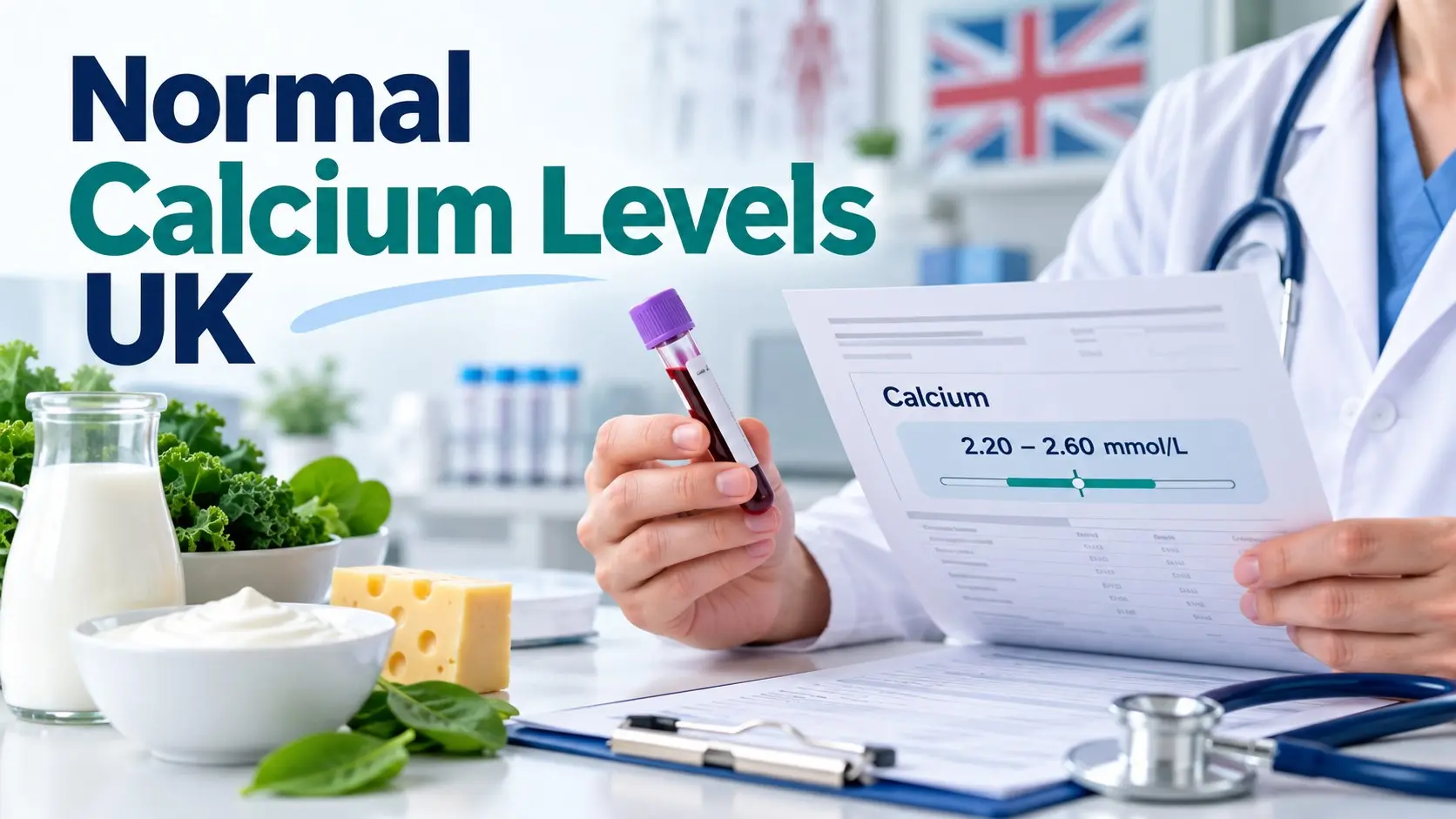
If you are checking normal calcium levels UK, the number most adults will commonly see on an NHS blood report is around 2.20 to 2.60 mmol/L for adjusted calcium.
That range is widely used by UK NHS laboratories, but it is not a universal rule. Your own laboratory reference range should always take priority because methods and reporting systems can differ.
There is also more than one type of calcium result. A report may show total calcium, adjusted calcium, or sometimes ionised calcium. These numbers are related, but they are not interchangeable.
The result must also be read alongside albumin, kidney function, vitamin D, magnesium, phosphate, parathyroid hormone, symptoms, medicines, and your medical history.
This article is for general information and education. It does not replace medical advice, diagnosis, or treatment.
Get urgent medical help if an abnormal calcium result comes with seizures, severe muscle spasms, fainting, major confusion, severe weakness, abnormal heart rhythm symptoms, or rapidly worsening illness.
A calcium result should not be treated at home simply by taking or stopping calcium tablets without medical advice.
Table of Contents
- Quick Answer
- Normal adult calcium range
- Why laboratories differ
- 9 Vital Facts
- Adult adjusted calcium is often 2.20 to 2.60 mmol/L
- Your laboratory range comes first
- Total and adjusted calcium differ
- Albumin affects total calcium
- Ionised calcium measures active calcium
- Children have different ranges
- High calcium has several causes
- Low calcium has several causes
- Blood calcium is not a bone density test
- High Calcium
- Low Calcium
- Tests Doctors May Request
- Calcium and Diet
- Frequently Asked Questions
Normal Calcium Levels UK: Quick Answer
For adults, several NHS laboratories use an adjusted calcium reference range of approximately:
2.20 to 2.60 mmol/L
This range is published by NHS laboratories including North West London Pathology, Oxford University Hospitals, Cambridge University Hospitals, Newcastle Hospitals, York and Scarborough, and others.
However, some laboratories use slightly different ranges for total calcium. This is normal.
Always compare your result with the reference interval printed beside it on your own blood report.
Normal Calcium Levels UK by Age
| Age | Typical NHS Reference Range | Unit |
|---|---|---|
| Birth to about 4 weeks | About 2.0 to 2.7 | mmol/L |
| About 1 month to 16 years | About 2.2 to 2.7 | mmol/L |
| Age 16 and over | About 2.2 to 2.6 | mmol/L |
These are useful examples, not a substitute for the range supplied by the laboratory that processed your sample.
9 Vital Facts About Normal Calcium Levels UK
1. Adult Adjusted Calcium Is Often 2.20 to 2.60 mmol/L
This is one of the most commonly published adult NHS reference ranges.
A result inside this interval is generally considered within range when that is the interval used by the laboratory.
A result outside the range does not automatically mean serious disease.
Doctors interpret the number together with:
- Symptoms
- Albumin
- Kidney function
- Phosphate
- Magnesium
- Vitamin D
- Parathyroid hormone
- Medicines
- Previous calcium results
2. Your Own Laboratory Range Comes First
Reference ranges are not exactly the same everywhere.
For example, some UK laboratories publish a total calcium interval slightly wider than 2.20 to 2.60 mmol/L.
This can happen because laboratories use different:
- Analysers
- Assays
- Calibration methods
- Reference populations
- Adjustment formulas
Do not compare your number with a random online range while ignoring the reference interval on your report.
3. Total Calcium and Adjusted Calcium Are Different
Blood calcium exists in several forms.
Some is free in the blood.
Some is attached to proteins, mainly albumin.
Total calcium measures both the free and protein bound calcium.
Because changes in albumin can change total calcium even when the active calcium has not changed, many UK laboratories calculate an adjusted calcium result.
4. Albumin Can Change the Meaning of Total Calcium
Albumin is a protein made mainly by the liver.
A significant amount of blood calcium is attached to albumin.
If albumin is low, total calcium can look low even when the biologically active calcium is satisfactory.
If albumin is unusual, an adjusted result may give a better estimate.
However, adjusted calcium is still a calculation.
It can become less reliable when albumin is extremely low or high, or when a person is critically ill.
5. Ionised Calcium Measures the Active Form
Ionised calcium measures the calcium that is free and biologically active.
It is not routinely needed for every person.
It may be more useful when:
- Someone is critically ill
- Albumin is very abnormal
- Blood pH is abnormal
- A major operation is taking place
- Large blood transfusions have been given
- The total or adjusted result may be misleading
Some UK hospital guidance uses an adult ionised calcium reference range around 1.1 to 1.3 mmol/L, but once again the laboratory's own range must be used.
6. Children's Calcium Ranges Are Different
Babies and children can have higher normal calcium results than adults.
That is why an adult reference range should not be applied to a child.
Age specific laboratory ranges are especially important during infancy and childhood.
7. High Calcium Has Several Possible Causes
A high adjusted calcium level is called hypercalcaemia.
Important causes include:
- Primary hyperparathyroidism
- Some cancers
- Excess vitamin D
- Some medicines
- Hyperthyroidism
- Sarcoidosis
- Long periods of immobility
- Some kidney problems
Primary hyperparathyroidism is one of the common causes seen outside hospital.
The cause cannot be identified from calcium alone.
8. Low Calcium Also Has Several Causes
A low calcium level is called hypocalcaemia.
Possible causes include:
- Vitamin D deficiency
- Hypoparathyroidism
- Low magnesium
- Chronic kidney disease
- Pancreatitis
- Problems absorbing nutrients
- Some medicines
A low total calcium result can also reflect low albumin rather than a true fall in biologically active calcium.
9. Blood Calcium Does Not Measure Bone Density
This is one of the most important facts to understand.
Your body keeps blood calcium within a narrow range because calcium is needed for nerves, muscles, and the heart.
If dietary intake is poor, the body can release calcium from bone to help maintain the blood level.
This means someone can have a normal blood calcium result and still have:
- Low calcium intake
- Osteopenia
- Osteoporosis
- Reduced bone strength
A bone density scan, usually a DEXA scan, is used when doctors need to assess bone mineral density.
If you are interpreting a full bone profile, our Abnormal Bone Profile Blood Test Guide explains the other common measurements.
What Is a Bone Profile Blood Test?
A UK bone profile often includes several results rather than calcium alone.
Depending on the laboratory, it may include:
- Total calcium
- Adjusted calcium
- Albumin
- Phosphate
- Alkaline phosphatase
- Total protein
Magnesium is not always included automatically.
This matters because magnesium can influence calcium regulation.
What Is Adjusted Calcium?
Adjusted calcium, sometimes called corrected calcium, is a calculated value.
It tries to estimate what the total calcium result would mean after taking albumin into account.
This is useful because albumin binds a large portion of circulating calcium.
A low albumin level can therefore make total calcium look lower than expected.
Should You Calculate Adjusted Calcium Yourself?
Usually not.
UK laboratories do not all use exactly the same adjustment formula.
For example, some laboratories have updated their equations as analytical methods have changed.
Use the adjusted calcium reported by your laboratory rather than applying a formula from another hospital website.
When Adjusted Calcium Can Be Misleading
Adjusted calcium is useful, but it is not perfect.
It can be less reliable when:
- Albumin is extremely low
- Albumin is very high
- A person is critically ill
- Blood pH is abnormal
- There has been a large blood transfusion
In these situations, clinicians may choose direct ionised calcium testing.
What Does High Calcium Mean?
When adjusted calcium is above the laboratory reference range, the result is called hypercalcaemia.
Some people have no symptoms when the rise is mild.
Possible symptoms include:
- Thirst
- Passing urine more often
- Constipation
- Nausea
- Reduced appetite
- Tiredness
- Muscle weakness
- Difficulty concentrating
- Confusion when more severe
Long lasting high calcium can also contribute to kidney stones.
What Calcium Level Is Considered High?
The exact definition follows your laboratory range.
When the adult upper limit is 2.60 mmol/L, a result above that level is classified as raised.
One NHS primary care guideline describes:
- Mild hypercalcaemia: 2.6 to 3.0 mmol/L
- Moderate hypercalcaemia: 3.0 to 3.4 mmol/L
- Severe hypercalcaemia: above 3.4 mmol/L
These categories are useful clinical examples, but treatment decisions depend on the whole situation, including symptoms, cause, kidney function, and how quickly the calcium rose.
Common Causes of High Calcium
Primary Hyperparathyroidism
The parathyroid glands help control calcium.
If one or more glands produce too much parathyroid hormone, blood calcium can rise.
This is called primary hyperparathyroidism.
Cancer
Some cancers can raise calcium by affecting bone or producing substances that alter calcium regulation.
A high calcium result does not automatically mean cancer.
Primary hyperparathyroidism is also a common cause.
Vitamin D Excess
Too much vitamin D can increase calcium absorption and may cause hypercalcaemia.
This is one reason very high dose vitamin D supplements should not be taken casually.
Medicines
Some medicines can affect calcium.
Examples include lithium and some diuretics.
Never stop a prescribed medicine because of a calcium result without discussing it with the prescriber.
What Does Low Calcium Mean?
When calcium is below the laboratory reference range, it may be described as hypocalcaemia.
Symptoms depend on how low calcium is and how quickly it falls.
Possible symptoms include:
- Tingling around the mouth
- Pins and needles in the fingers
- Numbness
- Muscle cramps
- Muscle spasms
- Twitching
- Weakness
- Palpitations
Severe hypocalcaemia can cause:
- Seizures
- Marked muscle spasms
- Abnormal heart rhythms
- Low blood pressure
- Confusion
Common Causes of Low Calcium
Vitamin D Deficiency
Vitamin D helps the intestine absorb calcium.
Low vitamin D can therefore contribute to low calcium in some people.
Hypoparathyroidism
Low parathyroid hormone can reduce blood calcium.
This can sometimes occur after surgery involving the thyroid or parathyroid glands.
Low Magnesium
Magnesium is needed for normal parathyroid hormone function.
Severe magnesium deficiency can therefore contribute to low calcium.
Our Benefits of Magnesium and Zinc Guide explains magnesium's wider role in the body.
Kidney Disease
Chronic kidney disease can disturb calcium, phosphate, parathyroid hormone, and vitamin D regulation.
Absorption Problems
Conditions that reduce nutrient absorption can affect vitamin D and calcium balance.
Total Calcium Versus Adjusted Calcium Versus Ionised Calcium
| Test | What It Measures | Why It Is Used |
|---|---|---|
| Total calcium | Free plus protein bound calcium | Standard laboratory measurement |
| Adjusted calcium | Calculated calcium adjusted for albumin | Helps account for abnormal albumin |
| Ionised calcium | Free biologically active calcium | Useful when adjusted calcium may be unreliable |
Why Might Your Doctor Repeat the Calcium Test?
One abnormal result does not always establish a diagnosis.
A repeat test may be useful when:
- The result is only slightly outside range
- It does not fit your symptoms
- Albumin is abnormal
- There may have been a sample problem
- A medicine could have affected the result
- The clinician needs to confirm whether the change persists
Sample contamination can also produce misleading calcium results.
For example, contamination with EDTA can make calcium appear falsely low.
What Other Tests May Be Ordered?
If calcium is repeatedly abnormal, clinicians may request other tests to identify the cause.
Parathyroid Hormone
PTH is one of the most important hormones controlling blood calcium.
The combination of calcium and PTH often provides more information than either test alone.
Vitamin D
Vitamin D helps calcium absorption.
A 25 hydroxy vitamin D test may be requested when deficiency is suspected.
Phosphate
Calcium and phosphate regulation are closely linked.
Magnesium
Very low magnesium can disturb PTH function and calcium balance.
Kidney Function
Kidneys help regulate minerals and activate vitamin D.
Alkaline Phosphatase
ALP can provide information about bone and liver activity.
It is commonly included in a bone profile.
Does a Normal Calcium Level Mean Your Bones Are Healthy?
No.
This is a common misunderstanding.
About 99 percent of the body's calcium is stored in bones and teeth.
The amount circulating in blood is tightly regulated.
Your body may maintain a normal blood calcium level even when bone calcium is being lost.
A calcium blood test cannot diagnose osteoporosis.
How Is Bone Density Tested?
A DEXA scan measures bone mineral density.
Doctors may consider it when someone has risk factors such as:
- Older age
- Previous low trauma fracture
- Long term steroid treatment
- Early menopause
- Low body weight
- Certain long term health conditions
The decision depends on individual risk rather than blood calcium alone.
Can You Have Low Calcium Intake With Normal Blood Calcium?
Yes.
This is why diet and blood results measure different things.
If calcium intake is consistently too low, the body can draw calcium from bone to help maintain the blood level.
Over many years, inadequate calcium intake can contribute to poor bone health.
How Much Calcium Do UK Adults Need?
The NHS states that adults need about 700 mg of calcium each day.
Most people should be able to meet this target through a varied diet.
Some people with osteoporosis or specific medical needs may be advised to have a different target.
Good Calcium Foods in the UK
Dairy Foods
- Milk
- Yoghurt
- Cheese
Fortified Alternatives
- Calcium fortified soya drinks
- Calcium fortified oat drinks
- Other fortified plant drinks
Shake fortified plant drinks before pouring because added calcium can settle at the bottom.
Fish With Edible Bones
- Sardines
- Pilchards
- Canned salmon with bones
Plant Sources
- Kale
- Broccoli
- Cabbage
- Okra
- Tofu made with calcium
- Some beans and pulses
Spinach contains calcium, but much of it is less easily absorbed because of oxalate.
Should You Take a Calcium Supplement?
Not automatically.
The NHS advises that most adults should be able to get enough calcium through a varied diet.
A supplement may be recommended when:
- Dietary intake is too low
- There is osteoporosis
- A clinician identifies a specific need
- Calcium intake is difficult to achieve through food
Do not take high doses simply because one calcium blood result was slightly low.
Can Too Much Calcium Be Harmful?
Yes.
The NHS states that taking more than about 1,500 mg of calcium a day can cause stomach pain and diarrhoea.
Very high calcium levels in the blood can also affect the kidneys, heart, nervous system, and digestive system.
Calcium supplements and vitamin D supplements should therefore be used sensibly.
Can Vitamin D Raise Calcium?
Yes.
Vitamin D increases calcium absorption from the gut.
This is useful when vitamin D is needed, but excessive vitamin D intake can lead to hypercalcaemia.
Do not use very high vitamin D doses without appropriate medical guidance.
Can Dehydration Affect Calcium Results?
Changes in fluid balance and protein concentration can influence laboratory measurements.
This is another reason doctors interpret calcium together with albumin, kidney function, symptoms, and the clinical situation rather than relying on one isolated number.
Can Medicines Change Calcium Levels?
Yes.
Medicines associated with calcium changes can include:
- Lithium
- Some diuretics
- Some osteoporosis medicines
- Some cancer treatments
- Vitamin D preparations
- Calcium supplements
Tell your doctor about prescribed medicines, over the counter products, and supplements.
Does High Calcium Always Mean Cancer?
No.
This is an important myth to correct.
Primary hyperparathyroidism is a common cause of raised calcium.
Cancer is another important cause, particularly in some hospital patients, but an elevated calcium result does not prove cancer.
The pattern of PTH and other tests helps doctors investigate the reason.
Does Low Calcium Always Mean You Need More Calcium Food?
No.
Low calcium may result from:
- Vitamin D deficiency
- Parathyroid disease
- Kidney disease
- Magnesium deficiency
- Abnormal albumin
- Some medicines
The right treatment depends on the cause.
Calcium and Kidney Stones
People with calcium stones sometimes think they must avoid calcium rich foods.
That can be the wrong approach.
Normal dietary calcium can bind oxalate in the digestive tract and may help reduce absorption of oxalate.
Stone prevention needs to match the type of stone and individual risk factors.
Read our Urinary Stones Cause Guide for more detail.
What If Your Calcium Is 2.1 mmol/L?
In an adult laboratory using a 2.20 to 2.60 mmol/L adjusted range, 2.1 mmol/L would be below range.
That does not tell you the cause or severity by itself.
Your clinician may consider:
- Whether the result is total or adjusted calcium
- Albumin
- Symptoms
- Vitamin D
- Magnesium
- PTH
- Kidney function
- Whether repeat testing is needed
What If Your Calcium Is 2.6 mmol/L?
In many UK adult laboratories, 2.60 mmol/L is around the upper edge of the reference range.
Whether it is flagged depends on the exact laboratory interval and whether the value is adjusted or total calcium.
One borderline result should be interpreted in context rather than self diagnosed.
What If Your Calcium Is 2.7 mmol/L?
For an adult laboratory using an upper limit of 2.60 mmol/L, 2.7 mmol/L is raised.
A clinician may repeat the test and review PTH, kidney function, medicines, vitamin D, symptoms, and previous results.
Do not assume the cause from the number alone.
What If Your Calcium Is Above 3.0 mmol/L?
This is clearly raised in standard adult UK ranges.
Some NHS guidance describes calcium between 3.0 and 3.4 mmol/L as moderate hypercalcaemia, where symptoms may become more likely.
How urgently it needs treatment depends on symptoms, the speed of the rise, kidney function, the cause, and clinical judgment.
Contact the healthcare professional responsible for the test rather than trying to correct the result yourself.
What If Calcium Is Low but You Feel Well?
A slow fall in calcium can produce few or no symptoms.
A slightly low result may also reflect albumin or another laboratory issue.
That is why repeat testing or further investigation may be recommended rather than immediate treatment.
Calcium Result Interpretation Table
| Finding | Possible Meaning | Useful Next Step |
|---|---|---|
| Within laboratory range | Blood calcium is within that laboratory's reference interval | Interpret with other results and symptoms |
| Low total calcium with low albumin | May not represent true low active calcium | Review adjusted or ionised calcium when appropriate |
| Raised adjusted calcium | Hypercalcaemia | Consider PTH, kidney function, medicines, and other causes |
| Low adjusted calcium | Possible true hypocalcaemia | Consider vitamin D, magnesium, PTH, kidney function, and symptoms |
| Normal calcium with osteoporosis risk | Blood calcium does not exclude weak bones | Assess bone health separately when indicated |
Common Myths About Calcium Blood Tests
Myth 1: Every UK Laboratory Uses Exactly the Same Range
False.
Many laboratories use 2.20 to 2.60 mmol/L for adult adjusted calcium, but ranges can vary slightly.
Myth 2: A Normal Calcium Test Means Strong Bones
False.
Blood calcium and bone density measure different things.
Myth 3: Low Calcium Always Means You Need Supplements
False.
The cause may involve vitamin D, parathyroid hormone, magnesium, kidney function, albumin, or another problem.
Myth 4: High Calcium Means Cancer
False.
Primary hyperparathyroidism is another major cause.
Myth 5: Adjusted Calcium and Ionised Calcium Are the Same Test
False.
Adjusted calcium is calculated. Ionised calcium is directly measured.
Myth 6: You Can Diagnose Calcium Problems From Your Nails
False.
Nail changes are not a reliable calcium test.
Read our Calcium Deficiency Nails Guide for a full explanation.
A Simple Checklist After Receiving a Calcium Result
- Check the unit. UK blood calcium is usually reported in mmol/L.
- Check the laboratory reference range. Do not rely only on an online number.
- Check whether it is total or adjusted calcium.
- Look at albumin. It can change interpretation.
- Review symptoms. Severe symptoms matter more than a mildly abnormal isolated result.
- Review medicines and supplements.
- Check whether repeat testing has been advised.
- Ask whether PTH, vitamin D, magnesium, phosphate, or kidney tests are relevant.
Conclusion
For many laboratories, normal calcium levels UK for adults are around 2.20 to 2.60 mmol/L for adjusted calcium, but your own laboratory range should always take priority.
The number makes more sense when you know whether it is total, adjusted, or ionised calcium. Albumin also matters because much of the calcium in blood is attached to protein.
A raised result can have causes such as primary hyperparathyroidism, medicines, excess vitamin D, and some cancers. Low calcium can occur with vitamin D deficiency, hypoparathyroidism, kidney disease, low magnesium, and other conditions.
Most importantly, a normal blood calcium result does not prove that your bones are strong or that your long term calcium intake is ideal.
Your next step is simple: compare your number with the range printed on your own laboratory report. If it is outside range, especially if you have symptoms, discuss the result with the healthcare professional who requested the test rather than trying to correct it with supplements on your own.
References and Sources
- North West London Pathology. Calcium Adjusted for Albumin.
https://www.nwlpathology.nhs.uk/test/calcium-adjusted-for-albumin/ - Oxford University Hospitals NHS Foundation Trust. Calcium.
https://www.ouh.nhs.uk/biochemistry/tests/tests-catalogue/calcium/ - Lab Tests Online UK. Calcium Test.
https://labtestsonline.org.uk/tests/calcium-test - NHS. Vitamins and Minerals: Calcium.
https://www.nhs.uk/conditions/vitamins-and-minerals/calcium/ - Cambridge University Hospitals NHS Foundation Trust. Parathyroid Surgery and Symptoms of Hypocalcaemia.
https://www.cuh.nhs.uk/patient-information/parathyroid-surgery-for-primary-hyperparathyroidism/ - Cambridge University Hospitals NHS Foundation Trust. Hypercalcaemia.
https://www.cuh.nhs.uk/patient-information/cinacalcet-used-to-treat-hypercalcaemia/ - Royal United Hospitals Bath NHS Foundation Trust. Calcium Blood Test Information.
https://www.ruh.nhs.uk/pathology/blood_test_info/tubelisting.asp?id=57&search_term=calcium
Internal Links + Hub
- Abnormal Bone Profile Blood Test
- Calcium Deficiency Nails
- Benefits of Magnesium and Zinc
- Urinary Stones Cause
- Healthy Eating for Older Adults
- Eating Lifestyle Guide
- Nutrition & Vitamins Hub
About the Author
Adel Galal is the founder and editor of NextFitLife. He writes practical consumer health, nutrition, healthy ageing, fitness, and wellness content using information from recognized NHS, medical, public health, and academic sources.
I am not a doctor, endocrinologist, clinical biochemist, registered dietitian, pharmacist, or other licensed healthcare professional. This content does not replace professional medical advice. What I share comes from real life experience, extensive research, and consultation with healthcare providers. Always consult qualified medical professionals for diagnosis and treatment of any health condition.
Learn more about NextFitLife, the author, and the site's editorial approach on the About Us page.
Frequently Asked Questions
What are normal calcium levels UK?
Many UK NHS laboratories use an adult adjusted calcium reference range of about 2.20 to 2.60 mmol/L. Your own laboratory range should take priority because methods and reference intervals can differ slightly.
Is 2.4 mmol/L a normal calcium level?
Yes, 2.4 mmol/L falls within the common adult adjusted calcium range of 2.20 to 2.60 mmol/L used by many UK laboratories.
Is 2.6 mmol/L calcium high?
In many UK laboratories, 2.60 mmol/L is around the upper limit of the adult adjusted calcium range. Check the exact range shown beside your own result.
Is 2.7 mmol/L calcium high?
For an adult laboratory using an upper reference limit of 2.60 mmol/L, 2.7 mmol/L is raised. A clinician may repeat the result and investigate the cause.
What is adjusted calcium?
Adjusted calcium is a calculated result that takes the blood albumin level into account because a large proportion of total calcium is attached to albumin.
What is ionised calcium?
Ionised calcium is the free biologically active calcium circulating in the blood. It may be measured when total or adjusted calcium could be misleading.
What causes high calcium?
Possible causes include primary hyperparathyroidism, some cancers, excess vitamin D, certain medicines, hyperthyroidism, sarcoidosis, prolonged immobility, and other medical conditions.
What causes low calcium?
Possible causes include vitamin D deficiency, hypoparathyroidism, low magnesium, chronic kidney disease, pancreatitis, absorption problems, some medicines, and abnormal albumin levels.
What are symptoms of low calcium?
Low calcium can cause tingling around the mouth or fingers, muscle cramps, twitching, spasms, weakness, or palpitations. Severe cases can cause seizures or abnormal heart rhythms.
What are symptoms of high calcium?
High calcium can cause thirst, frequent urination, constipation, nausea, reduced appetite, tiredness, muscle weakness, and confusion when more severe.
Does normal blood calcium mean my bones are healthy?
No. Blood calcium is tightly regulated and does not measure bone density. A person can have a normal calcium blood result and still have osteoporosis or poor long term calcium intake.
How much calcium do UK adults need each day?
The NHS recommends about 700 mg of calcium each day for adults. Most people should be able to get this through a varied balanced diet.
Should I take calcium supplements if my blood calcium is low?
Not without knowing the cause. Low calcium can result from vitamin D deficiency, parathyroid problems, kidney disease, low magnesium, abnormal albumin, or other conditions, so treatment needs to match the reason.

Health & wellness writer with 30+ years of experience in nutrition, fitness, and healthy aging. Founder of NextFitLife.com — evidence-based health guidance.