
Published on: Jul 17, 2023
Last updated: October 4, 2026
Next review: October 2027, or sooner if major pharmacology or medicine safety guidance changes.
Written and source checked by: Adel Galal, Founder and Lead Writer at NextFitLife
Medical review status: This educational article has not been medically reviewed by a doctor, pharmacist, clinical pharmacologist, or other licensed healthcare professional.
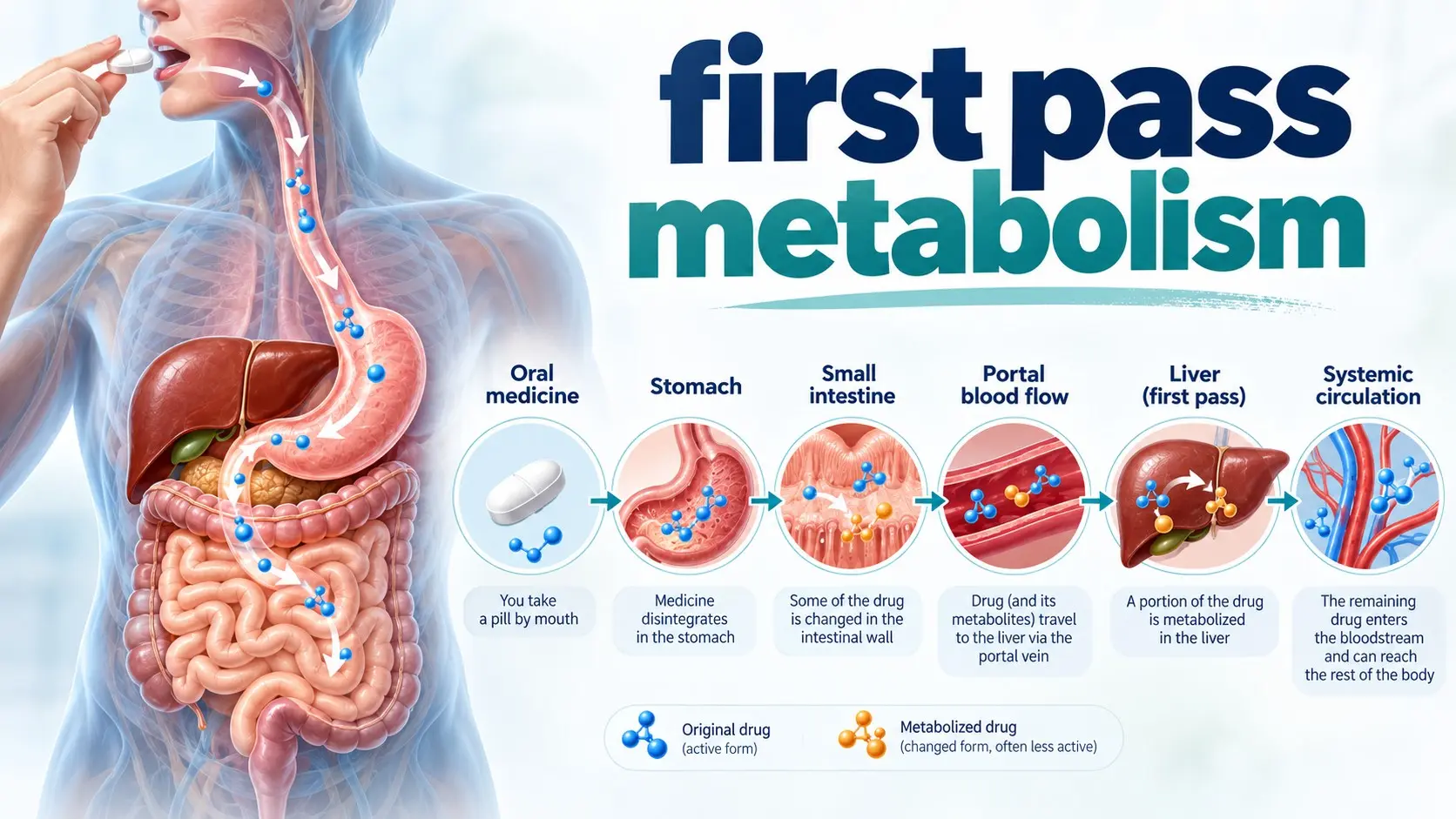
First pass metabolism happens when a medicine is changed before much of it reaches the general bloodstream. For many oral drugs, this happens in the intestinal wall and liver after absorption. The process can reduce drug bioavailability, create metabolites, change drug effects, and help explain why the same medicine may use different doses or routes.
The key point is simple.
Swallowing a tablet does not mean that the whole dose enters your bloodstream unchanged.
Some of the drug may never be absorbed. Some may be changed by enzymes in the gut. Some may reach the liver and be changed there before the remaining drug enters the rest of the body.
That journey is why first pass metabolism matters.
Medical Notice: This content is for general educational purposes and does not replace professional medical advice, diagnosis, or treatment. Consult an appropriately qualified healthcare professional for personal medical concerns. This article explains published guidance and does not provide a personal clinical assessment. Always consult qualified medical professionals for diagnosis and treatment of any health condition.
This article explains pharmacology. It does not tell you to change a medicine dose, crush a tablet, change the route, stop a medicine, or replace one formulation with another. Those changes can alter drug exposure and may be dangerous. Ask a doctor or pharmacist who knows the medicine and your medical history.
Table of Contents
- Quick Answer
- What first pass metabolism means
- The path an oral medicine takes
- 9 Essential Facts
- The liver is not the only site
- Absorption is not bioavailability
- Different drugs lose different amounts
- Metabolism does not always destroy a drug
- The route changes the pathway
- Food can change drug exposure
- Medicines can interact with enzymes
- People do not metabolize every drug the same way
- First pass metabolism affects medicine design and dosing
- Routes Compared
- Oral
- Intravenous
- Sublingual and buccal
- Transdermal
- Real Drug Examples
- Medicine Safety
- Frequently Asked Questions
What is first pass metabolism?
First pass metabolism, also called the first pass effect or presystemic metabolism, describes what can happen to a drug before it reaches the general bloodstream.
This is most often discussed with medicines that are swallowed.
After an oral drug is absorbed from the intestine, blood from the digestive tract travels through the portal circulation toward the liver.
Drug molecules can be changed along the way.
Some metabolism takes place in the intestinal wall. More metabolism may happen in the liver. The amount of unchanged medicine left after this process can affect how much reaches the systemic circulation.
This is one reason the dose printed on a tablet is not the same thing as the amount of unchanged medicine that reaches the bloodstream.
What path does an oral medicine take?
A simple version looks like this:
- You swallow the medicine.
- The tablet or capsule releases the drug.
- The drug reaches the stomach and small intestine.
- Some of the drug is absorbed through the intestinal wall.
- Some drug may be metabolized in the gut wall.
- Blood carries the absorbed drug through the portal vein toward the liver.
- Liver enzymes may change more of the drug.
- The remaining drug and any metabolites enter the general circulation.
This pathway helps explain why oral medicines can behave differently from the same active drug given by another route.
Fact 1: First pass metabolism is not only a liver process
The liver is the best known site of drug metabolism, but it is not the whole story.
The intestinal wall also contains drug metabolizing enzymes. For some medicines, intestinal metabolism can make a large contribution before the medicine ever reaches the liver.
This is why it is more accurate to think about the gut and liver together.
Other tissues can also metabolize drugs, but the intestinal wall and liver are the main sites discussed for most swallowed medicines.
This corrects a common oversimplification that says every oral drug first goes to the liver and only then begins to change.
Fact 2: Absorption and bioavailability are not the same thing
This distinction is one of the most useful parts of basic pharmacology.
Oral drug absorption describes the movement of a drug from the digestive tract into the body.
Drug bioavailability describes how much of the administered dose reaches the systemic circulation in an available form.
A drug can therefore be absorbed well but still have low oral bioavailability because much of it is metabolized before reaching the general bloodstream.
| Term | Simple Meaning | Why It Matters |
|---|---|---|
| Absorption | Drug moves from the administration site into the body | A drug must usually be absorbed before it can reach systemic blood |
| Bioavailability | Amount of the dose that reaches systemic circulation | Helps explain drug exposure after different formulations or routes |
| First pass metabolism | Metabolism before the drug reaches general circulation | Can lower the amount of unchanged drug reaching the bloodstream |
Fact 3: Different medicines have very different first pass effects
There is no fixed percentage that applies to every tablet.
Some drugs lose little during the first pass. Others undergo extensive metabolism.
The difference depends on several things, including:
- The drug's chemical properties
- How well it is absorbed
- Which enzymes metabolize it
- How active those enzymes are
- How much blood reaches the liver
- Other medicines and supplements
- Food interactions
- Liver health
- Age
- Genetic differences
This helps explain why two oral medicines cannot be compared just by looking at the number of milligrams on the label.
A 40 mg tablet of one drug has no simple dose relationship to a 40 mg tablet of another drug.
Fact 4: Metabolism does not always mean the drug becomes inactive
The word metabolism can sound like destruction.
That is too simple.
Drug enzymes can produce several types of metabolites.
- Inactive metabolites have little or no intended drug activity.
- Active metabolites can still produce a drug effect.
- Some metabolites may contribute to side effects or toxicity.
Some medicines are also designed as prodrugs. A prodrug starts in a less active or inactive form and must be changed in the body before the active compound is produced.
So metabolism can lower drug action, change it, or sometimes help create it.
Fact 5: The route of administration changes first pass exposure
The route of administration matters because different routes enter the circulation in different ways.
| Route | Typical First Pass Exposure | Simple Explanation |
|---|---|---|
| Oral | Often important | Absorbed drug commonly passes through gut metabolism and portal blood before systemic circulation |
| Intravenous | Bypasses first pass metabolism before entry into systemic blood | The medicine is placed directly into the bloodstream |
| Sublingual | Largely bypasses initial hepatic portal passage | Drug absorbed under the tongue enters veins that drain toward systemic circulation |
| Buccal | Largely bypasses initial hepatic portal passage | Drug is absorbed through the lining of the cheek |
| Transdermal | Avoids the gut and initial hepatic first pass pathway | Drug moves through the skin into systemic blood |
This does not mean one route is automatically better.
Each route has its own benefits, limits, safety concerns, absorption pattern, and approved uses.
Never move a medicine under your tongue, crush it, open it, inject it, or place it on the skin because you want to “bypass the liver.”
The product has been designed for a specific route.
Fact 6: Food can change how much medicine reaches the blood
Food can affect medicine absorption and metabolism in several ways.
One well known example is grapefruit.
Grapefruit can block CYP3A4, an important member of the cytochrome P450 enzyme family, in the small intestine.
For some medicines, this means less intestinal metabolism takes place and more drug reaches the bloodstream.
That can increase side effects.
But grapefruit does not affect every medicine the same way. The FDA also notes that grapefruit can reduce the absorption of some drugs by affecting transport proteins.
This is why broad advice such as “never eat grapefruit with medicine” is not correct.
Check the medicine label and ask your pharmacist whether your specific medicine interacts with grapefruit or other foods.
Fact 7: One medicine can change the metabolism of another
Drug enzymes can be blocked or made more active by other medicines, supplements, or foods.
If an enzyme is inhibited, less metabolism may take place. Drug levels may rise for some medicines.
If an enzyme is induced, metabolism may become faster. Drug exposure may fall for some medicines.
These drug interactions can matter when a drug depends strongly on one metabolic pathway.
This is why pharmacists and prescribers need a full list of what you take.
Include:
- Prescription medicines
- Over the counter medicines
- Vitamins
- Herbal products
- Sports supplements
- Weight loss products
- CBD or cannabis products where used
“Natural” does not mean “cannot interact with medicine.”
Fact 8: Two people may process the same oral drug differently
First pass metabolism is not identical in every person.
Differences can come from:
- Genetics
- Age
- Liver function
- Blood flow to the liver
- Gut enzyme activity
- Other medicines
- Supplements
- Smoking
- Food interactions
- Some diseases
These differences help explain why clinicians sometimes need to adjust treatment based on the person rather than using one dose for every patient.
It does not mean you should adjust your own dose.
Fact 9: First pass metabolism helps shape drug design and dosing
Drug developers need to know how much medicine is absorbed and how much survives intestinal metabolism and hepatic metabolism.
This can affect:
- The dose placed in a tablet
- How often a medicine is taken
- Which route is used
- Whether a special formulation is needed
- How food instructions are written
- Which interactions need warnings
- Whether blood levels need monitoring
This is one reason bioavailability studies are part of modern drug development.
What is bioavailability in simple terms?
Bioavailability tells us how much of a drug dose reaches the systemic circulation.
For intravenous administration, the drug enters systemic blood directly.
Oral bioavailability can be lower because of incomplete absorption and metabolism before systemic circulation.
A simple example makes this easier.
Imagine 100 units of a drug are swallowed.
Some may fail to cross the gut wall. Some may be metabolized in the gut. More may be metabolized in the liver.
The amount that finally reaches systemic blood unchanged may therefore be much less than 100 units.
This is only an illustration.
Real percentages are specific to each drug and formulation.
Real example 1: Propranolol
Propranolol is a useful example because its official prescribing information describes strong first pass metabolism.
The drug is well absorbed after oral administration, yet much of it is metabolized before it reaches systemic circulation.
DailyMed reports that, on average, about 25% reaches systemic circulation after an oral dose.
This is a clear example of why “well absorbed” and “high bioavailability” do not mean the same thing.
Do not use this number to calculate your own dose. Propranolol dosing depends on the condition, formulation, other medicines, health status, and prescriber instructions.
Real example 2: Morphine
Morphine is another medicine with significant first pass metabolism after oral administration.
Current NCBI pharmacology material notes that oral morphine has lower bioavailability because a large amount is metabolized before reaching systemic circulation.
Morphine also forms metabolites that have their own pharmacological effects.
This is one more reason oral and injected doses of the same active drug cannot be treated as simple one to one replacements.
Only a qualified clinician should convert between opioid doses or routes.
Does first pass metabolism always reduce drug effectiveness?
No.
It can lower the concentration of the original drug, but that is only part of the story.
A metabolite can be:
- Inactive
- Still active
- More active in a different way
- Associated with adverse effects
Clinical effect depends on the parent drug, its metabolites, the target tissue, the dose, and the person's ability to process the medicine.
Is first pass metabolism the same as liver metabolism?
No.
First pass metabolism happens before a drug first reaches general circulation.
Drug metabolism continues after that.
The liver can keep metabolizing drug molecules each time blood carries them through the organ.
So first pass metabolism is one part of the larger drug metabolism process.
Is first pass metabolism the same as detoxification?
No.
This word causes a lot of confusion online.
Drug metabolism is a set of enzyme driven chemical reactions. It can help the body process and later remove medicines and other compounds.
That does not mean the liver needs a juice cleanse, detox tea, supplement, or fast to perform first pass metabolism.
Some supplements sold as detox products can interact with medicines or injure the liver.
For evidence based liver guidance, read the NextFitLife Fatty Liver Disease Treatment Guide.
What role does CYP3A4 play?
CYP3A4 is one of the enzymes that helps metabolize many medicines.
It is found in both the intestine and liver.
Its intestinal location matters because metabolism can start as a medicine crosses the gut wall.
Some foods and medicines can inhibit this enzyme. Others can increase enzyme activity.
The result depends on the specific drug.
Do not assume an interaction that raises one medicine level will have the same effect on another medicine.
Does liver disease change first pass metabolism?
It can.
The liver plays a major role in the metabolism of many medicines, so liver disease can alter drug processing in some people.
The effect depends on the drug, type of liver disease, severity of disease, liver blood flow, and other factors.
This is why people with significant liver disease should not change medicine doses based on general online advice.
If you have diagnosed liver disease, bring a complete medicine and supplement list to your medical visits.
You can also read the NextFitLife Fatty Liver Disease Guide for broader liver health information.
Does age affect first pass metabolism?
Age can affect pharmacokinetics, including liver blood flow and drug metabolism.
Older adults may therefore process some medicines differently from younger adults.
This effect is not the same for every drug.
Age is also only one factor. Kidney function, liver function, body composition, other medicines, and illness matter too.
This is one reason medicine review becomes more important when a person takes several drugs.
What about genetics?
People can have genetic differences in drug metabolizing enzymes.
These differences can make some people process a medicine faster or slower.
For selected medicines, pharmacogenetic testing can help guide treatment.
That does not mean everyone needs genetic testing before taking medicine.
The usefulness depends on the drug and the clinical situation.
Can you bypass first pass metabolism on purpose?
Medicine developers and clinicians sometimes use routes that reduce or avoid initial hepatic first pass metabolism.
Examples include intravenous, sublingual, buccal, and transdermal delivery for suitable medicines.
But this is a drug design and prescribing decision.
Do not try to bypass first pass metabolism yourself.
A tablet designed to be swallowed may be unsafe or ineffective if used another way.
Why can crushing a tablet be dangerous?
Some tablets have special coatings or release systems.
Crushing them can release the medicine too quickly, damage the intended delivery system, irritate tissue, or change how much drug is absorbed.
Extended release and delayed release products deserve special care.
If swallowing a tablet is difficult, ask a pharmacist whether that exact product can be split, crushed, opened, or replaced with another formulation.
Why do food instructions differ between medicines?
Food can change medicine exposure in several ways.
It can change:
- How fast the stomach empties
- How well a drug dissolves
- How much is absorbed
- Intestinal enzyme activity
- Transport proteins
- Drug concentration in the blood
Some medicines should be taken with food.
Others work best on an empty stomach.
Some have special warnings about grapefruit or another food.
Follow the instructions for the exact medicine rather than applying one food rule to every tablet.
First pass metabolism versus normal elimination
| Process | When It Happens | Main Idea |
|---|---|---|
| Absorption | Before entry into systemic blood | Drug crosses from the administration site into the body |
| First pass metabolism | Before the first major entry into systemic circulation | Gut and liver enzymes may change part of the drug |
| Systemic metabolism | After drug reaches systemic circulation | Drug continues to be metabolized over time |
| Excretion | During drug elimination | Drug or metabolites leave the body, often through urine or bile |
Five first pass metabolism myths to drop
Myth 1: Every oral medicine is mostly destroyed by the liver
False.
The extent of first pass metabolism varies greatly between medicines.
Myth 2: First pass metabolism happens only in the liver
False.
The intestinal wall can make an important contribution.
Myth 3: A drug that is well absorbed must have high bioavailability
False.
A medicine can cross the intestinal wall well and still lose a large amount during first pass metabolism.
Myth 4: Bypassing first pass metabolism always makes a medicine better
False.
Different routes produce different absorption speeds and drug levels. A route must be chosen for the medicine and the patient.
Myth 5: You can improve first pass metabolism with a liver detox
False.
There is no proven juice, cleanse, or tea that safely “optimizes” drug first pass metabolism.
What should patients actually do with this information?
You do not need to calculate your own pharmacokinetics.
The useful lessons are practical.
- Take medicine by the route written on the label.
- Do not change the dose without professional advice.
- Do not crush or open a product unless a pharmacist says it is safe.
- Tell clinicians about supplements and over the counter products.
- Check whether your medicine has food or grapefruit instructions.
- Ask before changing between tablets, liquids, patches, injections, or other formulations.
- Tell your healthcare team about liver disease and other major health conditions.
The pharmacology is complex.
Your safety steps do not need to be.
Questions to ask your pharmacist
A pharmacist can help translate first pass metabolism into advice for your actual medicine.
Useful questions include:
- Should I take this medicine with food?
- Does grapefruit interact with this medicine?
- Can I split or crush this tablet?
- Does this supplement interact with my medicine?
- Can I change from a tablet to another formulation?
- Does liver disease affect this drug?
- Could another medicine change its blood level?
Conclusion
First pass metabolism is the processing that can happen before an administered drug reaches the general bloodstream, especially after an oral dose. The gut wall and liver can both take part, and the effect can change bioavailability, metabolites, drug interactions, route choice, and dosing.
The most useful next step is simple: take each medicine exactly by its approved route and directions, and ask a pharmacist before changing the dose, formulation, food timing, or way you take it.
Related NextFitLife Guides and Hubs
- General Wellness and Lifestyle Hub for broader health, medicine safety, preventive care, and healthy lifestyle guidance.
- Weight Management and Metabolism Hub for metabolism, medicines, weight management, and metabolic health.
- Weight Loss and Metabolism Guide for a broader explanation of human metabolism and energy use.
- Fatty Liver Disease Treatment Guide for liver health, medicines, supplements, and medical monitoring.
- NextFitLife Health, Fitness, Nutrition and Wellness Guides for the latest evidence informed health content.
References and Sources
- National Library of Medicine, StatPearls. First Pass Effect.
https://www.ncbi.nlm.nih.gov/books/NBK551679/
- National Library of Medicine, StatPearls. Pharmacokinetics.
https://www.ncbi.nlm.nih.gov/books/NBK557744/
- Merck Manual Professional Edition. Drug Bioavailability.
https://www.merckmanuals.com/professional/clinical-pharmacology/pharmacokinetics/drug-bioavailability
- U.S. Food and Drug Administration. Grapefruit Juice and Some Drugs Don't Mix.
https://www.fda.gov/consumers/consumer-updates/grapefruit-juice-and-some-drugs-dont-mix
- DailyMed, National Library of Medicine. Propranolol Hydrochloride Tablets.
https://dailymed.nlm.nih.gov/dailymed/drugInfo.cfm?setid=d027f39e-7648-44c8-a8dc-b26b4cdd81be
About the Author
Adel Galal is the founder and lead writer at NextFitLife. He researches practical health, fitness, nutrition, metabolism, medicine safety, and healthy aging topics using recognized government, medical, and scientific sources.
His goal is to turn complex topics such as pharmacokinetics and drug metabolism into clear explanations that readers can understand without turning educational information into personal medical instructions.
Adel is not a doctor, pharmacist, clinical pharmacologist, nurse, or other licensed healthcare professional.
Learn more about Adel Galal, NextFitLife, and the site's editorial approach on the About Us page.
Medical Disclaimer: This content is for general educational purposes and does not replace professional medical advice, diagnosis, or treatment. Consult an appropriately qualified healthcare professional for personal medical concerns. This article explains published guidance and does not provide a personal clinical assessment. Always consult qualified medical professionals for diagnosis and treatment of any health condition.
Frequently Asked Questions
What is first pass metabolism in simple terms?
First pass metabolism is the processing of a drug before it reaches the general bloodstream. For many oral medicines, the intestinal wall and liver can change part of the dose before systemic circulation.
Where does first pass metabolism happen?
The liver is a major site, but the intestinal wall can also play an important role. Other metabolically active tissues may contribute for some drugs.
Does every oral drug undergo first pass metabolism?
Not to the same degree. Some medicines undergo extensive first pass metabolism, while the effect is small for others.
What is the difference between absorption and bioavailability?
Absorption is the movement of a drug into the body. Bioavailability describes how much of the dose reaches systemic circulation. A drug can be well absorbed but still have low oral bioavailability because of first pass metabolism.
Does first pass metabolism always make a drug inactive?
No. Metabolism can create inactive metabolites, active metabolites, or compounds that contribute to unwanted effects.
Does intravenous medicine undergo first pass metabolism?
An intravenous dose enters systemic circulation directly, so it does not go through the initial gut and liver first pass pathway before reaching systemic blood.
Do sublingual medicines bypass first pass metabolism?
Medicines absorbed under the tongue largely bypass the initial hepatic portal route because blood from that tissue drains toward systemic circulation.
Does a skin patch bypass first pass metabolism?
Transdermal medicines enter through the skin and avoid the gastrointestinal and initial hepatic first pass pathway. This does not mean every drug can be safely delivered through the skin.
Can grapefruit affect first pass metabolism?
Yes, for some medicines. Grapefruit can inhibit intestinal CYP3A4 and allow more of certain drugs to reach the bloodstream. It can affect other drugs differently through transport proteins.
Can liver disease affect first pass metabolism?
Yes. Liver disease can change the metabolism of some medicines, but the effect depends on the drug, disease severity, liver blood flow, and other factors.
Can first pass metabolism cause drug interactions?
Yes. Medicines, foods, and supplements can inhibit or increase drug metabolizing enzymes and change how much medicine reaches the bloodstream.
Can I avoid first pass metabolism by crushing a pill?
No. Crushing a tablet does not safely bypass first pass metabolism and can be dangerous with some formulations. Ask a pharmacist before crushing, splitting, opening, or changing any medicine.
Why is first pass metabolism important for dosing?
It affects how much drug reaches systemic circulation, so drug developers and clinicians consider it when choosing doses, formulations, routes, and medicine instructions.
Is first pass metabolism a liver detox process?
No. It is a pharmacology term for drug processing before systemic circulation. Detox drinks and cleanses have not been shown to improve first pass metabolism.

Health & wellness writer with 30+ years of experience in nutrition, fitness, and healthy aging. Founder of NextFitLife.com — evidence-based health guidance.