Published on: Sep 5, 2022
Last updated: October 4, 2026
Next review: October 2027, or sooner if major nutrition or weight management guidance changes.
Written and source checked by: Adel Galal, Founder and Lead Writer at NextFitLife
Medical review status: This article has not been medically reviewed by a doctor, registered dietitian, obesity medicine specialist, endocrinologist, pharmacist, or eating disorder professional.
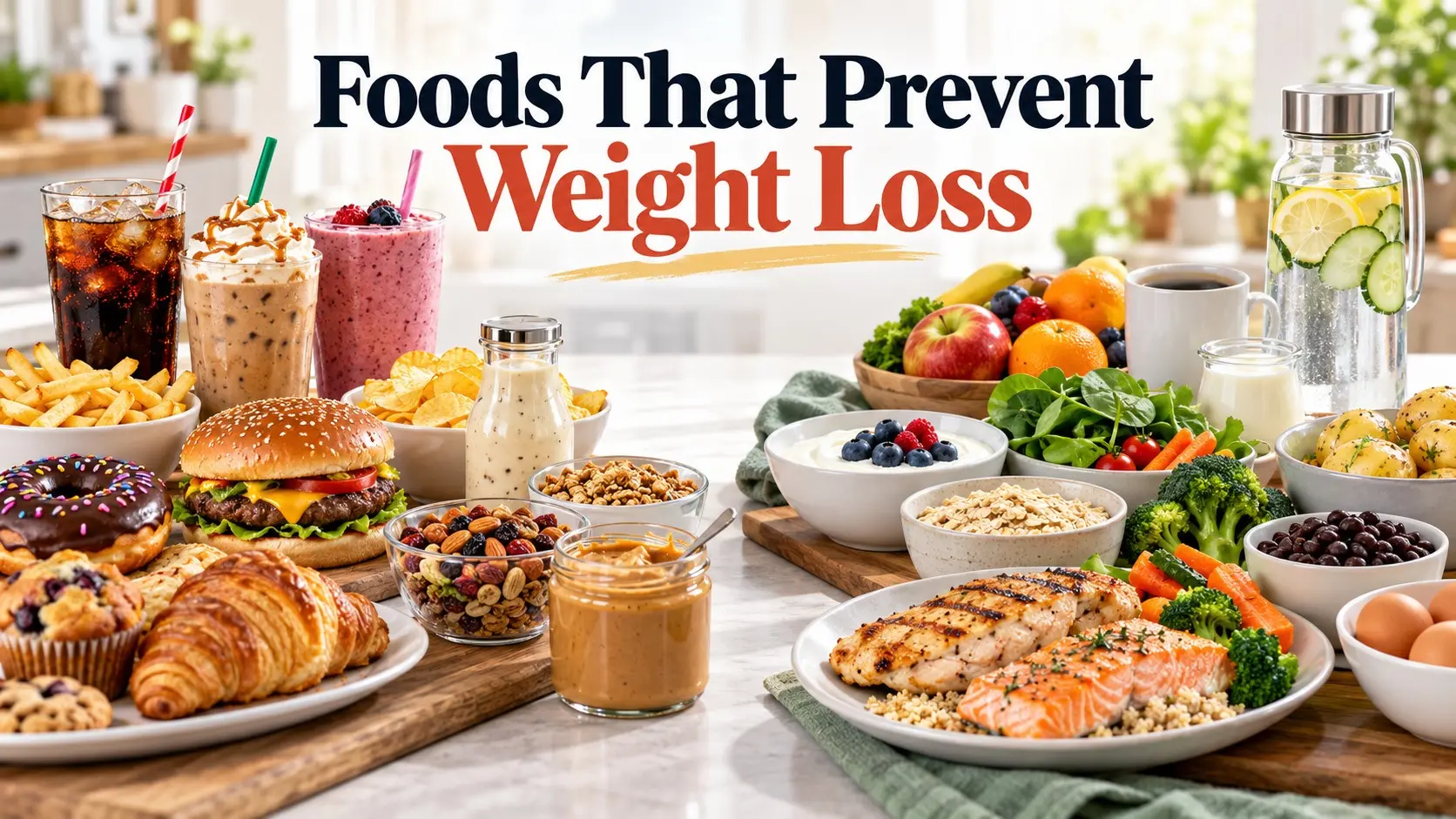
Foods that prevent weight loss do not stop fat loss by magic. The real traps are usually large portions, drinks that add energy quickly, rich extras, and foods that are easy to eat past fullness. Small changes can make a calorie deficit easier without banning bread, fruit, pasta, nuts, or dessert.
That difference matters.
I do not like weight loss lists that label normal foods as good or bad. A cookie does not shut down your metabolism. Rice does not switch off fat loss, and eating an avocado does not ruin a diet.
The full pattern matters much more.
Some foods give a lot of energy in a small amount. Some drinks go down fast without making you feel very full. Others look like a light snack but contain several rich ingredients at once.
Once you can spot those patterns, weight management becomes much less mysterious.
Medical and Nutrition Notice: This content is for general educational purposes and does not replace professional medical advice, diagnosis, or treatment. Consult an appropriately qualified healthcare professional for personal medical concerns. This article explains published guidance and does not provide a personal clinical assessment. Always consult qualified medical professionals for diagnosis and treatment of any health condition.
Weight loss is not safe or needed for every person. Do not begin a restrictive weight loss plan without professional guidance if you are pregnant, breastfeeding, under 18, underweight, recovering from serious illness, or living with an eating disorder.
Ask a doctor or registered dietitian for personal advice if you have diabetes, kidney disease, liver disease, heart disease, a digestive condition, or take medicine that affects weight, appetite, or blood sugar.
Table of Contents
- Quick Answer
- What foods that prevent weight loss really means
- Why calories and fullness both matter
- 18 Sneaky Food Traps
- Sugary drinks
- Sweet coffee
- Fruit juice
- Oversized smoothies
- Alcohol
- Pastries and large baked goods
- Fried foods
- Ultra processed meals and snacks
- Chips and crackers
- Granola and trail mix
- Nuts, oils, avocado, and nut butter
- Sauces and dressings
- Sweetened yogurt
- Protein and energy bars
- Dried fruit
- Large restaurant meals
- Healthy calorie stacking
- Large portions of any food
- Better Swaps
- Drinks
- Snacks
- Restaurant meals
- Breakfast
- What You Do Not Need to Ban
- Labels and Portions
- Weight Loss Plateaus
- When to Get Professional Help
- Frequently Asked Questions
What do foods that prevent weight loss really mean?
The phrase sounds stronger than the science.
No normal food prevents weight loss by itself. Body fat tends to decrease when the body uses more energy than it receives over time. This is often called a calorie deficit.
That does not mean every person should count calories.
It means the amount of food and drink matters along with food quality, hunger, activity, sleep, medicine, health, and many other factors.
A food becomes a practical weight loss trap when it makes it easy to take in more energy than you realize or leaves you hungry enough to keep eating.
For the bigger picture, visit the NextFitLife Weight Loss and Metabolism Hub.
Calories matter, but so does how easy a food is to eat
Two meals can have the same calories on paper yet feel very different.
A meal with protein, vegetables, beans, fruit, whole grains, or another source of fiber may feel more satisfying than a small amount of highly concentrated snack food.
This is where energy density becomes useful.
Energy dense foods give a lot of calories in a small amount. That does not make them unhealthy. Nuts, seeds, olive oil, avocado, and cheese are all nutrient rich foods, yet their portions still matter when weight loss is the goal.
The issue is not fear.
It is awareness.
1. Sugary drinks can add energy without feeling like food
Soda, sweet tea, fruit drinks, energy drinks, sports drinks, and sweetened waters can supply liquid calories quickly.
CDC says regular intake of sugar sweetened drinks is linked with weight gain and other health problems. These drinks are also a major source of added sugar.
The problem is easy to see. You can drink a large sweet beverage with lunch and still eat the same lunch.
Better swap
- Water
- Sparkling water without added sugar
- Plain tea
- Coffee with less sugar
- Water with lemon, berries, cucumber, or mint
You do not need to quit every sweet drink today. Replacing one regular drink is a useful start.
2. Sweet coffee can turn into dessert in a cup
Plain coffee contains very little energy.
The extras change the story.
Syrup, sugar, cream, chocolate, caramel, sweet foam, and whipped cream can turn a coffee into a large snack or dessert.
A large cup also gives those extras more room.
Better swap
Choose a smaller size, ask for less syrup, skip whipped cream, or use plain milk. You can still have coffee that tastes good without making every cup a full dessert.
3. A large glass of fruit juice is easy to drink fast
Fruit juice can contain vitamins and minerals. It can fit a healthy eating plan.
Still, whole fruit gives you more chewing and more intact fiber. A large juice is easy to drink in minutes.
This makes whole fruit a better everyday choice for many people who want more food volume.
Better swap
Eat the orange and drink water instead of drinking a large glass of orange juice. If you enjoy juice, use a smaller glass with a meal.
4. Smoothies can grow far beyond a normal meal
A smoothie is not bad for weight loss.
The problem starts when every healthy ingredient in the kitchen goes into the same blender.
Fruit, juice, oats, honey, nut butter, seeds, yogurt, protein powder, coconut, and granola can all be useful foods. Put them all together and the drink may be much larger than you planned.
Build a simpler smoothie
- Use milk or a suitable fortified alternative
- Add one or two fruit portions
- Add plain yogurt or tofu when you want protein
- Add oats when you need a larger meal
- Choose one rich extra such as seeds or nut butter
You do not need every healthy ingredient in one cup.
5. Alcohol brings calories and can change the rest of the evening
Alcohol supplies energy. Cocktails can also contain juice, syrup, cream, soda, or other sweet mixers.
The effect does not stop at the drink.
Alcohol can affect sleep, judgment, appetite, and food choices for some people.
A simpler approach
- Have alcohol free days
- Use a smaller serving
- Drink water between alcoholic drinks
- Choose less sweet mixers
- Choose an alcohol free drink when that suits you
Pregnancy, medicine use, liver disease, driving, and several other situations can mean alcohol should be avoided completely.
6. Pastries and large baked goods can look smaller than they are
A muffin looks like one item.
That does not mean it is a small snack.
Large pastries, muffins, cakes, doughnuts, and sweet breads can combine refined flour, sugar, oil, butter, icing, chocolate, or cream in a small space.
They can fit your diet. They just may not keep you full for very long when eaten alone.
Better swap
Choose a smaller portion or share a large item. Pair it with fruit, eggs, plain yogurt, or another food that makes breakfast or a snack more complete.
7. Fried foods add oil quickly
Oil contains a lot of energy in a small amount.
Deep frying lets food absorb some of that oil. Batter, sauces, cheese, and large portions can add more.
This is why fries, fried chicken, wings, fried snacks, and doughnuts can make a calorie deficit harder when they become frequent large meals.
Better cooking methods
- Bake
- Grill
- Roast
- Steam
- Air cook with a measured amount of oil
- Pan cook with a small amount of oil
You do not have to ban fried food. Frequency and portion still matter.
8. Ultra processed foods can make overeating easier
This deserves its own section.
Ultra processed foods are not one single nutrition group, and processing alone does not tell you whether a food is healthy.
Still, some highly processed meals and snacks are soft, fast to eat, very tasty, and easy to keep eating.
A controlled NIH study gave 20 adults an ultra processed diet and a minimally processed diet in separate two week periods. The meals were designed to be similar in several nutrients.
Participants ate about 500 more calories per day during the ultra processed diet and gained weight during that phase.
This was a small short study, so it does not prove that every processed food causes weight gain.
It does show why the way a food is made and eaten can matter.
What to do
Build more meals around foods such as vegetables, fruit, beans, eggs, fish, plain dairy or alternatives, oats, potatoes, rice, and other foods that make a complete meal.
You can still use convenient packaged foods.
9. Chips and crackers are very easy to eat from a large bag
Chips and crackers are a classic portion problem.
One handful becomes another, especially when the bag stays open beside you.
Words such as baked, vegetable, natural, multigrain, or gluten free do not tell you how many calories are in the portion.
Better habit
Put the amount you want into a bowl, then close the package.
If you need a more filling snack, add fruit, plain yogurt, hummus, or another source of protein or fiber.
10. Granola and trail mix pack a lot into a small bowl
Granola can contain oats, nuts, seeds, oil, dried fruit, and sweeteners.
Trail mix may add chocolate or candy too.
None of these ingredients is automatically bad, but they are concentrated.
A cereal bowl full of granola can be very different from using a small amount as a topping.
Better swap
Use granola on plain yogurt or oats. Put trail mix into a small container rather than carrying the full bag.
11. Nuts, nut butter, avocado, seeds, and oil are healthy but concentrated
This is where many “foods to avoid” articles go wrong.
Nuts, seeds, avocado, and olive oil provide useful fats and nutrients.
I would not remove them.
I would watch the amount.
A free pour of oil can become much larger than a spoon. A large handful of nuts can become several label servings. A thick layer of nut butter can add much more than expected.
Better habit
Measure oil for a short time if you are not sure how much you use. Use a small handful of nuts, a sensible spoon of nut butter, or part of an avocado.
This is portion control, not a ban on healthy fats.
12. Dressings and sauces can be the richest part of the meal
A salad can be light or very rich.
Cheese, creamy dressing, oil, mayonnaise, croutons, nuts, bacon, avocado, and sweet sauces can all sit on the same bowl.
The vegetables are not the problem.
The extras simply add up.
Better swap
Ask for dressing on the side, use a measured amount, or try yogurt with herbs, mustard, salsa, lemon, or vinegar when those options fit the meal.
13. Sweetened yogurt can hide a dessert sized sugar load
Yogurt can provide protein, calcium, and other nutrients.
Some flavored yogurts also contain a lot of added sugar.
Drinkable yogurt, flavored milk, frozen yogurt, and dairy desserts can be even easier to consume quickly.
Better swap
Compare labels. Plain yogurt with fruit is a simple choice, but you do not have to eat yogurt plain if you dislike it. A lower sugar flavored yogurt can still fit.
14. Protein bars are not automatically weight loss food
The word protein has a strong health halo.
A bar can be useful during travel, work, or a busy day. Some bars also contain a lot of added sugar, fat, or calories.
A product does not become ideal for weight management just because it has 20 grams of protein written on the wrapper.
Read the full label
- Serving size
- Calories
- Protein
- Fiber
- Added sugar
- Saturated fat
For useful protein choices, visit the NextFitLife High Protein Foods for Weight Loss Guide.
15. Dried fruit is much smaller than the fruit it came from
Dried fruit still contains fiber and useful nutrients.
Most of the water is gone, so the portion becomes small and easy to eat quickly.
A small pile of raisins came from many grapes.
That does not make raisins bad.
Better habit
Use a small amount in oats, yogurt, or salad. Choose fresh fruit when you want more volume for the same eating occasion.
16. Restaurant and takeout portions can be much larger than expected
Eating out does not stop weight loss.
The challenge is that restaurant portions may be large and recipes can use more oil, butter, cheese, cream, sauce, or sugar than you would use at home.
NIDDK advises portion awareness when eating away from home and suggests options such as sharing large meals or taking part of the meal home.
Simple restaurant habits
- Read the menu before you arrive
- Choose vegetables as a side when you like them
- Ask for sauce on the side
- Share a very large dish
- Save part for another meal
- Choose grilled, baked, or roasted foods more often
One restaurant meal does not ruin progress.
17. Healthy calorie stacking is easy to miss
This is one of the most useful traps to understand.
Imagine oatmeal with milk, banana, nuts, chia seeds, peanut butter, honey, granola, and dried fruit.
Every ingredient can fit a healthy diet.
But the meal contains several calorie dense foods at the same time.
The same thing happens with salads. Chicken, avocado, olive oil, nuts, cheese, dressing, seeds, croutons, and dried fruit can all land on one plate.
This is not a bad meal.
It may simply be much larger than you think.
Use the one or two rich extras rule
Keep the base of the meal, then choose one or two rich extras rather than every extra at once.
This keeps foods you enjoy while making the meal easier to judge.
18. Large portions of any food can slow progress
This final trap is the one that ties the whole list together.
Large portions of rice, pasta, bread, cereal, meat, cheese, nuts, oil, desserts, smoothies, or even very nutritious foods can make a calorie deficit harder.
NIDDK points out that how much you eat matters along with what you eat.
A portion is what you choose to eat. A serving size is the amount shown on a food label. They are not always the same.
The answer is not to make every plate tiny.
The answer is to understand your normal portions.
18 traps at a glance with better swaps
| No. | Common Trap | Simple Change | Why It Helps |
|---|---|---|---|
| 1 | Large soda | Water or smaller soda | Cuts easy liquid calories |
| 2 | Sweet coffee | Smaller coffee with milk and less syrup | Keeps flavor with fewer extras |
| 3 | Large juice | Whole fruit and water | Adds chewing and fiber |
| 4 | Huge smoothie | Fruit, milk, protein food, one rich extra | Keeps the drink simpler |
| 5 | Frequent alcohol | Alcohol free days | Reduces drink calories |
| 6 | Large pastry | Smaller serving with fruit or yogurt | Improves portion and fullness |
| 7 | Fried meal | Grilled or baked meal | May reduce added oil |
| 8 | Ultra processed snack meal | Simple meal with protein, produce, and a staple | May make eating easier to control |
| 9 | Chips from the bag | Put a serving in a bowl | Makes the amount visible |
| 10 | Granola bowl | Yogurt or oats with granola on top | Keeps crunch with more volume |
| 11 | Free poured oil | Measure it for a while | Shows your usual amount |
| 12 | Heavy dressing | Dressing on the side | Gives you control of the amount |
| 13 | Very sweet yogurt | Plain or lower sugar yogurt with fruit | Reduces added sugar when useful |
| 14 | Large energy bar | Fruit with yogurt or egg | Uses simple filling foods |
| 15 | Large dried fruit portion | Fresh fruit more often | Adds more water and volume |
| 16 | Huge restaurant meal | Save part for later | Turns one large meal into two |
| 17 | Too many healthy extras | Choose one or two rich toppings | Stops calorie stacking |
| 18 | Oversized portions | Review your normal serving | Matches intake more closely to your needs |
Foods you do not need to cut out
A useful weight loss plan should leave room for normal life.
Carbohydrates
Fruit, beans, oats, potatoes, rice, bread, pasta, milk, and yogurt all contain carbohydrate.
They are not the same food.
You do not have to remove carbohydrates to lose weight.
Fruit
Whole fruit provides water, fiber, vitamins, minerals, and plant compounds.
A whole apple is not the same eating experience as a large sweet fruit drink.
Potatoes
Plain boiled, baked, or roasted potatoes can fit.
The meal changes when the potato becomes a very large serving of fries with cheese and creamy sauce.
Bread and pasta
Bread and pasta can fit healthy eating for weight loss.
Pair them with vegetables and a useful protein food such as eggs, chicken, fish, beans, lentils, tofu, or yogurt.
Healthy fats
Olive oil, nuts, seeds, avocado, and fish can provide useful fats.
You do not need a fat free diet.
Portions simply deserve attention because fat is energy dense.
Dessert
Dessert can fit too.
Enjoy a portion, then move on with your day. You do not need to punish yourself, skip the next meal, or do extra exercise to “make up” for it.
How to read a food label without getting lost
A food label is information, not a grade.
Start with the serving size.
The FDA notes that serving size is based on how much people typically eat. It is not a recommendation for how much *you* should eat.
Check servings per container
A bag or bottle may contain more than one serving. If you eat the whole package, the total calories and nutrients change too.
Look at added sugar
This is especially useful for drinks, cereal, yogurt, snack bars, sauces, and desserts.
Look at protein and fiber
Protein and fiber rich foods can help make meals more satisfying.
Do not judge a product from one number alone.
Compare similar products
A nutrition label is most helpful when you compare two foods you would actually choose between.
You do not need to spend twenty minutes studying every package.
What should a more filling meal look like?
There is no perfect weight loss plate.
A simple meal can start with:
- A suitable protein food
- Vegetables or fruit
- Beans, potatoes, rice, oats, bread, or another useful carbohydrate food
- A suitable amount of fat
- Water or another suitable drink
This is flexible enough for many cultures and budgets.
For complete examples, use the NextFitLife Simple Meal Plan for Weight Loss.
Simple breakfast ideas that avoid the common traps
Option 1
Eggs with vegetables, whole grain toast, and fruit.
Option 2
Plain Greek yogurt with oats, berries, and a small amount of nuts.
Option 3
Oatmeal made with milk, fruit, and cinnamon.
Option 4
Beans with tomatoes and bread.
Find more options in the NextFitLife Healthy Breakfast Ideas Guide.
What if you eat healthy foods and still cannot lose weight?
Start by dropping the word healthy for a moment.
Look at the real week.
Portions may have grown. Drinks, oil, sauces, bites while cooking, or weekend meals may be larger than you remember.
Your activity may also have changed.
Then there are factors outside food.
Sleep, stress, medicine, hormones, health conditions, age, body size, and previous weight loss can all affect your energy needs and appetite.
This does not mean your metabolism is broken.
A weight loss plateau does not mean one food stopped working
Plateaus are common.
A smaller body usually needs less energy than a larger body. Hunger and daily movement can change during weight loss too.
The scale can also pause because of water, salt, hormones, constipation, food in the digestive system, or hard exercise.
Do not respond to three flat scale readings by cutting half your food.
Review these first
- Your weight trend over several weeks
- Drinks
- Oil and sauces
- Portion sizes
- Snacks and bites
- Activity
- Sleep
- Medicine changes
For a deeper review, see the NextFitLife Weight Loss Plateau Guide.
Do ultra processed foods have to be banned?
No.
The NIH study on ultra processed foods is useful, but it does not tell us that one cookie or one frozen meal prevents weight loss.
It tells us that a diet built heavily around foods that are easy to eat can change how much people eat without trying.
The current Dietary Guidelines for Americans, 2025 to 2030 also place more focus on whole nutrient rich foods while advising people to reduce highly processed choices, added sugars, and refined carbohydrates.
I would use that as a direction, not a purity rule.
Seven mistakes that make food changes harder
1. Banning every food on this list
Strict rules can turn normal meals into a test.
You can use portions and frequency without banning every favorite food.
2. Eating far too little
Tiny meals can leave you exhausted and hungry.
A weight loss plan still needs enough nutrition.
3. Calling all carbohydrates the problem
Beans and soda are both sources of carbohydrate. They do not have the same nutrition or effect on a meal.
4. Ignoring drinks
Sweet coffee, soda, juice, alcohol, and large smoothies are easy to forget because they do not look like a plate of food.
5. Trusting the front of the package
Natural, organic, high protein, plant based, gluten free, and multigrain do not tell you the full nutrition value.
6. Using detox products
Detox tea, laxatives, vinegar drinks, or fat burners do not create safe fat loss.
Some can cause harm.
7. Blaming yourself when weight loss is difficult
Weight management is not a character test.
Genes, medicine, medical conditions, income, sleep, stress, food access, work, disability, and the environment all matter.
A simple seven day reset without banning food
| Day | Focus | One Simple Action |
|---|---|---|
| 1 | Drinks | Replace one sugary drink with water |
| 2 | Portions | Put snacks in a bowl instead of eating from the bag |
| 3 | Protein | Add a protein food to one meal |
| 4 | Fiber | Add vegetables, fruit, beans, oats, or whole grains |
| 5 | Labels | Compare two similar foods you normally buy |
| 6 | Eating out | Save part of a large meal for later |
| 7 | Review | Keep the easiest useful change next week |
One repeatable habit beats seven rules you hate.
When should you get professional weight loss help?
Weight management can overlap with medicine, hormone problems, diabetes, nutrition deficiencies, and mental health.
Speak with a doctor or registered dietitian if you:
- Have diabetes, kidney disease, liver disease, or heart disease
- Take medicine that affects weight or appetite
- Are pregnant or breastfeeding
- Are under 18
- Are underweight
- Are losing weight without trying
- Feel weak, dizzy, or faint
- Have missed menstrual periods
- Have ongoing vomiting or diarrhea
- Have severe digestive symptoms
- Have had bariatric surgery
- Use prescription weight management medicine
Also seek support if tracking food or weight leads to strong fear, guilt, binge eating, purging, fasting, compulsive exercise, or constant thoughts about food.
Conclusion
Foods that prevent weight loss are better understood as foods and portions that can make an energy deficit harder to maintain. Sugary drinks, rich coffee, large smoothies, fried foods, snack foods, sauces, restaurant meals, and oversized portions can all play a part, but none needs to become a forbidden food.
Start with one useful change today. Measure the oil you normally pour, swap one sweet drink, put snacks into a bowl, or remove one rich extra from a meal. Keep the change that feels easy enough to repeat.
Related NextFitLife Guides and Hubs
- Weight Loss and Metabolism Hub for food, portions, metabolism, plateaus, safe progress, and weight management treatment.
- High Protein Foods for Weight Loss for animal and plant protein choices that can help build filling meals.
- Healthy Snacks for Weight Loss for practical snack ideas with protein, fruit, vegetables, and fiber.
- Simple Meal Plan for Weight Loss for a structured seven day meal example.
- Healthy Breakfast Ideas for simple morning meals.
- Weight Loss Plateau Guide for what to check when progress appears to stop.
References and Sources
- National Institute of Diabetes and Digestive and Kidney Diseases. Food Portions: Choosing Just Enough for You.
https://www.niddk.nih.gov/health-information/weight-management/just-enough-food-portions
- Centers for Disease Control and Prevention. Sugar Sweetened Beverage Consumption.
https://www.cdc.gov/nutrition/php/data-research/sugar-sweetened-beverages.html
- National Institutes of Health. Study Finds Heavily Processed Foods Cause Overeating and Weight Gain.
https://www.nih.gov/news-events/news-releases/nih-study-finds-heavily-processed-foods-cause-overeating-weight-gain
- U.S. Food and Drug Administration. How to Understand and Use the Nutrition Facts Label.
https://www.fda.gov/food/nutrition-facts-label/how-understand-and-use-nutrition-facts-label
- U.S. Department of Agriculture and U.S. Department of Health and Human Services. Dietary Guidelines for Americans, 2025 to 2030.
https://odphp.health.gov/our-work/nutrition-physical-activity/dietary-guidelines/current-dietary-guidelines
About the Author
Adel Galal is the founder and lead writer at NextFitLife. He researches practical health, fitness, nutrition, weight management, and healthy aging topics using recognized medical, government, public health, and scientific sources.
His goal is to turn complex health information into simple steps readers can understand without using fear, miracle claims, or strict food rules.
Adel is not a doctor, registered dietitian, endocrinologist, obesity medicine specialist, pharmacist, eating disorder professional, or other licensed healthcare professional.
Learn more about Adel Galal, NextFitLife, and the site's editorial approach on the About Us page.
Medical Disclaimer: This content is for general educational purposes and does not replace professional medical advice, diagnosis, or treatment. Consult an appropriately qualified healthcare professional for personal medical concerns. This article explains published guidance and does not provide a personal clinical assessment. Always consult qualified medical professionals for diagnosis and treatment of any health condition.
Frequently Asked Questions
What are foods that prevent weight loss?
No food blocks fat loss by itself. The phrase usually refers to foods or drinks that make a calorie deficit harder because they are easy to overeat, very energy dense, or consumed in large portions.
What food should I stop eating to lose weight?
You usually do not need to ban one food. Start by reviewing drinks, portions, sauces, snacks, restaurant meals, and rich extras. Choose changes you can keep doing.
Can healthy food prevent weight loss?
Nutritious foods such as nuts, avocado, olive oil, seeds, granola, and nut butter contain useful nutrients but are energy dense. Large portions can still make weight loss harder.
Do carbohydrates prevent weight loss?
No. Fruit, beans, oats, potatoes, rice, bread, and pasta can all fit. The type, portion, and full eating pattern matter more than the word carbohydrate.
Do sugary drinks stop weight loss?
They do not switch off fat loss, but they can add calories without much fullness. Frequent sugary drinks can make an energy deficit harder to maintain.
Are smoothies bad for weight loss?
No. A simple smoothie can fit. Problems start when large amounts of fruit, juice, honey, nut butter, seeds, oats, protein powder, and other extras all go into one drink.
Are nuts bad for weight loss?
No. Nuts provide protein, fiber, healthy fats, vitamins, and minerals. The portion matters because nuts provide a lot of energy in a small amount.
Do ultra processed foods make you gain weight?
An NIH controlled trial found that adults ate more calories and gained weight during an ultra processed diet compared with a minimally processed diet. This does not mean every processed food causes weight gain.
Why am I not losing weight even though I eat healthy?
Portions, drinks, oils, sauces, snacks, activity, sleep, medicine, hormones, health conditions, body size, and changes in energy needs can all affect progress.
Can I eat restaurant food and still lose weight?
Yes. Restaurant food can fit. Large portions and rich sauces may need attention, so sharing a meal, saving part for later, or asking for sauce on the side can help.
How do I know if my portion is too large?
Compare what you normally eat with the label serving and with your hunger, fullness, and overall progress. A label serving is information, not a personal prescription.
What is healthy calorie stacking?
Healthy calorie stacking happens when several energy dense foods such as oil, nuts, seeds, avocado, nut butter, cheese, granola, or dried fruit are added to one meal. Each food can be nutritious, but the combined meal can become much larger than expected.
What should I do if my weight loss has stopped?
Review your weight trend over several weeks, then check portions, drinks, oils, sauces, snacks, movement, sleep, and medicine changes. Avoid drastic cuts based on a few scale readings.
When should I seek professional weight loss help?
Seek qualified advice if you have a medical condition, take medicine that affects weight, are pregnant, are under 18, lose weight without trying, or develop harmful restriction, binge eating, purging, or strong food anxiety.

Health & wellness writer with 30+ years of experience in nutrition, fitness, and healthy aging. Founder of NextFitLife.com — evidence-based health guidance.