
Published on: Original publication date is not visible on the current public WordPress page
Last updated: September 13, 2026
Next review: September 2027, or sooner if major calcium or bone health guidance changes
Written and source-checked by: Adel Galal, Founder and Lead Writer at NextFitLife
Medical review status: This article has not been medically reviewed by a doctor, registered dietitian, endocrinologist, nephrologist, or other licensed healthcare professional.
Some green vegetables contain a surprising amount of calcium.
But there is one detail that matters just as much as the number on a nutrition table.
Your body does not absorb calcium from every vegetable equally.
That changes how we should rank Green Vegetables High in Calcium.
Spinach is the best example.
It contains plenty of calcium on paper.
But spinach also contains a lot of oxalates.
Oxalate binds calcium inside the digestive tract.
NIH estimates that only about 5 percent of the calcium in spinach is absorbed.
Low-oxalate greens such as kale, broccoli, and bok choy can provide much more usable calcium.
So the best calcium vegetable is not always the vegetable with the biggest calcium number.
Important health note: This content is for general educational purposes and does not replace professional medical advice, diagnosis, or treatment. Consult an appropriately qualified healthcare professional for personal medical concerns. This article explains published guidance and does not provide a personal clinical assessment. Always consult qualified medical professionals for diagnosis and treatment of any health condition.
Speak with a qualified healthcare professional or registered dietitian if you have osteoporosis, osteopenia, kidney disease, recurrent kidney stones, high blood calcium, parathyroid disease, digestive disease, a history of fractures, or take medicines that affect calcium, vitamin D, or bone health.
What Are the Best Green Vegetables High in Calcium?
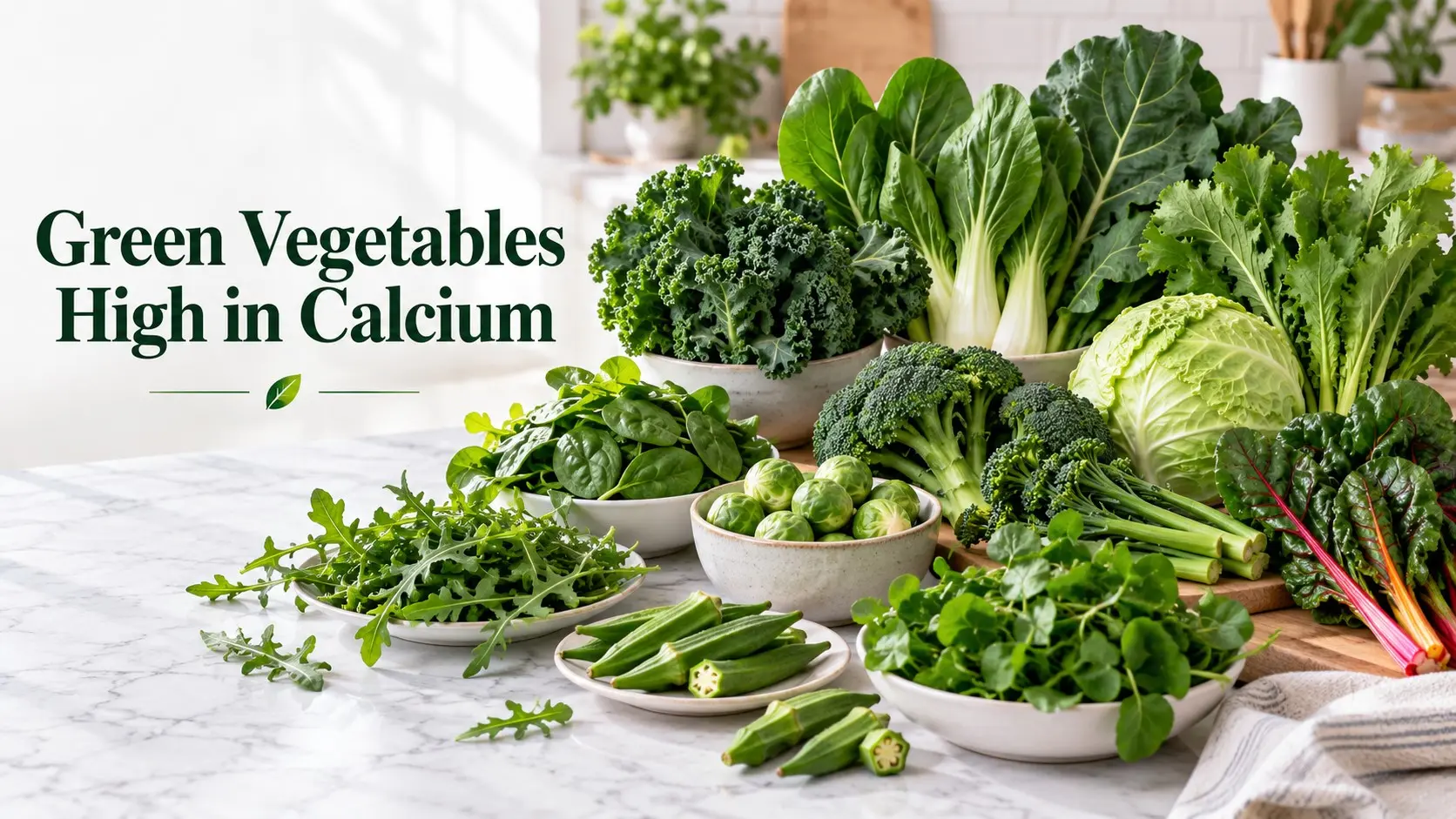
Quick answer: Some of the most useful Green Vegetables High in Calcium include turnip greens, kale, Chinese mustard greens, bok choy, mustard greens, collard greens, broccoli, broccoli rabe, Chinese broccoli, cabbage, watercress, and arugula.
Spinach and Swiss chard also contain substantial calcium.
However, their high oxalate content greatly reduces how much calcium your body absorbs.
For that reason, kale and bok choy can be better practical calcium sources even when spinach shows a larger calcium number on a food database.
Calcium Content Is Not the Same as Calcium Absorption
This is the most important fact in this article.
Calcium bioavailability means how much calcium your body can actually absorb and use.
NIH reports that calcium absorption from spinach is only about 5 percent.
Research on low oxalate vegetables such as kale, bok choy, and broccoli has found much higher absorption.
Some studies estimate absorption from these vegetables at roughly 40 to 60 percent.
That can be as good as or better than the percentage absorbed from milk.
But there is another detail.
Milk usually contains more calcium in a normal serving.
So you need to consider both:
- How much calcium the food contains
- How much of that calcium is absorbed
This is why I would not call spinach the calcium champion.
18 Green Vegetables That Contribute Calcium
Calcium values vary with variety, serving weight, growing conditions, and cooking method.
The values below are approximate examples based on food composition databases and published reviews.
Use them for comparison rather than treating every number as exact.
| Vegetable | Example Calcium Amount | Absorption Note | Practical Rating |
|---|---|---|---|
| 1. Chinese mustard greens | About 212 mg per 85 g serving in absorption research | About 40 percent absorption reported | Excellent |
| 2. Turnip greens | About 99 mg per 1/2 cup boiled | Useful leafy green source | Excellent |
| 3. Kale | About 94 mg per cooked cup in the current NIH table | Low oxalate with high fractional absorption | Excellent |
| 4. Bok choy | About 74 mg per raw shredded cup | Research suggests absorption above 50 percent | Excellent |
| 5. Mustard greens | About 165 mg per cooked cup in USDA-based food tables | Useful Brassica green | Excellent |
| 6. Collard greens | About 268 mg per cooked cup in USDA-based food tables | High total calcium, but oxalate can reduce absorption | Very good |
| 7. Broccoli | About 21 mg per raw 1/2 cup | Low oxalate and very efficient absorption | Very good |
| 8. Broccoli rabe | About 100 mg per cooked cup | A useful cruciferous green | Very good |
| 9. Chinese broccoli | About 80 to 90 mg per cooked cup depending on variety | Another useful Brassica vegetable | Very good |
| 10. Okra | About 80 mg per cooked cup | Contributes calcium plus fibre | Good |
| 11. Green cabbage | About 70 mg per cooked cup | Low-oxalate Brassica family vegetable | Good |
| 12. Brussels sprouts | About 55 mg per cooked cup | Useful calcium contributor | Good |
| 13. Green beans | About 50 to 55 mg per cooked cup | Modest calcium source | Helpful |
| 14. Watercress | About 40 mg per raw cup | Easy to add to salads and sandwiches | Helpful |
| 15. Arugula | About 30 mg per raw cup | Small amount per cup but easy to eat often | Helpful |
| 16. Spinach | High total calcium when cooked | Only about 5 percent is absorbed because of oxalate | Poor choice if calcium is the main goal |
| 17. Swiss chard | About 100 mg per cooked cup | High oxalate reduces usable calcium | Limited for calcium |
| 18. Beet greens | Can contain substantial calcium | Oxalate can greatly reduce absorption | Limited for calcium |
1. Chinese Mustard Greens
Chinese mustard greens deserve more attention.
Published calcium absorption research reported about 212 mg of calcium in an 85 gram serving.
Estimated absorption was about 40 percent.
That makes them one of the more impressive plant calcium choices in controlled absorption studies.
Try them:
- Steamed
- Added to soup
- Cooked with garlic
- Mixed into noodles or rice
2. Turnip Greens
Turnip greens are one of the simplest ways to add more plant calcium.
NIH lists about 99 mg of calcium in one half cup of boiled turnip greens.
That means a normal serving can contribute meaningfully to your daily calcium intake.
Do not throw away the leafy tops when buying turnips.
Cook them like other greens.
3. Kale
Kale is one of my preferred choices when calcium is the goal.
Not because it always has the highest total number.
Its advantage is calcium absorption.
Kale contains much less oxalate than spinach.
Research has reported fractional calcium absorption around 49 to 53 percent from kale.
This makes a smaller calcium amount more useful than it first appears.
Use kale in:
- Soups
- Egg dishes
- Bean meals
- Salads
- Rice bowls
4. Bok Choy
Bok choy may be one of the best examples of why bioavailability matters.
NIH lists about 74 mg of calcium in one cup of raw shredded bok choy.
Research has estimated calcium absorption from bok choy at more than 50 percent.
That is excellent for a vegetable.
Both the leaves and stems are edible.
Try bok choy with tofu, chicken, noodles, rice, or fish.
5. Mustard Greens
Mustard greens have a peppery flavour.
Cooking makes them milder.
They can provide a substantial amount of calcium in a cooked serving.
They also provide vitamin K, folate, carotenoids, and other nutrients.
Use them in soups, beans, eggs, and grain bowls.
6. Collard Greens
Collard greens are high in total calcium.
A cooked cup is often listed at about 268 mg in USDA-based food tables.
Calcium content and calcium absorption are different.
That amount does not mean a cup of collards automatically provides more usable calcium than milk.
NIH lists collard greens among vegetables that contain significant oxalic acid.
That can reduce calcium absorption.
Collards are still nutritious.
Just do not judge them only by the raw calcium number.
7. Broccoli
Broccoli contains less calcium per serving than many dark leafy greens.
Its advantage is absorption.
Low oxalate levels allow much of its calcium to remain available.
One calcium absorption study estimated more than 60 percent fractional absorption from broccoli.
Broccoli also provides vitamin C, vitamin K, folate, fibre, and other nutrients.
8. Broccoli Rabe
Broccoli rabe has a stronger, slightly bitter taste.
It can contribute around 100 mg of calcium in a cooked cup.
Try it with:
- Garlic
- Beans
- Whole grain pasta
- Eggs
- Chicken
Its bitterness becomes milder after cooking.
9. Chinese Broccoli
Chinese broccoli is also called gai lan.
It has thick stems and broad dark green leaves.
It provides calcium along with vitamin C, vitamin K, folate, and other plant nutrients.
Steam it or cook it quickly with garlic and ginger.
10. Okra
Okra is not a leafy green.
But it is a useful green vegetable that contributes calcium.
It also provides fibre.
Try it roasted if you do not like the softer texture of stewed okra.
11. Green Cabbage
Cabbage is inexpensive and versatile.
It belongs to the Brassica family along with kale, broccoli, and bok choy.
That makes it another useful lower-oxalate vegetable.
Eat it:
- Raw in slaw
- Cooked in soup
- Stirred into rice
- Roasted
- Added to bean dishes
12. Brussels Sprouts
Brussels sprouts provide a modest amount of calcium.
They also provide fibre, vitamin C, vitamin K, and folate.
Roasting often makes them sweeter and easier to enjoy.
Use a small amount of olive oil and season them well.
13. Green Beans
Green beans are not one of the highest-calcium vegetables.
They still contribute.
They are easy to include frequently.
This is important because nutrition is built across the whole day.
Several moderate sources can add up.
14. Watercress
Watercress has a peppery flavour.
It is easy to eat raw.
Add it to:
- Salads
- Sandwiches
- Eggs
- Soup
- Potato dishes
Its calcium contribution is modest per cup, but it adds variety.
15. Arugula
Arugula provides a smaller amount of calcium than kale or turnip greens.
That does not make it useless.
A cup can be added to sandwiches, pizza, eggs, grain bowls, and salads with almost no preparation.
Food frequency matters too.
16. Spinach Has a Calcium Problem
Spinach deserves its own section because it is often misunderstood.
Yes, spinach contains calcium.
No, it is not one of the best vegetables for getting usable calcium.
Oxalates bind much of the calcium.
NIH estimates spinach calcium absorption at only about 5 percent.
In one published comparison, an 85 gram spinach serving contained about 115 mg of calcium.
Only about 5.9 mg was estimated to be absorbed.
The same analysis estimated that an 85-gram serving of kale provided about 30 mg of absorbable calcium.
So spinach can show a higher calcium number and still deliver far less absorbed calcium.
Eat spinach because it provides many nutrients.
Just do not depend on it as your main calcium vegetable.
17. Swiss Chard Has the Same Oxalate Issue
Swiss chard contains calcium.
It also contains substantial oxalate.
That reduces calcium bioavailability.
Chard is still a nutritious vegetable.
Use it for variety rather than making it your main plant calcium source.
18. Beet Greens Also Contain Oxalate
Beet greens can contain significant calcium.
But they also contain oxalate.
That means the calcium number can look better than the amount your body actually absorbs.
Enjoy beet greens for their full nutrient profile.
Choose low oxalate greens as your stronger calcium anchors.
Best Calcium Greens if Absorption Is Your Priority
If your main goal is getting more absorbable calcium from vegetables, I would prioritize:
- Kale
- Bok choy
- Chinese mustard greens
- Broccoli
- Mustard greens
- Turnip greens
- Cabbage
Then use other greens for variety.
How Much Calcium Do You Need?
Calcium needs change with age and life stage.
| Group | Recommended Calcium Intake |
|---|---|
| Adults age 19 to 50 | 1,000 mg per day |
| Men age 51 to 70 | 1,000 mg per day |
| Women age 51 to 70 | 1,200 mg per day |
| Adults older than 70 | 1,200 mg per day |
| Teens age 14 to 18 | 1,300 mg per day |
These are general United States recommendations from NIH.
Your personal needs can differ because of medical conditions, pregnancy, medicines, digestive disorders, or other factors.
Vegetables Should Not Be Your Only Calcium Strategy
This is especially important for people avoiding dairy.
You can eat a lot of green vegetables and still struggle to reach 1,000 mg of calcium.
A more realistic dairy-free calcium plan may combine greens with:
- Calcium-fortified soy milk
- Other fortified plant drinks
- Calcium-set tofu
- Beans
- Tahini
- Almonds
- Fortified foods
- Canned fish with soft edible bones if you eat fish
NIH lists fortified foods and calcium set tofu as important nondairy calcium sources.
For the broader picture, visit the NextFitLife Nutrition and Vitamins Hub.
Calcium Set Tofu Can Be a Major Calcium Source
Not every tofu contains the same amount of calcium.
Tofu made with a calcium salt can contain a substantial amount.
Tofu made with another coagulant may provide much less.
Check the Nutrition Facts label.
This is especially useful for vegan diets because tofu also provides protein.
Fortified Plant Milk Can Make Calcium Planning Easier
Some fortified soy, almond, oat, and other plant drinks contain calcium amounts similar to dairy milk.
But products vary.
Check the label for:
- Calcium
- Vitamin D
- Protein
- Vitamin B12
- Added sugar
Shake fortified plant drinks before pouring if the product instructions say to do so because minerals can settle.
Vitamin D Helps Your Body Absorb Calcium
Vitamin D plays an important role in calcium absorption.
Low vitamin D status can reduce calcium absorption.
Food sources of vitamin D are limited.
They include:
- Fatty fish
- Egg yolks
- Fortified milk
- Fortified plant drinks
- Some mushrooms exposed to ultraviolet light
A suspected vitamin D deficiency should be assessed rather than treated with increasingly large supplement doses without guidance.
The NextFitLife Bone and Joint Health Hub connects calcium, vitamin D, protein, vitamin K, and other bone health topics.
Vitamin K Matters, but Do Not Oversimplify It
Leafy greens are rich in vitamin K1.
Vitamin K supports normal blood clotting and activates proteins involved in bone metabolism.
But saying vitamin K simply “pushes calcium into bones instead of arteries” is too simplistic.
Bone health depends on many factors.
If you take warfarin, do not suddenly start eating huge amounts of leafy greens or suddenly stop eating them.
The key is usually consistent vitamin K intake.
Discuss major dietary changes with your anticoagulation care team.
For more detail, read Vitamin K2 Benefits.
Does Vitamin C Increase Calcium Absorption?
Vitamin C is not a primary strategy for increasing calcium absorption.
Vitamin C is well known for improving absorption of nonheme iron from plant foods.
It is not a primary strategy for dramatically increasing calcium absorption from leafy greens.
Tomatoes, peppers, citrus fruit, and berries are still excellent foods.
Just do not add them because you believe they unlock spinach calcium.
Does Olive Oil Increase Calcium Absorption?
Olive oil can help make vegetables taste better.
Fat also helps with absorption of fat-soluble vitamins and carotenoids.
But olive oil does not solve the calcium oxalate problem in spinach.
Use it for flavour and healthy unsaturated fat.
Do not treat it as a calcium absorption hack.
Can Cooking Improve Calcium Absorption?
Cooking changes vegetables in several ways.
Boiling can reduce oxalate in foods such as spinach because some oxalate moves into the cooking water.
Research has found a substantial reduction in spinach oxalate after boiling.
That does not turn spinach into a low-oxalate food.
Kale, bok choy, and broccoli remain easier calcium choices.
Cooking also reduces food volume.
That can make it easier to eat more greens in one serving.
Is Raw or Cooked Kale Better for Calcium?
Both can contribute.
The apparent calcium number changes because cooking changes water content and serving size.
One cup of cooked kale contains far more leaves than one loose cup of raw kale.
That does not mean cooking created calcium.
It concentrated the vegetables into a smaller volume.
Why Calcium Matters for More Than Bones
Most people think of bones first.
Calcium is also involved in:
- Muscle function
- Nerve signaling
- Blood vessel function
- Hormone secretion
Your body tightly controls calcium levels in the blood.
Bone acts as a major calcium reservoir.
That is one reason long-term calcium intake matters.
Calcium Alone Does Not Prevent Osteoporosis
This deserves a clear answer.
Osteoporosis is not caused by simply forgetting to eat kale.
Bone health is affected by:
- Age
- Genetics
- Sex hormones
- Calcium intake
- Vitamin D status
- Protein intake
- Physical activity
- Smoking
- Alcohol
- Medicines
- Medical conditions
Food can support bone health.
Food does not replace osteoporosis testing or treatment.
Exercise Belongs in a Bone Health Plan
Weight-bearing exercise and resistance training can support bone and muscle health.
Examples can include:
- Walking
- Stair climbing
- Resistance training
- Age-appropriate impact exercise
- Balance training
The safest exercise depends on your health and fracture risk.
Someone with advanced osteoporosis may need professional exercise guidance.
What About Spinach Smoothies?
You can eat spinach smoothies if you enjoy them.
But do not count the spinach as one of your strongest calcium sources.
A better calcium focused smoothie might use:
- Fortified soy milk
- Calcium containing yogurt if you use dairy
- Kale
- Fruit
This gives you a more reliable calcium base.
People With Kidney Stones Need Extra Context
Some kidney stones are made from calcium oxalate.
That does not mean people with stones should automatically avoid all dietary calcium.
In fact, dietary calcium can play an important role in binding oxalate in the digestive tract.
But high oxalate foods such as spinach, Swiss chard, and beet greens may need individual planning.
If you have recurrent kidney stones, use guidance from your clinician or renal dietitian.
People With Kidney Disease Need Individual Advice
Kidney disease can change recommendations for calcium, phosphorus, potassium, vitamin D, protein, and fluids.
A generic high calcium vegetable plan may not be appropriate.
Do not use calcium supplements or large dietary changes without your kidney care team's guidance.
Should You Take a Calcium Supplement?
Not automatically.
First ask how much calcium you already get from food and fortified foods.
Supplements can be useful when intake remains inadequate, or a healthcare professional recommends them.
But more calcium is not always better.
Supplement type, dose, medicines, kidney function, and total calcium intake all matter.
Food is a useful first place to look.
A Simple Calcium-Rich Plant-Based Day
| Meal | Example |
|---|---|
| Breakfast | Oats made with calcium-fortified soy milk plus berries and chia seeds |
| Lunch | Calcium-set tofu with bok choy, broccoli, rice, and sesame |
| Snack | Fortified plant yogurt or dairy yogurt with fruit |
| Dinner | Lentils with cooked kale or turnip greens and potatoes |
The exact calcium total depends on brands and portions.
Check fortified food labels.
Easy Ways to Eat More Calcium-Friendly Greens
Add Kale to Soup
Stir chopped kale into bean, lentil, chicken, or vegetable soup near the end of cooking.
Use Bok Choy With Rice
Cook bok choy with tofu, chicken, shrimp, or beans.
Cook Turnip Greens With Beans
This gives you calcium, fiber, and plant protein in one meal.
Add Broccoli to Pasta
Use broccoli with tomato sauce, beans, chicken, tofu, or fish.
Replace Some Lettuce With Watercress or Arugula
This adds more flavour and a little more calcium.
Use Mustard Greens in Egg Dishes
Cook the greens first, then add eggs.
Common Calcium Mistakes
Mistake 1: Ranking Greens Only by Total Calcium
Absorption matters.
Mistake 2: Calling Spinach the Best Calcium Green
Its oxalate content makes the calcium poorly absorbed.
Mistake 3: Saying Vegetables Always Beat Dairy
Some low oxalate vegetables have excellent fractional absorption.
But diary often provides more total calcium per normal serving.
Mistake 4: Depending Only on Leafy Greens
Fortified foods, calcium-set tofu, dairy foods, or other calcium sources may make daily needs easier to meet.
Mistake 5: Assuming Calcium Alone Builds Strong Bones
Vitamin D, protein, exercise, hormones, age, and medical conditions also matter.
Mistake 6: Taking Supplements Without Checking Total Intake
More is not automatically better.
Mistake 7: Ignoring Vitamin K Medicine Interactions
People taking warfarin should keep leafy green intake reasonably consistent.
Mistake 8: Using Personal Symptoms to Diagnose Calcium Deficiency
Muscle cramps, fatigue, weak nails, and other symptoms have many possible causes.
My Practical Approach to Plant Calcium
I would not ask you to eat a mountain of spinach.
I would build a varied plan.
Use kale.
Use bok choy.
Use broccoli.
Use turnip or mustard greens.
Add calcium-set tofu or a fortified plant drink if you avoid dairy.
Check your vitamin D plan.
Eat enough protein.
Stay active.
That is more realistic than chasing one calcium superfood.
Conclusion
Green Vegetables High in Calcium can contribute valuably to your daily calcium intake.
But calcium content alone does not tell the full story.
Kale, bok choy, broccoli, Chinese mustard greens, turnip greens, and other low oxalate vegetables can provide calcium that is absorbed efficiently.
Spinach, Swiss chard, and beet greens contain calcium too, but high oxalate levels greatly reduce how much you absorb.
For stronger long-term nutrition, combine vegetables with other calcium foods, enough vitamin D, adequate protein, and appropriate physical activity.
Your next step: Choose one low oxalate green from this article and add it to two meals this week. If you avoid dairy, also check the calcium amount on your plant milk or tofu label.
References and Sources
- National Institutes of Health Office of Dietary Supplements. Calcium Fact Sheet for Health Professionals.This is the main source for calcium requirements, food sources, absorption, spinach oxalate, vitamin D effects, and calcium supplement safety.
- National Institutes of Health Office of Dietary Supplements. Calcium Fact Sheet for Consumers.NIH lists kale, broccoli, and Chinese cabbage among nondairy calcium sources and provides practical information about daily calcium needs.
- United States Department of Agriculture. FoodData Central.USDA FoodData Central provides nutrient composition data for vegetables, fortified foods, tofu, dairy foods, and thousands of other foods.
- Interventions to Improve Calcium Intake Through Foods in Populations With Low Intake.This open access review compares the calcium content and estimated absorption of foods including kale, spinach, bok choy, broccoli, Chinese mustard greens, beans, milk, and yogurt.
- National Institutes of Health Office of Dietary Supplements. Vitamin D Fact Sheet for Health Professionals.Vitamin D plays a central role in calcium absorption and normal bone mineralization.
Continue Reading on NextFitLife
Use these related NextFitLife guides to build a more complete bone health and mineral nutrition plan:
- Bone and Joint Health HubExplore calcium, vitamin D, vitamin K, magnesium, protein, exercise, and broader bone and joint nutrition.
- Nutrition and Vitamins HubReview calcium, magnesium, vitamin D, vitamin K, iron, zinc, vitamin B12, deficiencies, food sources, and supplement safety.
- Vitamin K2 BenefitsLearn how vitamin K-dependent proteins relate to calcium metabolism, bone health, and medication safety.
- Vitamin K1 Rich FoodsCompare leafy greens and other foods rich in vitamin K1, with practical guidance for people taking warfarin.
- Top Healthy Foods GuideBuild a varied eating pattern with vegetables, fruit, legumes, whole grains, protein foods, nuts, seeds, and healthy fats.
Main bone health hub: Visit the NextFitLife Bone and Joint Health Hub for related guides on calcium, vitamin D, vitamin K, magnesium, protein, and healthy aging.
About the Author
Adel Galal is the Founder and Lead Writer at NextFitLife.
Adel has maintained a personal interest in health, fitness, nutrition, sleep, wellness, and healthy aging for more than 30 years.
His health and wellness writing experience spans more than 15 years.
For nutrition articles, he compares government nutrient guidance, food composition data, systematic reviews, and human research before turning the evidence into practical food choices.
For calcium content in particular, he separates the amount of calcium listed in a food from the amount the body can actually absorb. This distinction is especially important for high oxalate greens such as spinach and Swiss chard.
Adel is not a doctor, dermatologist, registered dietitian, endocrinologist, nephrologist, pharmacist, or other licensed healthcare professional.
This article provides general education only. It does not diagnose calcium deficiency, osteoporosis, vitamin D deficiency, kidney stones, or other medical conditions and does not prescribe supplements.
Learn more about Adel Galal, NextFitLife, and the site's editorial approach on the About Us page.
Frequently Asked Questions
Which green vegetables are highest in calcium?
Collard greens, turnip greens, mustard greens, Chinese mustard greens, kale, and bok choy can provide substantial calcium. However, total calcium content should be considered together with absorption.
Which green vegetable has the best calcium absorption?
Bok choy, kale, and broccoli have excellent calcium bioavailability because they are relatively low in oxalate. Research has reported calcium absorption around 50 percent or more from some of these vegetables.
Is spinach high in calcium?
Spinach contains substantial calcium, especially when cooked. However, its high oxalate content binds calcium and makes most of it unavailable for absorption.
How much calcium from spinach is absorbed?
NIH estimates calcium absorption from spinach at only about 5 percent.
Is kale a better calcium source than spinach?
For absorbable calcium, yes. Spinach may contain more total calcium in some serving comparisons, but kale contains much less oxalate and its calcium is absorbed far more efficiently.
Is bok choy high in calcium?
Bok choy provides calcium and has excellent calcium bioavailability. NIH lists about 74 mg in one cup of raw shredded bok choy.
Is broccoli a good calcium source?
Broccoli does not contain as much total calcium as many leafy greens, but its calcium is absorbed efficiently because broccoli is low in oxalate.
Are collard greens high in calcium?
Yes. Cooked collard greens can contain substantial calcium. However, NIH notes that collards also contain oxalic acid, so the total calcium number is not the same as the amount absorbed.
Are turnip greens high in calcium?
Yes. NIH lists about 99 mg of calcium in one half cup of boiled turnip greens.
Are mustard greens good for calcium?
Yes. Mustard greens can make a meaningful contribution to calcium intake and also provide vitamin K, folate, and other nutrients.
Is Swiss chard good for calcium?
Swiss chard contains calcium but also contains substantial oxalate. This reduces calcium absorption, so kale, bok choy, or broccoli are generally better choices when calcium is the main goal.
Do green vegetables provide enough calcium for vegans?
They can make an important contribution, but relying only on green vegetables can make it difficult to meet daily calcium needs. Calcium-set tofu and calcium-fortified plant drinks can make a vegan calcium plan much easier.
How much calcium do adults need?
Most adults age 19 to 50 need about 1,000 mg per day. Women age 51 to 70, and all adults older than 70 generally need about 1,200 mg per day, according to NIH.
How much calcium do teenagers need?
Teenagers age 14 to 18 need about 1,300 mg of calcium per day, according to NIH.
Does vitamin D help calcium absorption?
Yes. Vitamin D is important for intestinal calcium absorption and normal bone mineralization.
Does vitamin C improve calcium absorption?
Vitamin C is best known for improving absorption of nonheme iron. It is not a main strategy for overcoming the poor calcium absorption caused by oxalate in spinach.
Does olive oil help calcium absorption?
Olive oil provides healthy unsaturated fat and can improve flavour. It does not remove oxalate or make spinach calcium highly absorbable.
Does cooking spinach remove oxalate?
Boiling can reduce oxalate because some moves into the cooking water. Spinach still remains a relatively high oxalate food compared with kale, broccoli, or bok choy.
Is raw kale or cooked kale better for calcium?
Both provide calcium. A cooked cup usually contains more leaves than a raw cup, which changes the apparent nutrient amount. Cooking does not create extra calcium.
Can green vegetables prevent osteoporosis?
No single food can prevent or treat osteoporosis. Green vegetables can contribute calcium, vitamin K, magnesium, and other nutrients, but bone health also depends on vitamin D, protein, exercise, hormones, age, medications, genetics, and medical care.
Should I take calcium supplements if I eat vegetables?
Not automatically. First estimate calcium from your full diet, including vegetables, fortified foods, tofu, dairy if used, and other sources. Supplements may be useful when food intake remains inadequate or a healthcare professional recommends them.
Can people with kidney stones eat calcium rich greens?
It depends on the type of kidney stone and the rest of the diet. Spinach, Swiss chard, and beet greens are high in oxalate and may require individual planning. People with recurrent stones should seek professional advice.
Can people taking warfarin eat leafy greens?
Yes, but vitamin K intake should usually remain reasonably consistent. Sudden large changes in leafy green intake can affect warfarin control, so discuss major diet changes with your healthcare team.
What is the easiest way to eat more calcium-rich greens?
Add kale to soup, cook bok choy with rice and tofu, mix turnip greens into beans, add broccoli to pasta, or use mustard greens with eggs and potatoes.
What are good nondairy calcium foods besides vegetables?
Useful choices include calcium-fortified plant drinks, calcium-set tofu, fortified foods, beans, tahini, almonds, and canned fish with edible bones for people who eat fish.

Health & wellness writer with 30+ years of experience in nutrition, fitness, and healthy aging. Founder of NextFitLife.com — evidence-based health guidance.