Published on: September 29, 2026
Last updated: September 29, 2026
Written by: Adel Galal, Founder and Lead Writer at NextFitLife
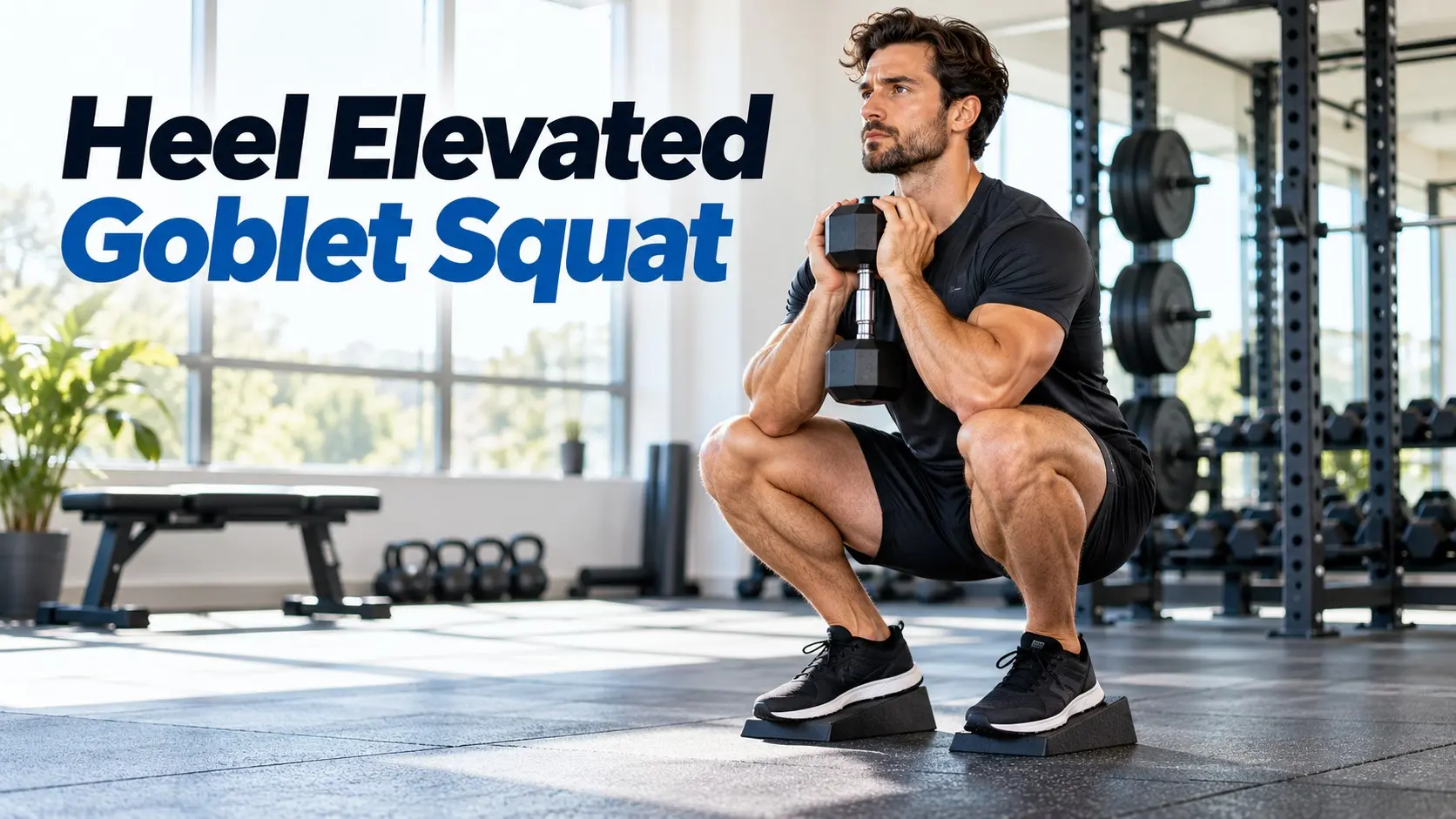
The Heel Elevated Goblet Squat is a simple way to change how a squat feels. Raise your heels on a firm wedge, hold one dumbbell or kettlebell at your chest, and your knees can move farther forward as you squat.
That usually makes the exercise feel more focused on the front of your thighs. It also helps many people reach a comfortable squat depth when ankle motion is limited.
There is one thing I want to clear up first. Raising your heels is useful, but it is not magic. Research shows that heel elevation changes squat mechanics, yet the effect on muscle activity is more mixed than many fitness videos suggest.
Quick Answer
The Heel Elevated Goblet Squat is a squat where your heels rest on a firm wedge while you hold a weight at your chest. The setup allows more forward knee movement, reduces how much extra ankle bend you need, and creates a more knee focused squat that strongly trains the quadriceps.
Important fitness and health note: This content is for general educational purposes and does not replace professional medical advice, diagnosis, or treatment. Consult an appropriately qualified healthcare professional for personal medical concerns. This article explains published guidance and does not provide a personal clinical assessment. Always consult qualified medical professionals for diagnosis and treatment of any health condition.
Exercise should not cause sharp pain, sudden swelling, numbness, severe weakness, or a feeling that a joint is giving way. Stop and seek qualified advice if those symptoms occur.
Table of Contents
- What Is a Heel Elevated Goblet Squat?
- What changes when you raise your heels?
- Muscles Worked
- 9 Smart Benefits
- How to Do It Correctly
- How High Should Your Heels Be?
- Common Form Mistakes
- Heel Elevated vs Regular Goblet Squat
- Sets, Reps, and Workout Placement
- Are Knees Past the Toes a Problem?
- Who Should Modify the Exercise?
- Frequently Asked Questions
- References and Sources
What Is a Heel Elevated Goblet Squat?
A Heel Elevated Goblet Squat is a goblet squat performed with your heels resting on a firm raised surface. Your toes and the front of your feet remain supported while you hold a dumbbell or kettlebell close to your chest.
The heel lift changes the starting angle at your ankle. This allows your shins and knees to move farther forward without demanding the same ankle position you would need on a flat floor.
The result is usually a more quad focused squat.
Your quadriceps do much of the work needed to straighten your knees, while your glutes and inner thigh muscles help you stand. Your core and upper back also work to control the weight at your chest.
If you are building a lower body routine with dumbbells, you can also see our Leg Exercises With Dumbbells guide for more squat, hinge, lunge, and step variations.
If you need the complete setup before focusing on depth, start with our complete Goblet Squat form guide. It covers the full movement, weight position, foot pressure, knee tracking, common mistakes, and progression.
What changes when you raise your heels?
This is where the exercise becomes interesting.
During a normal squat, your ankle must allow your shin to move forward while your foot stays planted. This movement is called ankle dorsiflexion.
If the ankle reaches its comfortable limit early, your body still has to find another way down. You might lean farther forward, stop at a higher depth, change your stance, or allow the heel to lift.
A firm heel lift changes that starting position.
This can let the knee travel farther forward while you remain balanced. The knee bends more and the quadriceps must work to straighten it as you rise.
What does current research say?
A 2026 systematic review and meta analysis examined 14 squat studies with 177 participants. The researchers found that heel elevation changed ankle and knee range of motion. Changes around the hip and trunk were less clear.
This matters because you will sometimes hear that heel elevation always makes the torso much more upright. It can help, but that response is not identical in every person.
A large biomechanical review also explains why forward knee travel matters. Moving the shin farther forward increases the external knee flexion moment. Your knee extensors, mainly the quadriceps, must produce force to control and reverse that movement.
So the useful effect comes from mechanics, not from a special muscle activation trick.
What Muscles Does the Heel Elevated Goblet Squat Work?
| Muscle Area | Main Role | What It Does |
|---|---|---|
| Quadriceps | Primary | Control knee bending and straighten the knee as you stand. |
| Gluteus maximus | Secondary | Helps extend the hip as you rise. |
| Adductors | Secondary | Help control and extend the hip during the squat. |
| Core | Stabilizer | Keeps your trunk controlled while the weight sits in front of you. |
| Upper back | Stabilizer | Helps keep the weight close to the chest. |
| Calf muscles | Support | Help control the ankle and maintain a stable foot position. |
Does raising the heels always increase quad activation?
No. This is one place where simple fitness advice can become too confident.
A 2022 study tested barbell squats with heel lifts of 0, 1.5, and 3 centimeters. Some muscle activity changed as heel height changed, including greater vastus lateralis activity at the 3 centimeter height in the male participants.
However, a 2019 study did not find a significant increase in knee extensor activation when people performed heel raised barbell squats instead of flat foot squats.
A 2026 study of trained men also found that both flat heel and heel elevated squats produced greater quadriceps activity than a forefoot elevated condition. Heel elevation did not simply beat the flat position across every measure.
That is why I prefer a more accurate message: heel elevation changes your joint positions and can increase knee extensor demand, but it does not guarantee that every person will show higher quad EMG just because a wedge is placed under the heels.
What Most Guides Miss
Most studies in this area use barbell back squats or front squats. They do not test the exact Heel Elevated Goblet Squat used in this article.
The biomechanics are useful, but we should not pretend a barbell study and a goblet squat study are the same thing. Direct research on the exact goblet variation is still limited.
9 Smart Benefits of the Heel Elevated Goblet Squat
1. It makes forward knee travel easier
Raising your heels allows the shin to move farther forward. Your knees can then move forward while your feet remain supported.
This makes the exercise useful when you want a more knee focused squat rather than a squat that asks you to push the hips far back.
2. It needs less extra ankle motion
A limited ankle can make a flat squat feel blocked.
The heel lift changes the ankle starting position, so you do not need the same amount of extra ankle dorsiflexion to reach your squat depth.
There is an important difference, though. A wedge can help you work around a mobility limit during the exercise. It does not prove that your ankle mobility has improved.
If mobility work is part of your goal, pair strength training with appropriate mobility work rather than expecting the wedge to fix the restriction.
3. It creates more knee extensor demand
More forward shin movement increases the knee flexion moment. Your quadriceps must produce force to control the descent and straighten your knees on the way up.
This is the mechanical reason the movement is commonly used as a quad focused squat.
4. It can make squat depth easier to Reach
Some people can squat lower with raised heels because the ankle is no longer the first part of the movement to run out of room.
That does not mean everyone should chase the deepest possible squat. Use the deepest position that remains stable, controlled, and comfortable for you.
Think control first. Depth comes after that.
5. The Goblet Hold Helps With Balance
The weight sits in front of your body instead of on your back.
That front load can act as a useful counterbalance, which is one reason many people find goblet squat form easier to learn than a heavy barbell squat.
Keep the weight close to your chest. If it drifts forward, your arms and upper back may become tired before your legs do.
6. You need very little equipment
You need one dumbbell or kettlebell and a stable squat wedge. A secure heel lift can also work if it cannot move under your feet.
This makes the exercise easy to use in a home workout.
If you train outside a gym, our Home Workouts and Equipment Guide explains how to build a safer training setup with simple equipment.
7. It Works Well for Slow Reps
You do not need to rush.
A slow descent makes it easier to watch your foot pressure, knee direction, balance, and squat depth. Pause briefly at the bottom if you can hold that position without losing control, then stand smoothly.
This is useful when learning technique or adding challenging quad work without turning every set into a heavy lift.
8. It gives you another way to Train the Quads
No single squat has to do everything.
Your program might contain a normal squat for general lower body strength, a Romanian deadlift for the back of the legs, and a Heel Elevated Goblet Squat for extra knee focused work.
That variety lets each exercise solve a clear job instead of trying to make one movement cover every goal.
9. It is easy to Adjust
You can change the load, reps, depth, tempo, stance, and heel height.
That makes progression simple. Start with a light weight and a low heel lift. Add difficulty only after the movement feels steady.
You can also use our Reps in Reserve guide to judge how hard your working sets feel without taking every set to failure.
How to Do a Heel Elevated Goblet Squat Correctly
A good rep should look controlled from start to finish. The setup matters as much as the squat itself.
- Set up a firm heel lift. Use a wedge or stable raised surface that cannot slide.
- Place both heels securely. Keep the front of each foot supported and balanced.
- Choose your stance. Start around hip width or slightly wider. Let your toes turn out naturally if that feels better.
- Hold the weight close. Keep the dumbbell or kettlebell close to the center of your chest.
- Brace your trunk. Keep your ribs and pelvis controlled before you begin the descent.
- Let your knees move forward. Allow the knees to follow the direction of your toes instead of forcing them backward.
- Lower with control. Bend your knees and hips together while keeping the feet stable.
- Reach your useful depth. Stop where you can still control your feet, knees, trunk, and weight.
- Stand smoothly. Straighten the knees and hips while keeping your balance over the feet.
What should the rep feel like?
You should feel the front of your thighs working hard, especially as you stand from the lower part of the squat.
You should not feel sharp pain inside the knee, sudden ankle pain, numbness, or a feeling that you are falling off the wedge.
If the setup feels unstable, stop and fix the setup before adding load.
How High Should Your Heels Be?
There is no proven perfect heel height for every person.
This deserves more attention because some exercise guides give a single number as if everyone has the same ankle motion, leg length, squat style, and training goal.
Research has tested several heights. For example, the 2022 barbell squat study compared flat feet with 1.5 and 3 centimeter heel lifts. Other research has also tested multiple elevations.
Those numbers are study conditions, not universal prescriptions.
My Practical Heel Height Rule
Use the lowest stable heel height that gives you the squat position you need. If a small lift already improves the movement, there is no reason to keep raising your heels just because a taller wedge looks more advanced.
Your heel height is probably useful when:
- Your whole foot feels stable.
- Your heels stay secure.
- Your knees follow the direction of your toes.
- You can control the bottom position.
- You can stand without rocking forward.
- The movement feels comfortable at the knee and ankle.
Your heel height may be too much when:
- You feel as if you are falling forward.
- Your heels slide on the support.
- Your feet lose contact or control.
- You cannot control the bottom of the squat.
- Your knees become painful.
- The setup forces you into a position you cannot own.
7 Common Heel Elevated Goblet Squat Mistakes
1. Using an unstable surface
Do not balance on an object that can roll, tip, or slide. The support should feel solid before you pick up the weight.
2. Raising the heels too high
More heel height is not automatically better.
Start low. Increase it only when there is a clear reason.
3. Pushing the hips too far back
This movement is meant to allow the knees to travel forward.
If you turn it into a large hip hinge, you reduce the feature that makes the exercise useful.
4. Holding the Weight Away From Your Chest
Keep the weight close. Stretching the arms forward makes the load harder to control and can make the upper body fail before the legs.
5. Forcing the knees out too far
Your knees do not need an exaggerated push outward. Let them follow the direction of your feet while the whole foot stays stable.
6. Dropping Into the Bottom
Control the descent instead of bouncing into a deep squat. A deeper position is useful only when you can control it.
7. Adding Weight Before Technique Is Ready
A heavier dumbbell does not fix poor balance.
Own the movement first, then progress the load.
Heel Elevated Goblet Squat vs Regular Goblet Squat
| Feature | Heel Elevated Goblet Squat | Regular Goblet Squat |
|---|---|---|
| Heel position | Raised | Flat |
| Ankle requirement | Needs less additional ankle bend for a given position | Needs more ankle motion as the knee moves forward |
| Knee travel | Usually easier to move farther forward | Depends more on ankle motion and body shape |
| Training emphasis | Useful for greater knee extensor demand | Useful for general lower body squat training |
| Equipment | Weight plus stable heel support | Weight only |
| Best use | Quad focused training and limited ankle motion | General strength and squat practice |
You do not need to choose one forever.
If a flat goblet squat feels good and matches your goal, keep it. Use heel elevation when you want a different knee and ankle position or more focused quad work.
How many sets and reps should you do?
There is no special research proven rep range for this exact exercise.
Current resistance training research also shows that useful strength and muscle gains can happen across different program designs. The 2026 American College of Sports Medicine position stand reviewed 137 systematic reviews involving more than 30,000 participants. It found that progressive resistance training improves strength, muscle size, power, endurance, balance, and physical function.
For muscle growth, total useful training volume across the week matters more than finding one magic rep number.
For the Heel Elevated Goblet Squat, I would use these as simple starting points:
| Goal | Sets | Reps | Main Focus |
|---|---|---|---|
| Learn the movement | 2 | 5 to 8 | Easy load and clean technique |
| Build muscle | 2 to 4 | 8 to 15 | Controlled hard sets |
| Accessory work | 2 to 3 | 10 to 15 | Extra quad training after your main exercise |
These are practical starting ranges, not a medical prescription and not a special formula proven for this exact exercise.
Where Should It Go in Your Workout?
If the Heel Elevated Goblet Squat is your main squat, place it near the start of the workout while you are fresh.
If you already perform a heavier squat or leg press, place the goblet variation later and use it for controlled quad volume.
Example Lower Body Order
- Main squat or leg press
- Heel Elevated Goblet Squat
- Romanian deadlift
- Split squat or step up
- Calf exercise
You can find more unilateral options in our Single Leg Exercises guide.
Are Knees Past the Toes a Problem?
Your knees moving past your toes is not automatically a form error.
Forward shin movement is actually part of the reason this exercise creates more knee flexion and greater knee extensor demand.
The better question is not, “Did my knee pass my toes?”
Ask whether the movement is controlled, comfortable, and suitable for your body.
Biomechanical research shows that moving the shin farther forward increases the knee flexion moment. That means the quadriceps must work harder to oppose that moment. It also means the knee experiences a different loading pattern.
This is not something to fear, but it is something to respect.
If you already have knee pain, a recent injury, surgery, swelling, instability, or exercise restrictions from a healthcare professional, do not use a generic internet rule to decide how far your knees should move.
Does heel elevation fix poor ankle mobility?
No.
This distinction is easy to miss.
A heel lift can help you squat without needing the same ankle position. That is a useful training tool, but it is not proof that your ankle has gained motion.
If you remove the wedge and the same ankle limit returns, the wedge worked around the restriction rather than changing it.
This can still be useful. You can train your legs while working separately on mobility if better ankle motion is one of your goals.
Can You Build Your Quads With This Exercise?
Yes, it can be part of a quad building program.
The movement trains the quadriceps through loaded knee extension, and heel elevation can create a squat position with more forward shin movement and greater knee demand.
But quad growth does not come from the wedge alone.
You still need enough resistance, useful weekly training volume, good effort, recovery, nutrition, and progression over time.
The 2026 ACSM resistance training position stand supports this larger view. Progressive resistance training works, while no single piece of equipment or exercise trick replaces consistent training.
Who should modify or Skip the Exercise?
Modify the movement or get individual advice if you have:
- Current knee pain
- Recent knee or ankle injury
- Recent surgery
- Joint swelling
- Severe balance problems
- Repeated joint instability
- Numbness or unusual weakness
- A medical or rehabilitation plan that limits loaded knee bending
Do not use the exercise to diagnose your ankle or knee problem.
A wedge is exercise equipment. It is not treatment.
My Simple Form Checklist
- Use a stable heel surface.
- Keep the weight close to your chest.
- Keep your whole foot controlled.
- Let your knees follow your toes.
- Allow natural forward knee travel.
- Lower with control.
- Use only the depth you can own.
- Do not chase the highest wedge.
- Stop if you feel sharp or unusual pain.
Conclusion
The Heel Elevated Goblet Squat is worth using when you want a squat with more forward knee movement, less dependence on your available ankle position, and strong quadriceps demand.
Keep the setup simple. Start with a low, secure heel lift and a lightweight. Record a few reps from the side if possible, check your balance and knee path, then add load only when your form stays clean.
Your next step is easy: try one light set beside your regular goblet squat and compare the two. Use the version that matches the job you want it to do.
Related NextFitLife Guides and Fitness Hub
This article is part of the NextFitLife Fitness Hub, where you can find practical guides on strength, cardio, mobility, recovery, and safe progression.
- Leg Exercises With Dumbbells
- Reps in Reserve
- Single Leg Exercises
- Home Workouts and Equipment Guide
- Strength Training Exercises at Home for Beginners
About the Author
Adel Galal is the founder and lead writer of NextFitLife. He has maintained a personal interest in health, fitness, nutrition, sleep, wellness, and healthy aging for more than 30 years. His work focuses on turning research and practical fitness concepts into clear steps readers can understand and use.
This content is for general educational purposes and does not replace professional medical advice, diagnosis, or treatment. Consult an appropriately qualified healthcare professional for personal medical concerns. This article explains published guidance and does not provide a personal clinical assessment. Always consult qualified medical professionals for diagnosis and treatment of any health condition.
Learn more about the author, editorial approach, and NextFitLife at About NextFitLife.
Frequently Asked Questions
What does the Heel Elevated Goblet Squat work?
The Heel- Elevated goblet squat mainly trains the quadriceps. Your glutes and inner thigh muscles help with hip movement, while your core, upper back, and calves help keep the movement stable.
Why elevate your heels during a goblet squat?
Heel elevation changes the ankle starting position and allows more forward knee travel. This can make squat depth easier for some people and create greater demand on the muscles that straighten the knee.
Is the Heel -Elevated goblet squat better for quads?
It is useful for creating a more knee focused squat and greater knee extensor demand. However, research does not show that heel elevation automatically creates higher quadriceps muscle activity in every person or every squat condition.
How high should my heels be for goblet squats?
There is no universal best height. Use the lowest stable heel lift that lets you reach your intended squat position with good balance, control, and no pain.
Can my knees go past my toes?
Yes. Forward knee travel is a normal part of many squat styles and is expected in this variation. The movement should still be controlled and comfortable for your knees.
Does a heel elevated goblet squat improve ankle mobility?
It can help you squat when ankle motion is limited, but the wedge does not automatically increase your true ankle mobility. It changes the position you squat from.
Are heel elevated goblet squats good for glutes?
Your glutes still work, but this variation is usually chosen for greater knee and quadriceps emphasis. Use other hip focused exercises if glute development is your main goal.
Can beginners do Heel Elevated Goblet Squats?
Yes, if the person can balance safely and control the movement. Start with a light weight, a low stable heel lift, and a comfortable squat depth.
References and Sources
- 2026 Heel Elevation Systematic Review
PubMed — Heel elevation systematic review
DOI / Sports Biomechanics - 2022 Heel Lift & Muscle Activation Study
PMC — Free Full Text - 2019 Heel-Raised Back Squat Study
PubMed — Heel-Raised Foot Posture Study - 2024 Squat Biomechanics Review
PMC — Free Full Text - 2026 ACSM Resistance Training Position Stand
PMC — Free Full Text

Health & wellness writer with 30+ years of experience in nutrition, fitness, and healthy aging. Founder of NextFitLife.com — evidence-based health guidance.