
Published on: Sep 29, 2023
Last updated: October 7, 2026
Written and edited by: Adel Galal, Founder and Editor of NextFitLife
Medical review status: This article has not been medically reviewed by a doctor, registered dietitian, pharmacist, or other licensed healthcare professional.
The phrase Omega-3-6-9 benefits makes these fats sound like one nutrient, but they are actually different families of fatty acids with different roles.
Omega 3 and omega-6 are essential fats. Your body cannot make enough of their parent fatty acids, so you must get them from food. Omega 9 is different because your body can make it.
The most useful health lesson is not to chase a perfect omega ratio or buy the biggest supplement bottle. It is to choose more unsaturated fats from fish, nuts, seeds, avocados, olives, and plant oils while replacing foods high in saturated and trans fats.
This article is for general information and education. It does not replace medical advice, diagnosis, or treatment.
Quick answer: Omega 3 includes ALA, EPA, and DHA. Omega 6 includes linoleic acid. Omega 9 is mainly represented in the diet by oleic acid. Omega 3 and omega 6 are essential, while omega 9 is not.
Food first is usually the best approach. Combined omega 3 6 9 supplements are rarely necessary for a person who already eats a varied diet.
Table of Contents
- Quick Answer
- What omega 3, 6, and 9 are
- Which fats are essential
- 11 Essential Facts
- Omega 3 is a family of fats
- ALA is essential
- EPA and DHA come mainly from seafood
- Omega 3 can lower triglycerides
- Omega 6 is essential too
- Omega 6 is not simply inflammatory
- Omega ratios are often overhyped
- Omega 9 is not essential
- Olive oil is a useful omega 9 source
- Food usually beats combination supplements
- Your whole diet matters most
- Food Sources
- Supplements
- Common Myths
- Safety and Side Effects
- Frequently Asked Questions
Omega-3-6-9 Benefits: Quick Answer
The main Omega-3-6-9 benefits come from including healthy unsaturated fats in your diet and using them in place of foods high in saturated fat.
The three groups are not equal.
- Omega 3 fatty acids include ALA, EPA, and DHA.
- Omega 6 fatty acids include linoleic acid and related fats.
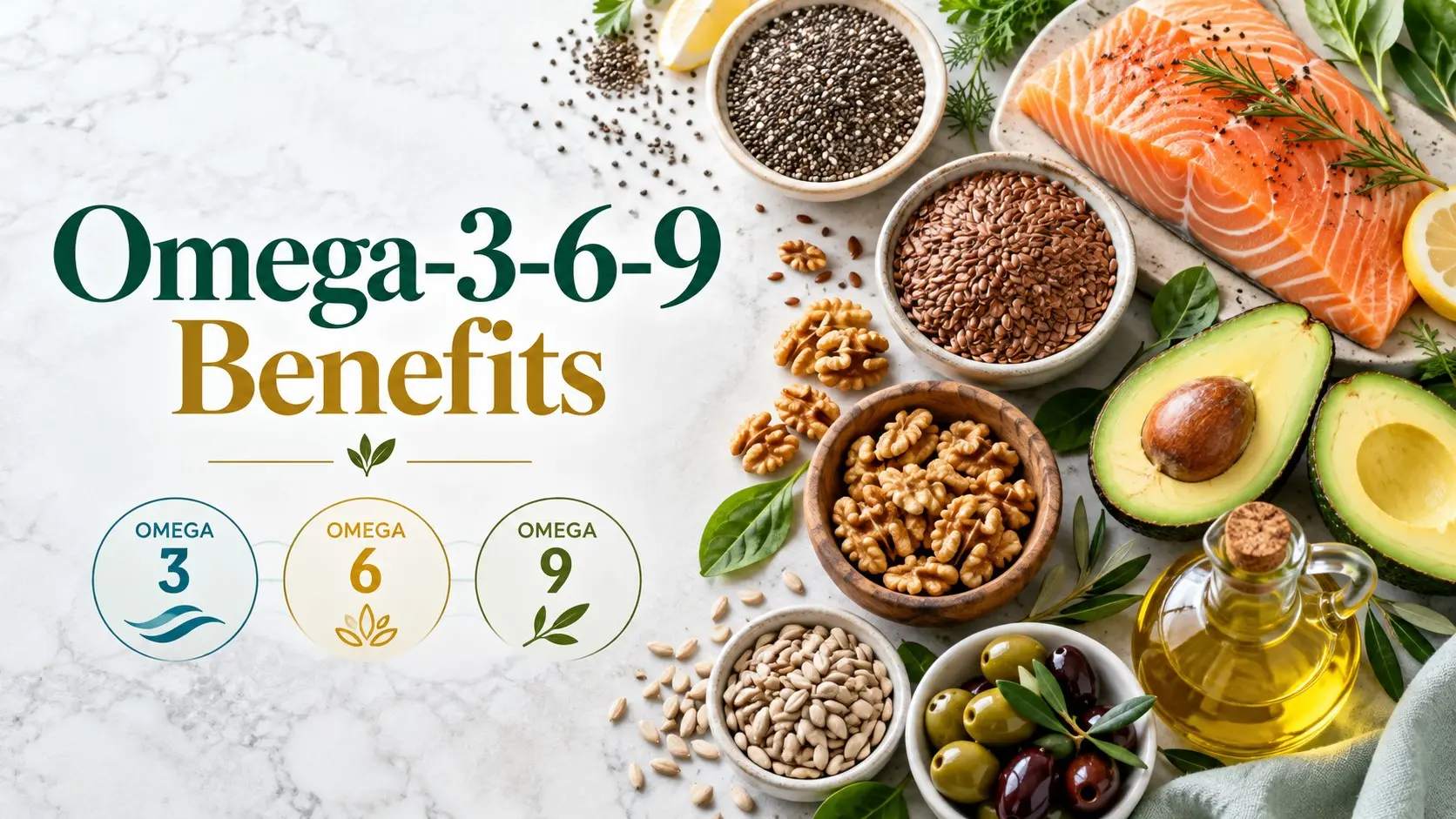
- Omega 9 fatty acids include oleic acid, which is abundant in olive oil.
Omega 3 and omega 6 contain essential fatty acids that your body needs from food.
Omega 9 is not essential because your body can make it.
What Are Omega Fatty Acids?
Fat is an important nutrient.
Your body uses fat to:
- Build cell membranes
- Store energy
- Absorb vitamins A, D, E, and K
- Produce signalling molecules
- Support normal growth
- Protect organs
The structure of a fatty acid determines whether it is saturated, monounsaturated, or polyunsaturated.
Omega 3 and omega 6 are polyunsaturated fats.
Omega 9 fats such as oleic acid are usually monounsaturated fats.
11 Essential Facts About Omega 3 6 9
1. Omega 3 Is a Family of Fats
The name omega 3 does not describe one single nutrient.
The three omega 3 fats discussed most often are:
- Alpha linolenic acid, or ALA
- Eicosapentaenoic acid, or EPA
- Docosahexaenoic acid, or DHA
They are related, but they are not interchangeable.
2. ALA Is an Essential Omega 3
ALA omega 3 is essential because the body cannot make it.
You can find ALA in:
- Flaxseed
- Chia seeds
- Walnuts
- Soybeans
- Canola oil
The body can convert some ALA into EPA and then DHA, but the conversion is limited.
That is why direct sources of EPA and DHA can still matter.
3. EPA and DHA Come Mainly From Seafood
EPA and DHA are found mainly in fish and seafood.
Good sources include:
- Salmon
- Sardines
- Mackerel
- Herring
- Trout
Algal oil can also provide DHA and sometimes EPA, making it useful for people who do not eat fish.
The NHS recommends at least two portions of fish each week for many adults, including one portion of oily fish.
4. Omega 3 Can Lower Triglycerides
This is one of the best supported medical effects of long chain omega 3 fats.
EPA and DHA can lower high blood triglyceride levels.
Prescription omega 3 medicines may be used at higher doses for selected people with high triglycerides.
That is different from taking an ordinary fish oil supplement from a supermarket.
A dietary supplement should not be used as a replacement for prescribed triglyceride treatment without medical advice.
5. Omega 6 Is Essential Too
Omega 6 fats sometimes receive a bad reputation online, but linoleic acid is an essential nutrient.
Your body cannot make it.
Common sources include:
- Soybean oil
- Sunflower oil
- Corn oil
- Safflower oil
- Nuts
- Seeds
These fats provide energy and contribute to normal cell structure and signalling.
6. Omega 6 Is Not Simply “Inflammatory”
It is common to hear that omega 6 automatically creates harmful inflammation.
Human research does not support that simple claim.
Carefully controlled feeding studies have not shown that normal intake of linoleic acid increases inflammatory markers.
Omega 6 rich polyunsaturated fats can also lower LDL cholesterol when they replace saturated fats.
The goal is not to remove omega 6 from your diet.
7. The Omega 6 to Omega 3 Ratio Is Often Overhyped
You may see advice telling you to achieve a specific omega 6 to omega 3 ratio.
Current evidence does not support treating this ratio as a reliable score for diet quality.
Both omega 3 and omega 6 can be part of a healthy diet.
A better approach is to:
- Eat more omega 3 rich foods
- Choose unsaturated plant oils
- Reduce excess saturated fat
- Eat fewer highly processed foods
You do not need to reduce healthy nuts, seeds, or vegetable oils simply to force the ratio lower.
8. Omega 9 Is Not Essential
Omega 9 fatty acids are different from omega 3 and omega 6 because the body can produce them.
The best known omega 9 fat is oleic acid.
Common sources include:
- Olive oil
- Avocados
- Almonds
- Peanuts
- Some other nuts
You still benefit from eating foods rich in omega 9, but you do not need omega 9 in a supplement to prevent deficiency.
9. Olive Oil Is a Useful Source of Omega 9
Olive oil is rich in monounsaturated fat, especially oleic acid.
The strongest benefit comes when olive oil replaces foods rich in saturated fat such as butter or certain solid fats.
This is one reason olive oil features heavily in the Mediterranean eating pattern.
The American Heart Association recommends monounsaturated and polyunsaturated fats in place of saturated and trans fats.
10. Combination Omega 3 6 9 Supplements Are Often Unnecessary
Many supplement bottles combine all three types.
That may sound more complete, but it is not automatically more useful.
Most people already consume plenty of omega 6 and omega 9 through ordinary foods.
If a person needs an omega supplement, the important question is usually what amount of EPA, DHA, or another specific fatty acid is needed.
Adding more omega 6 and omega 9 to the bottle does not necessarily provide an extra benefit.
11. Your Whole Diet Matters More Than One Fat
No fatty acid can compensate for an otherwise poor diet.
A healthy pattern includes:
- Vegetables
- Fruit
- Whole grains
- Beans
- Lentils
- Nuts
- Seeds
- Fish when appropriate
- Healthy plant oils
This is more useful than focusing on one nutrient in isolation.
Our Eating Lifestyle Guide explores how these choices can fit into everyday meals.
Omega 3 Versus Omega 6 Versus Omega 9
| Fat | Main Examples | Essential? | Useful Sources |
|---|---|---|---|
| Omega 3 | ALA, EPA, DHA | ALA is essential | Fish, seafood, flaxseed, chia, walnuts, algae |
| Omega 6 | Linoleic acid, arachidonic acid | Linoleic acid is essential | Nuts, seeds, soybean, sunflower, safflower, and corn oils |
| Omega 9 | Oleic acid | No | Olive oil, avocado, almonds, peanuts |
What Are the Best Omega 3 Foods?
Oily Fish
Oily fish provides preformed EPA and DHA.
Examples include:
- Salmon
- Mackerel
- Sardines
- Herring
- Trout
Flaxseed
Flaxseed is one of the richest plant sources of ALA.
Ground flaxseed is easier to use in:
- Oatmeal
- Yogurt
- Smoothies
- Homemade bread
Chia Seeds
Chia seeds provide ALA as well as fibre.
They can be added to porridge, yogurt, or overnight oats.
Walnuts
Walnuts provide ALA and other unsaturated fats.
A small handful can be an easy snack.
Algal Oil
Algal oil can provide DHA and sometimes EPA without fish.
It may be useful for vegans or people who avoid seafood.
What Are Good Omega 6 Foods?
Omega 6 is widely available.
Useful sources include:
- Walnuts
- Sunflower seeds
- Pumpkin seeds
- Soy foods
- Sunflower oil
- Safflower oil
- Soybean oil
- Corn oil
The fact that a food contains omega 6 does not automatically make it unhealthy.
A handful of nuts and a packet of heavily processed snacks may both contain omega 6, but their overall nutritional value is very different.
What Are Good Omega 9 Foods?
Foods rich in monounsaturated fats include:
- Extra virgin olive oil
- Olives
- Avocado
- Almonds
- Peanuts
- Hazelnuts
- Some other plant oils
These foods fit well within Mediterranean style eating.
Do Omega 3 6 9 Fats Help the Heart?
They can support a heart healthy eating pattern, but the evidence differs by fat.
Omega 3
Eating seafood as part of a balanced diet is associated with cardiovascular benefits.
EPA and DHA also lower triglycerides.
Omega 6
Replacing saturated fat with omega 6 rich polyunsaturated fat can lower LDL cholesterol.
Omega 9
Monounsaturated fats from foods such as olive oil are useful when they replace saturated fats.
The replacement matters.
Adding large amounts of olive oil to an already high calorie diet does not automatically improve health.
Do Omega 3 Fats Improve Brain Health?
DHA is an important structural component of the brain and retina.
It has a clear biological role in nervous system development.
However, this does not mean that high dose fish oil supplements are proven to make every healthy adult smarter or prevent dementia.
Brain health depends on many factors including:
- Blood pressure
- Physical activity
- Sleep
- Smoking
- Diabetes
- Hearing
- Social activity
- Overall diet
Read our How to Build and Maintain a Healthy Brain guide for a broader evidence based approach.
Do Omega 3 Fats Prevent Depression?
The evidence is mixed.
Some studies suggest that certain EPA rich formulations may help selected people with depression when used alongside standard treatment.
That does not make ordinary fish oil a proven treatment for depression.
Do not replace psychotherapy or prescribed medication with omega supplements without professional advice.
Do Omega 3 Fats Reduce Inflammation?
EPA and DHA are involved in pathways that regulate inflammatory responses.
They can change production of signalling molecules in the body.
However, saying that omega 3 “switches off inflammation” is too broad.
Inflammation is also a normal part of healing and immune defence.
Omega 3 supplements should not be presented as a universal treatment for inflammatory disease.
Are Omega 6 Fats Bad for Inflammation?
No, not simply because they are omega 6.
This is one of the most persistent nutrition myths.
Human studies do not show that normal linoleic acid intake automatically increases inflammatory markers.
The American Heart Association has also supported omega 6 polyunsaturated fats as part of a heart healthy diet.
Do You Need a 1 to 1 Omega Ratio?
No specific ratio has been proven necessary for good health.
The idea is popular online because omega 3 and omega 6 share some metabolic enzymes.
However, a ratio can be misleading.
Someone could improve their ratio by eating less omega 6 without eating any more omega 3, even though that may not improve the diet.
A more useful target is to increase healthy omega 3 foods while keeping nutritious sources of omega 6.
Is Omega 9 Better Than Saturated Fat?
Replacing saturated fat with monounsaturated fat can improve blood lipid patterns.
That means using olive oil instead of butter can be a useful change.
The American Heart Association recommends monounsaturated and polyunsaturated fats in place of saturated fats.
Are Omega 3 6 9 Supplements Worth Taking?
For many people, a combined product is not necessary.
You can already get plenty of omega 6 and omega 9 from ordinary foods.
If there is a reason to use an omega supplement, it may make more sense to choose one targeted to the nutrient you actually need.
For example:
- Fish oil may provide EPA and DHA
- Algal oil may provide DHA and EPA
- Prescription omega 3 may be used for high triglycerides
Check the actual amount of EPA and DHA on the label rather than judging a product by the total milligrams of “fish oil.”
Fish Oil Versus Omega 3 6 9 Supplements
| Product | Usually Contains | Main Consideration |
|---|---|---|
| Fish oil | EPA and DHA | Check EPA and DHA dose, not just total oil |
| Algal omega 3 | Usually DHA and sometimes EPA | Useful plant based option |
| Omega 3 6 9 blend | Mixture of several oils | Often adds omega 6 and 9 that food already supplies |
| Prescription omega 3 | Standardized EPA or EPA plus DHA formulations | Used for specific medical indications under supervision |
How Much Omega 3 Do You Need?
Recommendations depend on which omega 3 you mean.
ALA has established adequate intake recommendations.
EPA and DHA recommendations are often expressed through fish consumption rather than one universal supplement dose.
The NHS recommends at least two portions of fish each week for many adults, including one portion of oily fish.
People who are pregnant, breastfeeding, planning pregnancy, or feeding children should follow specific fish safety advice because some seafood contains pollutants such as mercury.
Should Pregnant Women Take Omega 3?
DHA has an important role in fetal brain and eye development.
However, supplement choices during pregnancy need care.
Do not use fish liver oil during pregnancy because it can contain high levels of vitamin A in the form of retinol.
The NHS advises avoiding supplements containing retinol during pregnancy.
Pregnant people should also follow guidance about the types and amounts of fish they eat.
Can Children Take Omega 3?
Children need healthy dietary fats for normal growth and development.
Fish, nuts, seeds, and suitable plant foods can provide these nutrients.
High dose supplements should not be given to children simply because a product claims to support intelligence or behaviour.
Ask a paediatric healthcare professional when supplementation is being considered for a medical reason.
Can Vegans Get Enough Omega 3?
Yes, with planning.
Plant sources of ALA include:
- Ground flaxseed
- Chia seeds
- Walnuts
- Canola oil
- Soy foods
Algal oil can provide direct DHA and sometimes EPA without fish.
Can Omega 3 Lower Cholesterol?
Omega 3 is better known for lowering triglycerides than LDL cholesterol.
Some DHA containing products can even raise LDL cholesterol slightly in certain people while lowering triglycerides.
If your main concern is high LDL cholesterol, the broader diet, saturated fat intake, fibre, body weight, activity, and medication when needed may matter more.
Can Omega 6 Lower Cholesterol?
Yes, when omega 6 rich polyunsaturated fats replace saturated fats.
Linoleic acid has a well established LDL lowering effect in this context.
Can Olive Oil Lower Cholesterol?
Replacing saturated fats such as butter with olive oil can improve the overall fat quality of the diet.
Olive oil is rich in monounsaturated fat.
It should be viewed as a replacement rather than a medicine.
Do Omega 3 6 9 Fats Help With Weight Loss?
They are not weight loss supplements.
All fats are energy dense and provide about 9 calories per gram.
Nuts, seeds, olive oil, and avocado are nutritious, but portions still matter if weight loss is the goal.
Read our Weight Management and Metabolism Hub for a broader approach.
Do Omega 3 6 9 Fats Improve Skin and Hair?
Essential fatty acid deficiency can affect the skin, but deficiency is uncommon in people eating varied diets.
There is not strong evidence that a combined omega 3 6 9 supplement will reliably produce thicker hair or glowing skin in healthy people.
Skin and hair health also depend on:
- Protein intake
- Iron status
- Zinc
- Overall calorie intake
- Hormonal health
- Medical conditions
Possible Omega 3 Supplement Side Effects
Fish oil supplements may cause:
- Fishy taste
- Burping
- Heartburn
- Nausea
- Loose stools
- Digestive discomfort
Higher doses deserve medical supervision.
Who Should Ask a Doctor Before Taking Omega Supplements?
Speak with a healthcare professional if you:
- Take anticoagulant or antiplatelet medicine
- Have a bleeding disorder
- Have a history of abnormal heart rhythm
- Are having surgery
- Are pregnant or breastfeeding
- Have very high triglycerides
- Take several medicines
- Have a fish or seafood allergy
- Have significant liver or kidney disease
Supplement dose and formulation matter.
What Should You Look for on a Fish Oil Label?
Do not look only at the number on the front of the bottle.
A capsule labelled “1,000 mg fish oil” does not necessarily contain 1,000 mg of EPA plus DHA.
Check the nutrition panel for:
- EPA per serving
- DHA per serving
- Total serving size
- Other added oils
- Vitamin A if fish liver oil is used
The NIH notes that supplement formulations vary widely.
Food First Omega Plan
| Goal | Simple Food Choice | Main Fat |
|---|---|---|
| Increase marine omega 3 | Salmon, sardines, trout, herring | EPA and DHA |
| Increase plant omega 3 | Flaxseed, chia, walnuts | ALA |
| Replace saturated fat | Olive or canola oil instead of butter | Monounsaturated and polyunsaturated fats |
| Add healthy snacks | Nuts and seeds | Omega 6, omega 9, and some omega 3 |
| Plant based DHA | Algal oil when appropriate | DHA and sometimes EPA |
Common Omega 3 6 9 Myths
Myth 1: Omega 6 Is Bad for You
False.
Linoleic acid is essential, and omega 6 rich polyunsaturated fats can support heart health when they replace saturated fat.
Myth 2: Everyone Needs an Omega 3 6 9 Supplement
False.
Most diets already contain plenty of omega 6 and omega 9.
Myth 3: A Perfect Omega Ratio Prevents Disease
Not proven.
Current human evidence does not support using one fixed ratio as the key measure of a healthy diet.
Myth 4: More Fish Oil Is Always Better
False.
High doses are not appropriate for everyone and may be used medically only for specific reasons.
Myth 5: Omega 9 Is an Essential Fat
False.
Your body can make omega 9 fatty acids.
Myth 6: Plant Omega 3 and Fish Omega 3 Are Identical
False.
ALA, EPA, and DHA are different molecules. Conversion of ALA to EPA and DHA is limited.
A Simple 7 Day Healthy Fat Upgrade
Day 1
Replace butter with olive oil in one meal.
Day 2
Add ground flaxseed or chia seeds to breakfast.
Day 3
Choose a handful of unsalted nuts instead of a heavily processed snack.
Day 4
Have oily fish if it fits your dietary needs.
Day 5
Add avocado or olives to a meal.
Day 6
Check your supplement label and see how much EPA and DHA it actually contains.
Day 7
Look at your overall fat sources and identify one saturated fat that you can replace with an unsaturated option.
Conclusion
The real Omega-3-6-9 benefits are more nuanced than supplement marketing suggests.
Omega 3 and omega 6 provide essential fatty acids. Omega 9 is a useful monounsaturated fat, but it is not essential because your body can make it.
EPA and DHA have established roles in the body and can lower triglycerides. Omega 6 rich polyunsaturated fats can help lower LDL cholesterol when they replace saturated fat, while omega 9 rich foods such as olive oil fit well within heart healthy dietary patterns.
You do not need to fear omega 6 or chase a perfect omega ratio.
Your next step is simple: add more whole food sources of unsaturated fats and use them to replace saturated fats where practical. If you are considering a supplement for high triglycerides, pregnancy, heart disease, or another medical reason, ask a qualified healthcare professional which type and dose actually fit your needs.
References and Sources
- National Institutes of Health Office of Dietary Supplements. Omega 3 Fatty Acids: Fact Sheet for Health Professionals.
https://ods.od.nih.gov/factsheets/Omega3FattyAcids-HealthProfessional/ - National Institutes of Health Office of Dietary Supplements. Omega 3 Fatty Acids: Consumer Fact Sheet.
https://ods.od.nih.gov/factsheets/Omega3FattyAcids-Consumer/ - American Heart Association. Fats in Foods. Reviewed January 9, 2026.
https://www.heart.org/en/healthy-living/healthy-eating/eat-smart/fats/fats-in-foods - Harvard T.H. Chan School of Public Health. Omega 3 Fatty Acids: An Essential Contribution.
https://nutritionsource.hsph.harvard.edu/what-should-you-eat/fats-and-cholesterol/types-of-fat/omega-3-fats/ - NHS. Fish and Shellfish.
https://www.nhs.uk/live-well/eat-well/food-types/fish-and-shellfish-nutrition/ - American Heart Association. Omega 6 Fatty Acids and Risk for Cardiovascular Disease.
https://professional.heart.org/en/science-news/omega-6-fatty-acids-and-risk-for-cardiovascular-disease
Internal Links + Hub
- Omega 3 Benefits for Women
- Eating Lifestyle Guide
- Healthy Eating for Older Adults
- Foods for Eye Health
- How to Build and Maintain a Healthy Brain
- Nutrition & Vitamins Hub
- Weight Management & Metabolism Hub
About the Author
Adel Galal is the founder and editor of NextFitLife. He writes practical consumer health, nutrition, fitness, healthy ageing, and wellness content using information from recognized medical, public health, and academic sources.
I am not a doctor, registered dietitian, nutritionist, pharmacist, or other licensed healthcare professional. This content does not replace professional medical advice. What I share comes from real life experience, extensive research, and consultation with healthcare providers. Always consult qualified medical professionals for diagnosis and treatment of any health condition.
Learn more about NextFitLife, the author, and the site's editorial approach on the About Us page.
Frequently Asked Questions
What are the main Omega-3-6-9 benefits?
The main Omega-3-6-9 benefits come from getting essential omega 3 and omega 6 fats and using healthy unsaturated fats in place of saturated fats. EPA and DHA can lower triglycerides, while omega 6 and omega 9 rich foods can support healthier blood lipids when they replace saturated fat.
What is the difference between omega 3, 6, and 9?
Omega 3 and omega 6 are families of polyunsaturated fats that include essential fatty acids. Omega 9 is usually monounsaturated and is not essential because the body can make it.
Is omega 6 bad for you?
No. Linoleic acid is an essential omega 6 fat. Human evidence does not support the simple claim that normal omega 6 intake causes harmful inflammation, and omega 6 rich fats can lower LDL cholesterol when they replace saturated fat.
Is omega 9 essential?
No. The body can make omega 9 fatty acids such as oleic acid, so they are not classed as essential nutrients.
Do I need an omega 3 6 9 supplement?
Most people do not need a combined omega 3 6 9 supplement because omega 6 and omega 9 are already common in food. If supplementation is needed, the useful target is often a specific amount of EPA, DHA, or another particular nutrient.
What foods contain omega 3?
EPA and DHA are found mainly in oily fish and seafood. ALA is found in flaxseed, chia seeds, walnuts, soybeans, and canola oil. Algal oil can provide DHA and sometimes EPA.
What foods contain omega 6?
Omega 6 is found in nuts, seeds, soybean oil, sunflower oil, safflower oil, corn oil, and many other plant foods.
What foods contain omega 9?
Olive oil, avocados, almonds, peanuts, olives, and several other plant foods are rich in omega 9 monounsaturated fats.
Do omega 3 supplements lower triglycerides?
EPA and DHA can lower triglycerides, and prescription omega 3 medicines are used for selected people with high triglyceride levels. Ordinary supplement doses and prescription treatment are not equivalent.
Do I need to balance omega 6 and omega 3?
You do not need to chase a specific ratio. Current evidence supports increasing healthy omega 3 sources while continuing to eat nutritious omega 6 foods rather than cutting omega 6 simply to change a number.
Is fish oil better than an omega 3 6 9 supplement?
If your goal is to increase EPA and DHA, a product that clearly provides those fats may be more targeted than a blend containing omega 6 and omega 9 that you already get from food.
Can omega 3 6 9 supplements cause side effects?
Yes. Fish oil products can cause burping, heartburn, nausea, loose stools, or digestive discomfort. Higher doses and use alongside certain medicines should be discussed with a healthcare professional.

Health & wellness writer with 30+ years of experience in nutrition, fitness, and healthy aging. Founder of NextFitLife.com — evidence-based health guidance.