
Published on: Aug 1, 2023
Last updated: October 5, 2026
Next review: October 2027, or sooner if major oral health guidance changes.
Written and source checked by: Adel Galal, Founder and Lead Writer at NextFitLife
Medical review status: This article has not been medically reviewed by a dentist, oral medicine specialist, doctor, pharmacist, or other licensed healthcare professional.
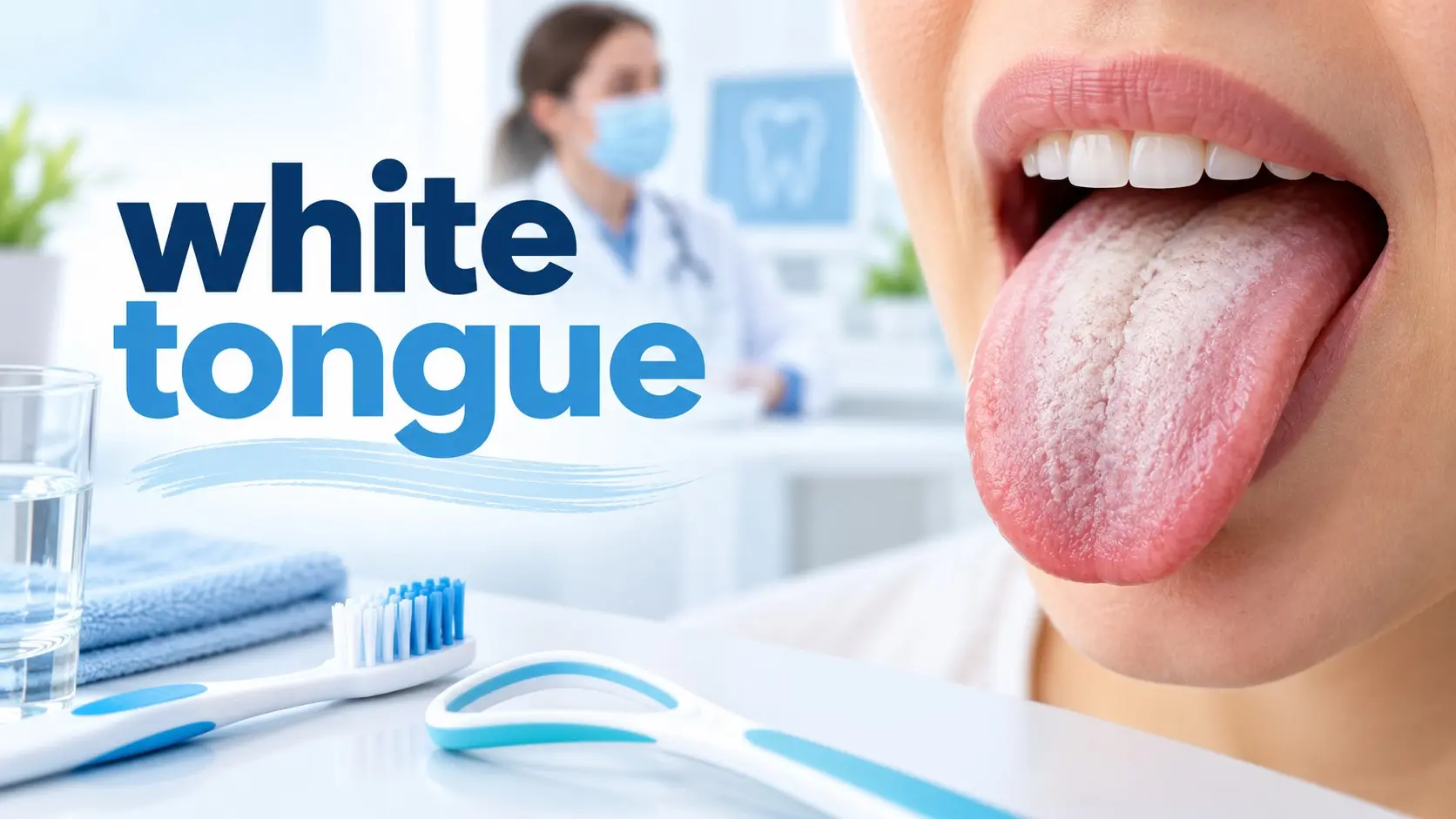
A white tongue is often caused by a harmless coating of dead cells, bacteria, food, and other debris trapped around the tiny bumps on the tongue. Dry mouth, mouth breathing, smoking, illness, and poor tongue cleaning can make the coating worse.
But not every white tongue is a simple coating.
Oral thrush, leukoplakia, oral lichen planus, geographic tongue, hairy tongue, irritation, and some more serious mouth conditions can also cause white areas.
The most useful first question is simple:
Is this a coating over the tongue, or is it a fixed white patch in the tissue?
That difference can change what you should do next.
Medical Notice: This content is for general educational purposes and does not replace professional medical advice, diagnosis, or treatment. Consult an appropriately qualified healthcare professional for personal medical concerns. This article explains published guidance and does not provide a personal clinical assessment. Always consult qualified medical professionals for diagnosis and treatment of any health condition.
Do not aggressively scrape, burn, bleach, or apply harsh chemicals to a white patch. A persistent patch, lump, ulcer, unexplained bleeding, trouble swallowing, or ongoing mouth pain needs professional assessment.
Table of Contents
- Quick Answer
- What white tongue means
- Coating versus fixed patch
- 9 Common Clues
- Ordinary tongue coating
- Dry mouth and dehydration
- Oral thrush
- Hairy tongue
- Geographic tongue
- Leukoplakia
- Oral lichen planus
- Irritation and tobacco
- Other medical causes
- Safe Home Care
- Gentle tongue cleaning
- Hydration
- Oral hygiene
- Denture care
- What Not to Do
- When to See a Dentist or Doctor
- Frequently Asked Questions
What does a white tongue mean?
A normal tongue has many tiny bumps called papillae.
When these bumps become longer or swollen, material can collect between them. This can include dead cells, bacteria, food debris, and other material.
The result may look like a pale or white film.
This common coated tongue is often harmless and temporary.
It can become more visible when your mouth is dry or when tongue cleaning has been poor.
A fixed white patch is different.
White tissue that stays in one place, does not wipe away, or keeps returning needs more attention.
Coating or patch? Start with this simple check
| What You See | Possible Cause | Useful Clue |
|---|---|---|
| Thin white film over much of the tongue | Coated tongue | May improve with gentle cleaning and better moisture |
| Creamy raised patches with a sore or red mouth | Oral thrush | Patches can sometimes wipe away and leave red or tender tissue |
| White or pale furry surface | Hairy tongue | Papillae become longer and trap debris or stain |
| Smooth red patches with pale or white borders | Geographic tongue | Patches may change shape or location over time |
| Thick fixed white patch that will not wipe off | Leukoplakia or another lesion | Needs professional assessment |
| Fine lace like white lines or patches | Oral lichen planus | May occur on the tongue or inside the cheeks |
| White patch with an ulcer, lump, red area, bleeding, or pain | Needs examination | Do not keep treating it as a coating at home |
This table cannot diagnose your tongue.
It helps you notice the pattern.
1. A simple tongue coating is very common
The most ordinary cause of a white coating on tongue is buildup around the papillae.
This can include:
- Dead cells
- Bacteria
- Food debris
- Other material trapped on the tongue
You may also notice bad breath or an unpleasant taste.
A simple coating is more likely when the whole upper surface looks pale rather than when one hard white patch sits in one place.
Gentle tongue cleaning may help.
For a complete daily routine, use the NextFitLife Oral Hygiene Guide.
2. Dry mouth can make the tongue look much whiter
Saliva does a lot of quiet work.
It moistens the mouth and helps clear food and debris.
When saliva falls, material can build up more easily.
Dry mouth can happen because of:
- Dehydration
- Mouth breathing
- Some medicines
- Smoking
- Alcohol
- Diabetes
- Some autoimmune conditions
- Cancer treatment
If you wake with a dry mouth every morning, look at the bigger pattern.
Snoring, blocked nasal breathing, medicines, or another health issue may be part of the problem.
What may help?
Drink enough water for your health needs.
Use nasal breathing when you can.
Sugar free gum may help saliva flow for some people.
Do not stop a prescription medicine because you think it causes dry mouth.
Ask the prescriber, dentist, or pharmacist first.
3. Oral thrush is one cause, not another name for white tongue
This is an important correction.
White tongue and oral thrush are not the same diagnosis.
Thrush is a fungal infection caused by an overgrowth of Candida.
It can cause creamy or cottage cheese like white patches on the tongue, inside the cheeks, roof of the mouth, gums, tonsils, or throat.
The mouth may also feel sore or red.
Taste can change.
Some people develop cracks at the corners of the mouth.
White patches may sometimes wipe away and leave red tissue that can bleed.
Do not keep scraping the area to test this.
A clinician can usually assess the pattern more safely.
For the full guide, read Oral Thrush in Adults: Symptoms, Causes, Treatment and Red Flags.
Who is more likely to get oral thrush?
Thrush becomes more likely when something changes the normal balance in the mouth.
Risk factors can include:
- Recent antibiotic treatment
- Inhaled or systemic corticosteroids
- Dentures
- Persistent dry mouth
- Diabetes
- Cancer treatment
- A weakened immune system
- Some other medicines
An adult who keeps getting thrush should not simply keep buying antifungal products.
Recurring infection can be a reason to look for the cause.
Does every white tongue need antifungal medicine?
No.
Antifungal medicine treats fungal infection.
It does not treat:
- A simple coated tongue
- Leukoplakia
- Geographic tongue
- Oral lichen planus
- Most irritation
- A hairy tongue caused by elongated papillae
Using antifungal treatment without knowing the cause can delay the right diagnosis.
If thrush is confirmed, treatment depends on the site, severity, health history, and other medicines.
4. Hairy tongue can look white, yellow, brown, or black
The name sounds worse than the condition usually is.
Hairy tongue happens when the papillae become longer than usual and do not shed normally.
Food, tobacco, bacteria, yeast, and other material can then become trapped.
The tongue may look furry.
The color is not always black. It can also look brown, yellow, green, or white.
Possible triggers include:
- Poor mouth and tongue cleaning
- Dry mouth
- Tobacco
- Antibiotic use
- A very soft diet
- Some medicines
- Heavy coffee or tea intake
Gentle cleaning and removing the trigger often help.
A dentist or healthcare professional should check persistent changes.
5. Geographic tongue can have white borders
Geographic tongue often creates smooth red areas with light or white edges.
The pattern can look like a map.
The patches may change shape, size, or location.
It is considered a harmless condition.
Some people feel burning or sensitivity when eating spicy or acidic food.
It does not usually need treatment when it causes no symptoms.
The key difference is that geographic tongue is not usually a thick white coating over the whole tongue.
6. A white patch that will not wipe off needs more attention
Leukoplakia causes a white patch or patches inside the mouth.
The tongue can be affected.
The patches are often painless and cannot be simply rubbed or wiped away.
Most leukoplakia is not cancer.
But some patches contain abnormal cells or can be linked with a higher risk of mouth cancer.
This is why a fixed white patch should not be attacked with a scraper.
It should be examined.
Common risk factors
Tobacco is strongly linked with leukoplakia.
Long term irritation and heavy alcohol use may also play a role.
Stopping tobacco is one of the most useful changes you can make for your whole mouth.
7. Oral lichen planus can form white lace like lines
Oral lichen planus is an inflammatory condition.
It can create delicate white lines that look like lace.
The tongue, gums, and inside of the cheeks can be affected.
Some people have no pain.
Others develop red, sore, or ulcerated areas that sting while eating.
This pattern needs a professional diagnosis.
Do not treat lichen planus as simple thrush based only on its color.
8. Irritation, tobacco, and mouth breathing can change the tongue
The mouth reacts to its environment.
Possible irritants include:
- Smoking
- Chewing tobacco
- Vaping
- Heavy alcohol use
- A sharp tooth edge
- A rough dental appliance
- Poorly fitting dentures
- Repeated biting or rubbing
Mouth breathing also dries the tongue and makes a coating more likely.
If one area of the tongue keeps rubbing against a sharp tooth or denture edge, have the cause checked rather than repeatedly treating the tongue.
9. Some white tongue changes need medical assessment
A white tongue is usually not an emergency.
Still, some patterns deserve proper examination.
Possible causes can include infection, immune conditions, precancerous change, or oral cancer.
A dentist or doctor may need to look at the entire mouth rather than the tongue alone.
They may check:
- The tongue surface
- The sides and underside of the tongue
- The floor of the mouth
- The gums
- The inside of the cheeks
- The throat
- The neck and jaw
Some lesions may need a swab, blood test, or biopsy.
Can a white tongue be a sign of mouth cancer?
Most white tongues are not cancer.
But a persistent red or white patch is one of the mouth changes that should be checked.
Mouth cancer can affect the tongue and other parts of the mouth.
Warning signs can include:
- A red or white patch that does not go away
- A mouth ulcer that lasts more than three weeks
- A lump in the mouth, lip, neck, or throat
- Ongoing mouth pain
- Difficulty swallowing
- Difficulty speaking
- A lasting hoarse voice
- Unexplained weight loss
These symptoms do not prove cancer.
They are reasons to get checked.
Early assessment matters.
Does the ability to wipe a patch off diagnose the cause?
No.
It gives a clue, but it is not a home diagnostic test.
A simple surface coating may come away with gentle cleaning.
Thrush patches can sometimes wipe away and expose sore red tissue.
Leukoplakia usually does not wipe away.
That does not mean you should aggressively scrape every white area to identify it.
If the tissue hurts, bleeds, feels thick, or stays in one place, stop testing it and get it examined.
How can you clean a simple white tongue safely?
Gentle is the key word.
Step 1: Brush your teeth normally
Use a soft toothbrush and fluoride toothpaste.
Brush twice each day.
Clean between the teeth once a day.
Step 2: Clean the tongue gently
You can use a soft toothbrush or a suitable tongue scraper.
Start farther back only as far as feels comfortable.
Move toward the front with light pressure.
You do not need to scrape until the tongue turns bright pink.
Stop if it hurts or bleeds.
Step 3: Rinse the tool
Wash the toothbrush or tongue cleaner after use.
Allow it to dry.
Step 4: Give it time
A simple coating may improve over several days as oral hygiene, moisture, and the underlying trigger improve.
If it does not, get dental advice.
Is a tongue scraper better than a toothbrush?
Both can clean the tongue.
You do not need an expensive device.
The technique matters more than the label on the tool.
Use light pressure.
Aggressive scraping can irritate normal tissue and make the tongue sore.
The goal is to remove loose surface coating, not scrape away tongue tissue.
Should you use mouthwash for a white tongue?
Mouthwash is not a universal treatment.
A cosmetic mouthwash may only freshen breath.
A dentist may recommend a therapeutic rinse for a specific problem.
Prescription antifungal rinses are used for selected cases of thrush.
They should not be treated as a general cure for every white tongue.
Strong alcohol based rinses may feel uncomfortable if you already have a dry or sore mouth.
For a complete daily routine, use the NextFitLife Oral Care Guide.
Does salt water remove a white tongue?
Salt water is not a cure for the many conditions that can cause a white tongue.
A mild rinse may feel soothing in some mouth problems, but it will not treat leukoplakia, oral lichen planus, or every case of thrush.
Do not use highly concentrated salt solutions that sting or burn.
The diagnosis still matters.
Should you use baking soda on your tongue?
I would not recommend scrubbing the tongue with concentrated baking soda.
The mouth lining is sensitive tissue.
Harsh homemade mixtures can irritate it.
You do not need to change the tongue's pH aggressively to remove a normal surface coating.
Gentle oral care is the better first step.
What about hydrogen peroxide?
Do not use concentrated household hydrogen peroxide on the tongue.
It can irritate or injure oral tissue.
Some regulated mouth products contain carefully formulated peroxide, but that is different from applying household peroxide directly.
Follow product instructions and dental advice.
Can antibiotics cause a white tongue?
They can contribute.
Antibiotics change bacterial populations in the body.
For some people, this gives Candida a chance to grow too much and cause oral thrush.
Antibiotics can also be linked with hairy tongue.
Do not stop an antibiotic early because your tongue looks white.
Contact the prescriber if you think a medicine is causing a new mouth problem.
Can an asthma inhaler cause oral thrush?
Inhaled corticosteroids can raise the risk of thrush in the mouth.
If you use one, follow the inhaler instructions carefully.
Many people are told to rinse the mouth and spit after using an inhaled corticosteroid.
A spacer may also be recommended for some inhalers.
Do not stop asthma treatment because of suspected thrush.
Ask the clinician or pharmacist to check your technique and symptoms.
Can diabetes cause a white tongue?
Diabetes does not mean every white tongue is caused by high blood sugar.
But diabetes can raise the risk of oral thrush, especially when glucose levels are not well controlled.
Recurring thrush in an adult can be one reason a healthcare professional looks at diabetes and other possible causes.
Thrush alone does not prove you have diabetes.
Can dehydration make your tongue white?
Yes, dehydration can contribute to a dry mouth and a more visible tongue coating.
You may also notice:
- Dry lips
- Sticky saliva
- Thirst
- Dark urine
- Less frequent urination
Drink according to your body's needs and your medical advice.
People with some heart or kidney conditions may have special fluid instructions.
Can smoking cause a white tongue?
Smoking and other tobacco use can irritate the mouth and contribute to tongue changes.
Tobacco is also an important risk factor for leukoplakia and mouth cancer.
A persistent white patch in someone who uses tobacco should not be dismissed as simple coating.
Get it checked.
Can stress cause a white tongue?
Stress is not a clear direct cause of every white tongue.
It can affect habits around the problem.
A stressed person may:
- Drink less water
- Breathe through the mouth
- Smoke more
- Sleep with the mouth open
- Pay less attention to oral hygiene
- Develop dry mouth from medicines
If stress and a white tongue appear together, look for the direct cause rather than assuming stress alone changed the tongue.
What if the white area is actually a mouth ulcer?
Mouth ulcers often have a white, yellow, or pale center with a sore red border.
That is different from a coated tongue.
Most simple ulcers heal on their own.
An ulcer that stays for more than three weeks should be assessed.
Read the NextFitLife Mouth Ulcers Guide for causes, relief, and warning signs.
What if the white spots are farther back near the tonsils?
The tongue may not be the source at all.
White spots near the tonsils can come from tonsil stones, tonsillitis, strep infection, or other throat conditions.
Location matters.
For that pattern, read White Spots on Tonsils: Causes, Treatment and Warning Signs.
A simple seven day white tongue care plan
This plan is for a mild surface coating without warning signs.
It is not a treatment plan for a fixed lesion or diagnosed infection.
| Day | Focus | Simple Action |
|---|---|---|
| 1 | Look carefully | Check whether it is a broad coating or one fixed patch |
| 2 | Tongue care | Clean the tongue gently once or twice as part of normal oral care |
| 3 | Moisture | Notice dry mouth, mouth breathing, and your normal fluid intake |
| 4 | Medicines | Review recent antibiotics, inhalers, and medicines that cause dry mouth |
| 5 | Tobacco | Avoid smoking, vaping, chewing tobacco, and other oral irritants |
| 6 | Dentures | Clean removable dental appliances as directed and check for rubbing |
| 7 | Review | If the coating is not improving or the area is fixed, painful, or unusual, arrange professional care |
When should a white tongue be checked?
Arrange a dental or medical assessment when:
- The white area does not go away
- A patch cannot be wiped away
- The change lasts around two weeks or longer
- You have ongoing pain or burning
- The tongue bleeds without clear injury
- You develop a lump
- An ulcer does not heal
- You have red and white areas together
- You have trouble swallowing
- You have trouble speaking
- You have persistent hoarseness
- You have a lump in the neck
- You lose weight without trying
- You have a weakened immune system
- Thrush keeps returning
A persistent patch does not mean you have cancer.
It means the cause deserves to be identified.
When is a mouth problem urgent?
Seek urgent medical or dental care for:
- Fast swelling of the tongue, mouth, face, or neck
- Trouble breathing
- Severe trouble swallowing
- Drooling because you cannot swallow
- Heavy uncontrolled mouth bleeding
- Severe illness with fever and spreading mouth or facial swelling
- Signs of a serious allergic reaction
Seven white tongue mistakes to avoid
1. Calling every white tongue thrush
Thrush is only one possible cause.
2. Scraping until the tongue bleeds
Gentle surface cleaning is enough.
Blood is a sign to stop.
3. Using antifungal medicine without knowing the cause
Antifungal medicine will not treat leukoplakia, geographic tongue, or most simple coatings.
4. Trying to burn the coating away
Lemon juice, vinegar, concentrated peroxide, harsh salt, or other acidic and caustic mixtures can irritate oral tissue.
5. Ignoring dry mouth
Dryness can affect the tongue, teeth, gums, comfort, and infection risk.
6. Assuming a painless patch is harmless
Leukoplakia is often painless.
Pain is not required for a patch to need examination.
7. Ignoring a patch because you smoke
Tobacco makes professional assessment more important, not less.
White tongue myths worth dropping
| Myth | Better Answer |
|---|---|
| White tongue always means Candida | Many white tongues are simple coating or another oral condition |
| A tongue must be bright pink to be healthy | Natural tongue colour and surface appearance vary |
| Scraping harder cleans better | Hard scraping can damage the tongue |
| Antifungal mouthwash fixes every white patch | Antifungal treatment is for fungal infection |
| A painless patch can be ignored | Persistent painless patches may still need examination |
What will a dentist or doctor do?
They will usually start by looking closely at the tongue and the rest of your mouth.
They may ask about:
- How long the change has been present
- Pain or burning
- Whether the area changes or moves
- Recent antibiotics
- Inhaled steroids
- Dentures
- Dry mouth
- Diabetes
- Tobacco and alcohol
- Immune conditions
- Your current medicines
Some conditions can be diagnosed by appearance.
Others may need more testing.
A persistent patch may sometimes need a biopsy so the tissue can be examined properly.
Conclusion
A white tongue is often a simple coating caused by trapped cells, bacteria, debris, or dryness. Gentle tongue cleaning, good oral hygiene, enough moisture, and removing common irritants may help when that is the cause.
But do not turn every white tongue into a thrush diagnosis. A fixed patch, lace like lesion, persistent sore, lump, unexplained bleeding, or area that does not improve needs a dentist or healthcare professional.
Your next step is simple: look at the pattern rather than only the color. If it is a mild surface coating, start gentle care today. If it is fixed or persistent, book an examination instead of scraping harder.
Related NextFitLife Guides and Hub
NextFitLife Oral Care Guide
for teeth, gums, tongue care, mouth symptoms, dry mouth, and safe daily oral care.
Oral Hygiene Guide
for brushing, tongue cleaning, fluoride, interdental care, dry mouth, and dental warning signs.
Oral Thrush in Adults
for Candida risk factors, treatment, recurrent thrush, and swallowing warning signs.
Mouth Ulcers Guide
for painful white centered sores, causes, relief, and signs that need assessment.
White Spots on Tonsils
for white areas farther back in the mouth or throat.
References and Sources
- Mayo Clinic. White Tongue: Causes and Definition.
https://www.mayoclinic.org/symptoms/white-tongue/basics/causes/sym-20050676
- Centers for Disease Control and Prevention. Symptoms of Candidiasis.
https://www.cdc.gov/candidiasis/signs-symptoms/index.html
- NHS. Sore or White Tongue.
https://www.nhs.uk/symptoms/sore-or-white-tongue/
- NHS. Leukoplakia.
https://www.nhs.uk/conditions/leukoplakia/
- NHS. Symptoms of Mouth Cancer.
https://www.nhs.uk/conditions/mouth-cancer/symptoms/
About the Author
Adel Galal is the founder and lead writer at NextFitLife. He researches practical health, fitness, nutrition, beauty, oral health, and healthy aging topics using recognized medical, dental, government, and public health sources.
His work focuses on comparing health claims with trusted guidance, finding unsafe advice, and turning difficult information into simple steps readers can understand.
For oral health content, Adel reviews sources from organizations such as the NHS, CDC, Mayo Clinic, National Institute of Dental and Craniofacial Research, American Dental Association, and other recognized health authorities.
Adel is not a dentist, physician, oral medicine specialist, pharmacist, registered dietitian, or other licensed healthcare professional.
Learn more about Adel Galal, NextFitLife, and the site's editorial approach on the About Us page.
Medical Disclaimer: This content is for general educational purposes and does not replace professional medical advice, diagnosis, or treatment. Consult an appropriately qualified healthcare professional for personal medical concerns. This article explains published guidance and does not provide a personal clinical assessment. Always consult qualified medical professionals for diagnosis and treatment of any health condition.
Frequently Asked Questions
Why is my tongue white?
A white tongue often comes from a buildup of dead cells, bacteria, food debris, and other material around the tongue's papillae. Dry mouth, poor oral hygiene, mouth breathing, smoking, illness, or other mouth conditions can also contribute.
Does a white tongue always mean oral thrush?
No. Oral thrush is only one possible cause. A simple coated tongue, hairy tongue, leukoplakia, geographic tongue, oral lichen planus, dry mouth, and irritation can also make the tongue look white.
How do I know if a white tongue is thrush?
Thrush often causes creamy white patches with a red or sore mouth. The patches may sometimes wipe away and leave red tissue underneath. A professional examination is safer than repeatedly scraping the tongue to test it.
What does a white patch that will not scrape off mean?
A fixed white patch can have several causes, including leukoplakia. A patch that does not wipe away or does not go away should be checked by a dentist or healthcare professional.
Can dehydration cause a white tongue?
Yes. Dehydration can contribute to dry mouth, which makes surface coating easier to notice and may allow more debris to collect on the tongue.
Can antibiotics cause a white tongue?
Yes. Antibiotics can change the normal bacteria in the mouth and increase the risk of oral thrush in some people. They may also contribute to hairy tongue.
Can an inhaler cause oral thrush?
Inhaled corticosteroids can increase the risk of oral thrush. Follow the inhaler instructions, including mouth rinsing when recommended, and ask a clinician or pharmacist about persistent mouth symptoms.
Can diabetes cause oral thrush?
Diabetes can raise the risk of Candida infection, especially when blood glucose is not well controlled. Recurrent thrush may be a reason for a clinician to review possible underlying causes.
Should I scrape a white tongue?
A mild surface coating can be cleaned gently with a soft toothbrush or tongue cleaner. Do not scrape hard or keep scraping a fixed white patch. Stop if the tongue becomes painful or bleeds.
Can I use baking soda for a white tongue?
You do not need concentrated baking soda to clean a simple tongue coating. Harsh homemade mixtures can irritate the mouth. Gentle oral hygiene is the safer first step.
Does mouthwash cure a white tongue?
No single mouthwash treats every cause. Antifungal products treat confirmed fungal infection, while other white tongue conditions need different care.
Is geographic tongue dangerous?
Geographic tongue is usually harmless. It causes smooth red patches with light borders that can change position. Some people have mild burning or food sensitivity.
Can white tongue be a sign of cancer?
Most white tongues are not cancer. However, a persistent red or white patch, mouth ulcer, lump, unexplained bleeding, swallowing problem, or other lasting mouth change should be professionally checked.
How long should I wait before seeing a dentist?
A mild tongue coating may improve with gentle care. Arrange an examination sooner for pain, bleeding, a fixed patch, a lump, trouble swallowing, or another worrying change. A persistent white patch should not simply be ignored.
When is a white tongue an emergency?
A white tongue alone is rarely an emergency. Seek urgent help for fast swelling of the mouth, tongue, face, or neck, trouble breathing, severe trouble swallowing, heavy bleeding, or signs of a serious spreading infection.

Health & wellness writer with 30+ years of experience in nutrition, fitness, and healthy aging. Founder of NextFitLife.com — evidence-based health guidance.