
First published: May 27, 2023
Last updated: September 30, 2026
Written and source checked by: Adel Galal, Founder and Lead Writer at NextFitLife
Clinical review status: This article has not been formally reviewed by a dentist, oral surgeon, maxillofacial surgeon, pharmacist, or other licensed healthcare professional.
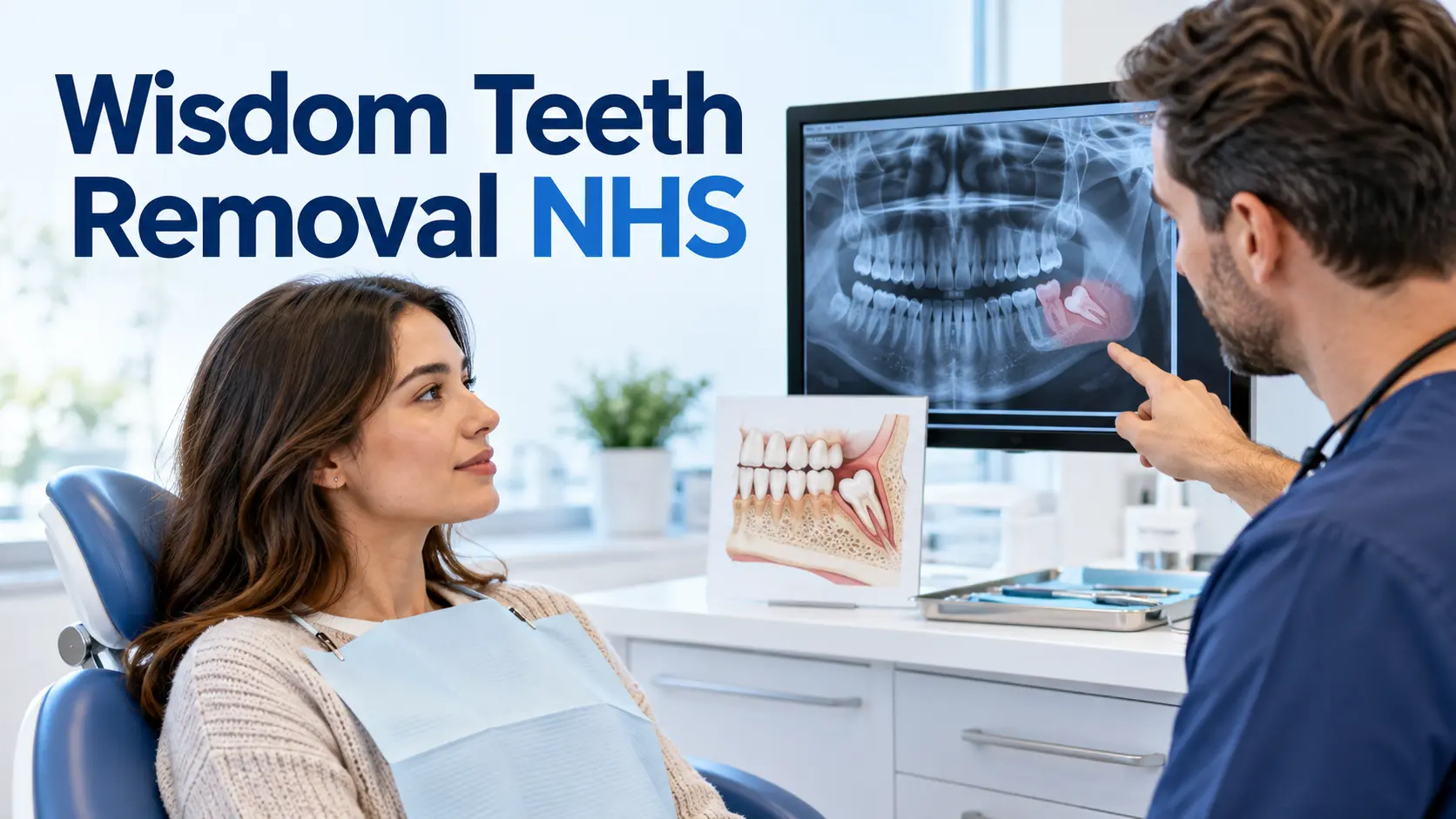
Wisdom Teeth Removal NHS treatment is available when a wisdom tooth is causing a clinical problem, but an impacted tooth does not automatically need to come out.
NICE guidance says healthy impacted wisdom teeth should not be removed routinely. Pain, repeated infection, decay, an abscess, a cyst, damage to nearby teeth, or another clear problem can make removal appropriate.
Quick Answer
Wisdom teeth can be removed on the NHS when treatment is clinically necessary. Your dentist normally examines the tooth and may take an X ray before deciding whether to monitor it, remove it, or refer you to an oral surgery service. Recovery commonly involves pain, swelling, a stiff jaw, soft foods, and careful cleaning for several days.
Get Urgent Dental Help If
Seek urgent dental care or NHS 111 advice if bleeding will not stop, pain or swelling becomes severe or keeps getting worse, painkillers are not helping, or you develop pain with a bad taste, fever, or feel unwell.
Get emergency medical help for rapidly spreading facial or neck swelling, difficulty breathing, severe difficulty swallowing, collapse, or another life threatening symptom.
Medical and dental notice: This content is for general educational purposes and does not replace professional medical advice, diagnosis, or treatment. Consult an appropriately qualified healthcare professional for personal medical concerns. This article explains published guidance and does not provide a personal clinical assessment. Always consult qualified medical professionals for diagnosis and treatment of any health condition. I am also not a dentist or oral surgeon. A qualified dental professional should diagnose and treat wisdom tooth problems.
Table of Contents
- What Wisdom Teeth Are
- 12 Essential NHS Facts
- When Removal Is Needed
- When Removal Is Not Needed
- How Much NHS Treatment Costs
- What Happens Before Removal
- Local Anaesthetic, Sedation, and General Anaesthetic
- What Happens During Extraction
- Recovery Timeline
- What to Eat
- Dry Socket
- Nerve Injury
- Coronectomy
- When to Seek Urgent Help
- References and Sources
- Related NextFitLife Oral Health Guides
- About the Author
- Frequently Asked Questions
What Are Wisdom Teeth?
Wisdom teeth are your third molars.
They sit at the very back of the mouth and usually appear later than the other adult teeth.
Some people have four wisdom teeth. Others have fewer, and some people do not develop any.
A wisdom tooth can grow normally and never cause trouble.
It can also become trapped under the gum or bone because there is not enough room for it to come through. This is called an impacted wisdom tooth.
Some impacted teeth are completely hidden. Others come through only partly, leaving a flap of gum where food and bacteria can collect.
12 Essential Facts About Wisdom Teeth Removal on the NHS
1. An affected Wisdom Tooth Does Not Automatically Need Removal
This is the first thing many people get wrong.
NICE guidance says the NHS should not routinely remove pathology free impacted wisdom teeth.
If the tooth is not causing disease, it can usually be monitored during normal dental care.
Being crooked, buried, or impacted by itself does not always justify surgery.
2. Removal Is Usually Based on a Real Dental Problem
Wisdom tooth removal becomes more reasonable when the tooth is causing disease or repeated trouble.
Examples include:
- Tooth decay that cannot be restored
- Repeated gum infection
- Dental abscess
- Cellulitis
- A cyst
- Damage to a nearby tooth
- Root resorption
- Fracture
- Other clear disease around the tooth
Your dentist looks at symptoms, examination findings, and imaging before recommending surgery.
3. One Mild Episode of Pericoronitis Does Not Always Mean Surgery
Pericoronitis is inflammation or infection in the gum around a partly erupted wisdom tooth.
NICE guidance says one episode, unless it is particularly severe, is not usually enough reason on its own to remove the tooth.
A second or later episode makes removal more reasonable.
This is useful because repeated infection tells a different story from one brief flare.
4. Your Dentist May Remove the Tooth or Refer You
Some wisdom teeth are straightforward enough for a general dentist to remove.
Others need a dentist with additional oral surgery experience or an oral surgeon.
You may be referred to:
- Another dental practice
- An oral surgery clinic
- A hospital oral and maxillofacial service
The route depends on the position of the tooth, difficulty of removal, health conditions, anaesthetic needs, and local NHS services.
5. An X Ray Helps Plan the Extraction
A dentist may take an X ray to see:
- The direction of the wisdom tooth
- How deeply it is affected
- The shape of the roots
- The tooth next to it
- The surrounding bone
- How close lower roots are to important nerves
This information helps decide whether normal extraction, specialist referral, or another approach is safer.
6. Most Extractions Use Local Anaesthetic
A local anaesthetic numbs the gum and surrounding tissue.
You should not feel sharp pain during the extraction, although pressure and movement are normal.
Some people also receive sedation to help them relax.
A general anaesthetic, where you are asleep, may be considered for more difficult surgery or certain clinical situations.
7. A Wisdom Tooth May Need to Be Cut Into Pieces
Removal is not always a simple pull.
The dentist or surgeon may:
- Numb the area.
- Make a small cut in the gum if needed.
- Remove a small amount of bone if the tooth is covered.
- Widen the socket.
- Remove the tooth whole or divide it into smaller pieces.
- Place stitches when needed.
NHS guidance says the procedure may take only a few minutes and usually takes no more than about 40 minutes.
8. The Blood Clot Is Part of the Healing Process
After extraction, a blood clot forms inside the empty socket.
That clot protects the healing tissue underneath.
You do not want to keep disturbing it.
This is why your dental team may tell you to avoid forceful rinsing, aggressive spitting, smoking, and other actions that can disturb the healing socket.
9. Pain and Swelling Are Normal, but They Should Improve
Some pain, swelling, bruising, jaw stiffness, and chewing discomfort are expected.
Swelling can become more noticeable during the first few days.
NHS guidance says symptoms can continue for up to two weeks, although they should gradually improve.
Pain that gets much worse after it first seemed to improve needs a different look.
10. Dry Socket Causes Increasing Pain After Extraction
Dry socket develops when the protective clot does not form properly or is lost before the socket has healed enough.
The classic clue is pain that becomes worse instead of better several days after extraction.
You may also notice:
- Deep throbbing pain
- Poor taste
- Bad breath
- Pain spreading toward the ear or jaw
A dentist or oral surgery team can clean the socket and may place a dressing.
Do not try to pack the socket yourself.
11. Lower Wisdom Teeth Can Sit Close to Important Nerves
Two nerves deserve special attention during lower wisdom tooth surgery.
The inferior alveolar nerve supplies feeling to areas including the lower lip and chin.
The lingual nerve supplies feeling to the tongue and contributes to taste sensation.
These nerves can be bruised or injured during difficult extraction.
Temporary numbness or tingling is much more common than permanent nerve problems.
Several NHS oral surgery leaflets report temporary altered sensation in up to about 1 in 10 higher risk cases, while persistent problems beyond a year are reported in fewer than 1 in 100.
Your personal risk can be much lower or higher depending on exactly where your tooth roots sit.
12. Coronectomy Can Be an Option When Nerve Risk Is High
Sometimes removing the entire lower wisdom tooth would put the nearby nerve at greater risk.
A coronectomy may then be discussed.
Instead of removing the whole tooth, the surgeon removes the crown and leaves the roots in place.
BAOMS explains that this technique can reduce the chance of numbness affecting the lower lip and chin in selected high risk cases.
It is not suitable for every wisdom tooth.
When Does a Wisdom Tooth Need to Come Out?
A painful wisdom tooth does not always need immediate surgery, but some problems make removal more likely.
| Problem | Why It Matters | Possible Next Step |
|---|---|---|
| Repeated pericoronitis | Gum around the tooth keeps becoming infected | Dental assessment and removal |
| Decay | A difficult to clean tooth can develop a cavity | Repair when possible or removal if unrestorable |
| Abscess | Pus and infection can spread | Urgent dental treatment and later definitive care |
| Cyst | A fluid filled lesion can develop around an unerupted tooth | Specialist assessment |
| Damage to second molar | The wisdom tooth can affect the tooth in front | Consider removal based on imaging and damage |
When Is Removal Usually Not Needed?
If an impacted wisdom tooth is healthy and causing no disease, NICE recommends leaving it rather than removing it routinely.
The tooth can be checked during normal dental visits.
This avoids exposing someone to surgical risk when there is no clear benefit.
A future problem can still develop, so monitoring matters.
How Much Does Wisdom Tooth Removal Cost on the NHS?
Charges depend on where in the UK you receive treatment.
England
From April 1, 2026, NHS Band 2 dental treatment in England costs £76.60.
Band 2 includes tooth extraction and other oral surgery procedures.
If your NHS dentist removes the wisdom tooth as part of a Band 2 course of treatment, you normally pay the Band 2 charge unless you qualify for free treatment or help with dental costs.
If you are referred for NHS hospital treatment, charging arrangements can differ from primary dental care.
Scotland, Wales, and Northern Ireland
NHS dental charging systems differ across the four UK nations.
Do not use the England Band 2 figure as a UK wide price.
Ask your dental service what charge applies where you live before treatment starts.
Can You Get Wisdom Tooth Removal Free on the NHS?
Some people qualify for free NHS dental treatment or help with costs.
Eligibility depends on factors such as age, pregnancy, maternity status, certain benefits, and income.
Your dentist should explain the expected NHS charge before treatment.
Do not assume private treatment is required just because a wisdom tooth is difficult.
What Happens Before Wisdom Tooth Removal?
Your dentist or surgeon reviews the problem first.
This can include:
- Your symptoms
- How often infection happens
- Dental examination
- X ray imaging
- Medicines
- Medical history
- Bleeding risk
- Previous anaesthetic problems
- Smoking
- Pregnancy when relevant
Tell the dental team about medicines that affect bleeding, allergies, and major health conditions.
Do not stop a prescribed medicine unless the clinician responsible for your care tells you to do so.
Will Wisdom Tooth Removal Hurt?
The area should be numb before extraction begins.
You may feel pressure, pushing, pulling, or vibration.
You should not feel sharp pain.
Tell the dentist or surgeon if you do.
Once the anaesthetic wears off, soreness is expected and can usually be managed with the pain relief recommended by your dental team.
Local Anaesthetic, Sedation, or General Anaesthetic?
Local Anaesthetic
This numbs the treatment area while you stay awake.
It is enough for many wisdom tooth extractions.
Sedation
Sedation can make you relaxed and less aware of the procedure while you remain responsive.
If you receive a sedative injection, NHS guidance says you should not drive for 24 hours.
General Anaesthetic
A general anaesthetic means you are unconscious during the procedure.
It is normally reserved for situations where it is clinically appropriate.
NHS guidance says not to drive for 48 hours after a general anaesthetic.
Follow the exact instructions from your anaesthetic team because restrictions can differ according to the medicine and procedure.
What Happens During Wisdom Tooth Removal?
The exact technique depends on the tooth.
A simple fully erupted wisdom tooth may come out much like another tooth.
An impacted tooth may need surgery.
The surgeon can make a cut in the gum, expose the tooth, divide it into smaller pieces, and remove the parts carefully.
The wound may then be closed with dissolvable stitches.
These normally disappear on their own.
Wisdom Tooth Recovery: What to Expect
First 24 Hours
A small amount of bleeding or blood stained saliva can be normal.
The clot needs time to settle.
Rest and follow your surgery team's instructions.
Days 2 and 3
Swelling and jaw stiffness can become more noticeable.
This does not automatically mean infection.
Symptoms should begin to settle rather than continue getting worse.
Days 4 to 7
Many people feel much better.
Eating and opening the mouth should become easier.
Some people need longer after difficult lower wisdom tooth surgery.
Up to Two Weeks
The NHS says pain, swelling, bruising, jaw stiffness, and chewing discomfort can last up to two weeks.
The socket itself continues healing after you feel better.
When Can You Go Back to Work?
NHS guidance says many people can return to normal activities the next day.
If removal was difficult or you had a general anaesthetic, you may need around one to three days away from work.
Some hospital oral surgery services advise a couple of days off and avoiding strenuous exercise.
Your job matters too.
A desk job is different from heavy lifting or physical labour.
What Should You Eat After Wisdom Tooth Removal?
Choose foods that need little chewing while the area is sore.
Examples include:
- Soup that is not very hot
- Mashed potato
- Scrambled egg
- Yoghurt
- Soft pasta
- Soft cooked vegetables
- Banana
- Porridge once comfortable
Avoid hard, sharp, crunchy foods that can hit the wound.
The NHS also advises avoiding small foods such as nuts and seeds that can become trapped in the socket.
How Should You Clean Your Mouth After Extraction?
Follow the instructions from your own dentist because timing can differ.
Many NHS oral surgery services advise starting gentle warm salt water or recommended mouthwash rinses from the day after surgery.
Brush the rest of your teeth carefully.
Do not attack the extraction socket with a toothbrush.
Your goal is a clean mouth without damaging the clot or stitches.
For everyday care after healing, see the NextFitLife Oral Hygiene Guide.
What Is Dry Socket?
Dry socket, also called alveolar osteitis, is a painful problem that develops after extraction when the protective clot is lost or does not form properly.
The pain typically becomes worse a few days after surgery rather than steadily improving.
Dry socket is more common after lower wisdom tooth removal.
Smoking increases the risk.
Contact your dentist or oral surgery team if you develop worsening throbbing pain, especially with a bad taste or bad breath.
How Can You Lower the Risk of Dry Socket?
- Do not smoke during healing.
- Follow the dental team's mouth cleaning advice.
- Avoid aggressive rinsing.
- Do not keep touching the socket.
- Avoid hard foods that can injure the wound.
- Follow instructions about alcohol and strenuous exercise.
No home routine can guarantee that dry socket will not happen.
What Does Wisdom Tooth Nerve Damage Feel Like?
Lower wisdom teeth can lie near the inferior alveolar nerve and lingual nerve.
If one is bruised, symptoms can include:
- Numb lower lip
- Numb chin
- Numb tongue
- Pins and needles
- Burning or altered sensation
- Rare taste changes
Most nerve symptoms improve.
Some can take weeks or months to recover.
Persistent altered sensation is much less common.
Your surgeon should explain your personal risk before surgery when the roots lie close to a nerve.
What Is a Coronectomy?
A coronectomy is an alternative to complete extraction for selected lower wisdom teeth.
The surgeon removes the crown of the tooth but intentionally leaves the roots.
The aim is to reduce the chance of injuring a nerve when the roots are very close to it.
BAOMS describes coronectomy as a useful option in selected higher risk cases.
The roots may move later and sometimes need further treatment, so it is not a risk free alternative.
Is Infection Normal After Wisdom Tooth Removal?
No.
Some swelling and pain are expected, but infection is different.
Contact your dentist if symptoms include:
- Pain that keeps getting worse
- Increasing swelling
- High temperature
- Feeling unwell
- Pus or discharge
- Unpleasant taste with worsening pain
- Hot or very tender swelling
Antibiotics are not routinely needed for every wisdom tooth extraction.
A clinician should decide when antibiotics are appropriate.
What If the Socket Keeps Bleeding?
A little bleeding on the day of surgery is common.
NHS advice says that if active bleeding occurs, place clean material over the socket and apply firm pressure by biting down for at least 10 minutes.
Some hospital services advise 20 minutes.
If bleeding does not stop despite firm pressure, contact your dental service or seek urgent dental help.
Can You Smoke After Wisdom Tooth Removal?
Smoking can interfere with healing and increases the risk of infection and dry socket.
Avoid smoking during recovery.
If you want to stop smoking, your GP, pharmacist, or NHS stop smoking service can help.
Can You Drink Alcohol After Removal?
The NHS advises avoiding alcohol during early recovery because it can contribute to bleeding and can interact with some medicines or sedation instructions.
Follow the advice given with your medicines and anaesthetic.
What If the Tooth Is Close to the Sinus?
Upper wisdom tooth roots can sit close to the maxillary sinus.
Removal can rarely create a communication between the mouth and sinus or cause other sinus related problems.
Your dentist or surgeon should tell you when imaging suggests a higher risk.
What Questions Should You Ask Before Surgery?
- Why does this wisdom tooth need to be removed?
- What happens if we leave it and monitor it?
- Does the X-ray show the tooth close to a nerve?
- Would a coronectomy be safer in my case?
- Will I need local anaesthetic, sedation, or general anaesthetic?
- What is my personal risk of numbness?
- How long should I take off work?
- When can I exercise again?
- Which painkillers are suitable for me?
- When should I start salt water rinses?
- Which symptoms mean I should call you urgently?
- What will the NHS charge be for my treatment?
When Should You Get Urgent Dental Help?
Contact an urgent dentist or NHS 111 if:
- Bleeding will not stop
- Pain becomes severe or gets worse
- Painkillers are not helping
- Swelling keeps increasing
- You have pain with an unpleasant taste
- You develop a high temperature
- You feel unwell
When Is It an Emergency?
Get emergency medical help for:
- Difficulty breathing
- Rapidly spreading swelling of the face or neck
- Severe difficulty swallowing
- Collapse
- Severe uncontrolled bleeding
A dental article should never delay emergency care for airway symptoms.
Conclusion
Wisdom Teeth Removal NHS treatment is based on clinical need, not simply on whether a wisdom tooth is affected.
A healthy tooth can often stay where it is. Repeated infection, severe decay, an abscess, a cyst, damage to nearby teeth, or another simple problem may make removal the better option.
If your dentist recommends extraction, ask to see the X-ray and understand why the tooth needs to come out, what anaesthetic will be used, how close the roots are to nearby nerves, and what warning signs to watch for afterward.
Your next step is simple: if a wisdom tooth keeps hurting, swelling, or becoming infected, book a dental assessment rather than repeatedly treating the symptoms at home.
References and Sources
- NHS.
Wisdom Tooth Removal.
Official NHS guidance covering indications, procedure, anaesthesia, recovery, dry socket, infection, nerve injury, and urgent warning symptoms.
https://www.nhs.uk/tests-and-treatments/wisdom-tooth-removal/ - National Institute for Health and Care Excellence, NICE.
Guidance on the Extraction of Wisdom Teeth, TA1.
NICE guidance stating that pathology free impacted wisdom teeth should not be routinely removed and listing clinical indications for extraction.
https://www.nice.org.uk/guidance/ta1/chapter/1-Recommendations - NHS Business Services Authority.
Current NHS Treatment Costs in England.
Current 2026 NHS dental charges including the Band 2 charge used for extraction and oral surgery in NHS primary dental care in England.
https://faq.nhsbsa.nhs.uk/knowledgebase/article/KA-03997/en-us - British Association of Oral and Maxillofacial Surgeons, BAOMS.
Coronectomy.
Patient guidance explaining coronectomy, nerve proximity, bleeding, infection, and the role of the technique in reducing selected nerve risks.
https://www.baoms.org.uk/patients/procedures/44/coronectomy - Cambridge University Hospitals NHS Foundation Trust.
Patient Information and Consent to Surgical Removal of Impacted Wisdom Teeth.
NHS specialist information covering nerve injury, temporary and persistent altered sensation, dry socket, nearby tooth damage, and alternatives to complete extraction.
https://www.cuh.nhs.uk/patient-information/patient-information-and-consent-to-surgical-removal-of-impacted-wisdom-teeth/ - NHS Inform Scotland.
Wisdom Tooth Removal.
Official Scottish NHS patient information covering impacted teeth, X rays, extraction, recovery, and oral surgery.
https://www.nhsinform.scot/tests-and-treatments/dental-treatments/wisdom-tooth-removal
Related NextFitLife Oral Health Guides
- Oral Hygiene Guide: 15 Daily Habits for Healthy Teeth and Gums
- Mouth Ulcers: Causes, Relief, Prevention and Warning Signs
- Oral Thrush in Adults: Symptoms and Treatment
- Best Teeth Whitening Tips for Safe Results
About the Author
Adel Galal is the founder and lead writer of NextFitLife. He researches and writes health, fitness, nutrition, oral care, sleep, and healthy aging content using recognised medical, dental, public health, and academic sources.
For dental content, his role is to compare guidance from qualified dental and health organisations and explain it in clear language. He does not examine patients, diagnose dental disease, prescribe medication, or perform dental treatment.
This content is for general educational purposes and does not replace professional medical advice, diagnosis, or treatment. Consult an appropriately qualified healthcare professional for personal medical concerns. This article explains published guidance and does not provide a personal clinical assessment. Always consult qualified medical professionals for diagnosis and treatment of any health condition.
Learn more about Adel Galal and the NextFitLife editorial approach on the About Us page.
Frequently Asked Questions
Can you get wisdom teeth removed on the NHS?
Yes. Wisdom teeth can be removed on the NHS when removal is clinically necessary. Your dentist may remove the tooth or refer you to a specialist service.
Does every impacted wisdom tooth need to be removed?
No. NICE says pathology free impacted wisdom teeth should not be removed routinely. A tooth that is healthy and causing no problems can usually be monitored.
How much does wisdom tooth removal cost on the NHS in England?
From April 1, 2026, NHS Band 2 dental treatment in England costs £76.60. Extraction and oral surgery can fall under Band 2 in NHS primary dental care. Different charging rules apply in other UK nations and in some hospital referral pathways.
When should a wisdom tooth be removed?
Removal may be recommended for problems such as repeated pericoronitis, severe decay, an abscess, a cyst, damage to nearby teeth, root resorption, or another clear dental disease.
Does one wisdom tooth infection mean it needs removing?
Not always. NICE says a first episode of pericoronitis, unless especially severe, is not normally enough reason by itself. Repeated episodes make removal more appropriate.
How long does wisdom tooth removal take?
NHS guidance says some removals take only a few minutes and the procedure should usually take no more than about 40 minutes.
How long does wisdom tooth recovery take?
Many people return to normal activity quickly, but soreness, swelling, bruising, jaw stiffness, and chewing discomfort can continue for up to two weeks.
When is swelling worst after wisdom tooth removal?
Swelling commonly becomes more noticeable during the first two or three days, then starts to improve. Swelling that continues getting worse with fever, severe pain, or feeling unwell needs dental review.
What is dry socket?
Dry socket is a painful condition where the protective blood clot does not form properly or becomes lost before the extraction socket has healed enough. Pain usually worsens several days after extraction instead of getting better.
Can wisdom tooth removal damage a nerve?
Yes, especially during lower wisdom tooth surgery when roots lie close to the inferior alveolar or lingual nerve. Most altered sensation is temporary, but persistent nerve problems can occur rarely.
What is a coronectomy?
A coronectomy removes the crown of a lower wisdom tooth but leaves the roots in place. It can be considered when complete removal would carry a higher risk of damaging a nearby nerve.
Can I drive after wisdom tooth removal?
Driving restrictions depend on the anaesthetic. NHS guidance says not to drive for 24 hours after sedative injection or 48 hours after general anaesthetic. Follow the exact advice from your treatment team.
What foods should I eat after wisdom tooth removal?
Choose soft foods that need little chewing while the area is sore. Avoid hard, crunchy food and small pieces such as nuts or seeds that can become trapped in the socket.
Can I smoke after wisdom tooth removal?
Smoking can interfere with healing and increases the risk of infection and dry socket. Avoid smoking during recovery.
When should I call NHS 111 after wisdom tooth removal?
Seek urgent dental advice if bleeding will not stop, pain or swelling becomes severe or keeps getting worse, painkillers do not help, or you develop worsening pain with a bad taste, fever, or feel unwell.
FAQ Schema

Health & wellness writer with 30+ years of experience in nutrition, fitness, and healthy aging. Founder of NextFitLife.com — evidence-based health guidance.