Published: April 4, 2023
Last updated: September 28, 2026
Written and source -checked by: Adel Galal, Founder and Lead Writer at NextFitLife
Medical review status: This article has not been medically reviewed by a gastroenterologist, doctor, pelvic floor physical therapist, pharmacist, or registered dietitian.
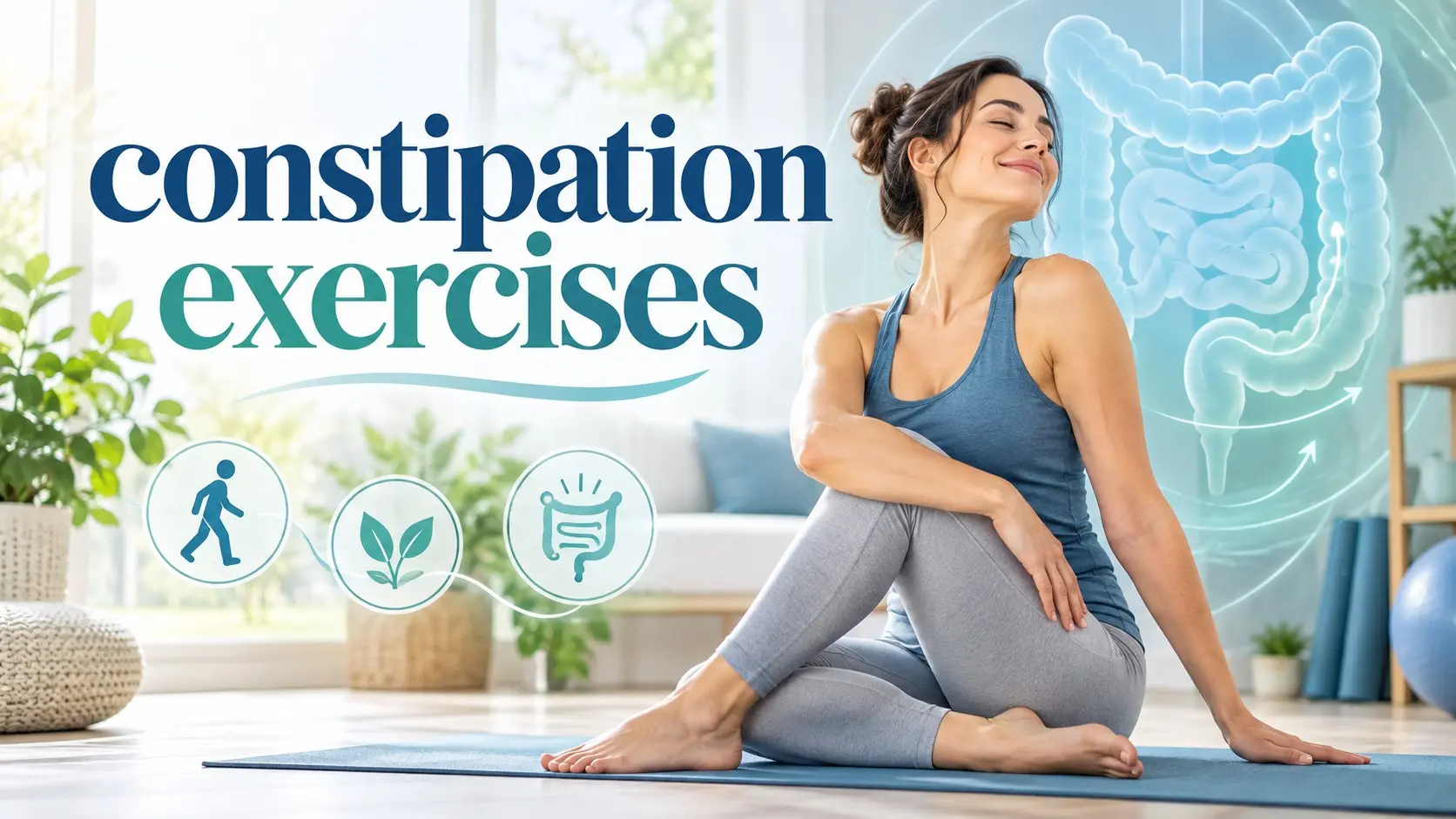
Constipation exercises may help if too much sitting and too little movement are part of your problem.
Walking is the simplest place to start. Gentle mobility work can also help you move more often, while slow breathing may make it easier to relax the belly and pelvic floor.
But exercise is not a magic laxative.
Quick answer: Regular physical activity may support bowel regularity, and walking is the easiest evidence based starting point. Gentle movements such as marching, sit to stands, pelvic tilts, knee to chest stretches, cat cow, and relaxed breathing can help you stay active and reduce stiffness. Specific yoga poses have much less direct research than physical activity as a whole. If constipation keeps returning despite good habits, ask whether medicines, slow colon transit, or pelvic floor dysfunction could be involved.
A 2024 systematic review of 13 cohort studies involving more than 119,000 people found that higher physical activity was associated with a lower risk of constipation.
That is useful evidence for movement.
It is not proof that one twist, pose, or abdominal exercise will immediately produce a bowel movement.
Medical notice: This content is for general educational purposes and does not replace professional medical advice, diagnosis, or treatment. Consult an appropriately qualified healthcare professional for personal medical concerns. This article explains published guidance and does not provide a personal clinical assessment. Always consult qualified medical professionals for diagnosis and treatment of any health condition.
Table of Contents
- Do constipation exercises actually work?
- When exercise is not enough
- 11 smart movements to try
- A simple beginner routine
- The best time to move
- Walking and the gastrocolic reflex
- Breathing and pelvic floor relaxation
- Why hard core exercises can backfire
- Toilet posture and footstools
- Abdominal massage evidence
- Exercise for older adults
- Pregnancy and constipation
- Constipation in children
- Fibre, fluids, and toilet habits
- When pelvic floor biofeedback is needed
- When constipation needs medical care
- References and Sources
- Related NextFitLife guides
- About the author
- Frequently asked questions
Do Constipation Exercises Actually Work?
Regular movement can be part of a good constipation plan.
NIDDK recommends regular physical activity as one of the lifestyle steps that may help relieve constipation.
Mayo Clinic gives similar advice and recommends exercising on most days of the week when it is safe for you.
Research also supports an association.
A 2024 systematic review found that people with higher physical activity levels had a lower risk of constipation than people who were less active.
There is an important limit to this evidence.
Most research looks at physical activity as a whole. It does not prove that a certain yoga pose, twist, or core move is uniquely effective.
That is why this guide separates stronger evidence from practical movements that simply help you become less sedentary.
What Is Constipation?
Constipation can mean more than not having a bowel movement every day.
Symptoms may include:
- Fewer than three bowel movements in a week
- Hard or lumpy stool
- Straining
- Pain when passing stool
- Feeling blocked
- Feeling that stool remains inside
Normal bowel frequency varies between people.
The bigger concern is often a change from your normal pattern or repeated difficulty passing stool.
For food and digestion guidance, visit the NextFitLife Gut Health and Digestion Hub.
When Exercise Is Not Enough
Constipation can have many causes.
Low activity is only one.
Other causes can include:
- Low fibre intake
- Medicine side effects
- Opioid pain medicine
- Iron or calcium supplements
- Hypothyroidism
- Diabetes
- Neurological disease
- Slow transit constipation
- Pelvic floor dysfunction
- IBS with constipation
This matters because another set of stretches will not correct every cause.
The American Gastroenterological Association updated its advice in January 2026 and stressed that people with difficult chronic constipation may need testing for pelvic floor dysfunction before the condition is labelled refractory.
11 Smart Constipation Exercises and Movements
1. Walking
Walking is the best first movement for most people because it is simple, low cost, and easy to repeat.
You do not need to sprint.
Start with an easy five or ten minute walk if you have been inactive.
You can gradually increase the time as your fitness improves.
How to do it
- Stand tall.
- Relax your shoulders.
- Walk at a comfortable pace.
- Let your arms swing naturally.
- Breathe normally.
A short walk after breakfast or another meal may fit especially well because eating naturally stimulates colon activity.
2. Marching in Place
You do not need outdoor space or a treadmill to add movement.
Marching in place is a simple option when you work from home, travel, or cannot take a full walk.
How to do it
- Stand beside a stable chair if you need support.
- Lift one foot.
- Lower it.
- Lift the other foot.
- Continue for one to three minutes.
The benefit is mainly that you are moving instead of sitting.
There is no evidence that marching has a special bowel effect beyond general activity.
3. Chair Marches
Chair marches are useful for older adults or people who are not comfortable marching while standing.
How to do it
- Sit near the front of a stable chair.
- Keep your back comfortably upright.
- Lift one knee a small amount.
- Lower it.
- Repeat on the other side.
- Continue for ten to twenty repetitions.
Stop if you feel dizzy, short of breath, or unwell.
4. Sit to Stand
This exercise adds leg movement and breaks up long periods of sitting.
How to do it
- Sit in a stable chair.
- Place both feet on the floor.
- Lean forward slightly.
- Stand up.
- Sit down slowly.
- Repeat five to ten times if comfortable.
Use the chair arms or another stable support if needed.
5. Knee to Chest Stretch
This is a gentle hip and lower back stretch.
Some people find it comfortable when bloating and abdominal tightness come with constipation.
It has not been proven to push stool through the colon.
How to do it
- Lie on your back.
- Bend one knee.
- Bring it gently toward your chest.
- Hold for about ten to twenty seconds.
- Release.
- Repeat on the other side.
Do not pull hard.
6. Pelvic Tilts
Pelvic tilts gently move the lower back, pelvis, and abdominal area.
How to do it
- Lie on your back with your knees bent.
- Keep both feet on the floor.
- Gently flatten your lower back.
- Relax.
- Repeat eight to ten times.
Keep breathing normally throughout the movement.
7. Cat Cow Movement
Cat cow gently moves the spine and abdomen.
It is useful mainly as mobility work, not because research has proved it is a constipation treatment.
How to do it
- Start on your hands and knees.
- Let your belly soften as you gently lift your chest.
- Then slowly round your back.
- Move with your breathing.
- Repeat five to ten times.
If hands and knees are uncomfortable, do a smaller version while sitting in a chair.
8. Seated Trunk Rotation
This gentle rotation can help break up stiffness caused by prolonged sitting.
How to do it
- Sit upright in a chair.
- Keep both feet on the floor.
- Turn your upper body gently to one side.
- Return to the centre.
- Turn to the other side.
- Repeat five times on each side.
Do not force the twist or hold your breath.
9. Standing Side Bends
This move adds gentle trunk mobility.
How to do it
- Stand with your feet comfortably apart.
- Let one hand slide gently toward your knee.
- Return to the centre.
- Repeat on the opposite side.
- Do five repetitions on each side.
Keep the movement small if you have back problems.
10. Diaphragmatic Breathing
Constipation is not always caused by weak abdominal muscles.
Some people have difficulty relaxing and coordinating their pelvic floor muscles when they try to pass stool.
Slow diaphragmatic breathing can help you practise relaxing rather than clenching.
How to do it
- Sit or lie comfortably.
- Place one hand on your abdomen.
- Breathe slowly through your nose.
- Allow your abdomen to expand gently.
- Breathe out slowly.
- Let your belly, jaw, and pelvic area soften.
- Continue for one to three minutes.
Do not turn this into forceful pushing.
11. Gentle Whole Body Mobility Flow
You can combine several comfortable moves into one short routine.
Example flow
- Walk or march for two minutes.
- Do five slow sit to stands.
- Do five seated rotations on each side.
- Do five pelvic tilts or cat cow movements.
- Finish with one minute of relaxed breathing.
This gives you a practical five to ten-minute movement break without claiming that one particular pose is a cure.
Which Constipation Exercise Has the Best Evidence?
There is no single proven winner.
The best evidence is for regular physical activity as a general habit.
NIDDK recommends regular activity, Mayo Clinic recommends exercising most days when safe, and the 2024 systematic review found lower constipation risk among more physically active people.
Walking is therefore the easiest evidence based choice for most readers.
The other moves in this guide are useful ways to increase mobility, reduce long periods of sitting, or practise relaxation.
How Long Should You Exercise?
You do not need a long workout just to support bowel health.
If you are inactive, start small.
You might begin with:
- Five minutes of walking
- One or two movement breaks during the workday
- A short mobility routine
- One to three minutes of relaxed breathing
For general health, work gradually toward the normal physical activity recommendations that apply to your age and health.
If a medical condition limits exercise, ask your healthcare professional what level is safe.
What Is the Best Time to Exercise for Constipation?
There is no magic clock time.
However, after breakfast can be practical.
Eating activates the gastrocolic reflex, which naturally increases colon movement after a meal.
Mayo Clinic suggests trying to have a bowel movement about 15 to 45 minutes after eating because digestion helps stimulate the colon.
A short walk after breakfast can fit naturally into that routine.
A 7 Minute Morning Routine
| Time | Movement | Goal |
|---|---|---|
| 2 minutes | Walk or march | Wake up the whole body |
| 1 minute | Sit to stand | Break up sitting |
| 1 minute | Seated rotations | Gentle trunk mobility |
| 1 minute | Pelvic tilts | Gentle pelvic movement |
| 2 minutes | Diaphragmatic breathing | Relax abdominal and pelvic floor tension |
You can then eat breakfast and give yourself an unhurried chance to use the bathroom if the urge appears.
Can Yoga Help Constipation?
Yoga can be a useful form of gentle physical activity.
It can also combine movement with slow breathing and relaxation.
That does not mean specific poses have been proven to move stool through the colon.
Claims that one twist “detoxes” the bowel or physically squeezes stool out go beyond the evidence.
Use comfortable yoga because it helps you move and relax, not because you need a specific pose to clean your colon.
Can Hard Abdominal Exercises Make Things Worse?
More abdominal pressure is not always better.
If your constipation is caused by a defecator disorder, the problem may be that pelvic floor muscles tighten when they should relax.
Repeated hard, bracing, breath holding, or bearing down does not teach the muscles to coordinate correctly.
If you repeatedly:
- Strain hard
- Feel blocked at the rectum
- Need to press around the pelvic area
- Feel that stool is still trapped
- Spend a long time trying to empty
ask about pelvic floor testing rather than adding harder core exercises.
When Is Pelvic Floor Biofeedback Better Than Exercise?
A defecatory disorder needs targeted assessment and treatment.
The AGA recommends pelvic floor biofeedback therapy when constipation is caused by a defecatory disorder.
Its 2026 update says that most patients with difficult chronic constipation should be evaluated with tests such as anorectal manometry and balloon expulsion when appropriate before being labelled refractory.
Biofeedback teaches the pelvic floor and rectal muscles to work together during bowel movements.
It is more specific than ordinary stretching.
Does a Toilet Footstool Help?
Maybe for some people, but not everyone.
A toilet footstool changes the angle of the hips and knees.
It is often promoted as a universal constipation solution.
The research is more mixed.
A randomized trial in people with constipation found that a footstool changed posture but did not improve balloon expulsion time or perceived ease of evacuation overall.
So you can test a comfortable footstool if you like, but do not assume you need one or that failure means you are doing something wrong.
More important habits are:
- Do not ignore the urge
- Avoid forceful straining
- Give yourself privacy and time
- Do not sit on the toilet for long periods scrolling
What About Abdominal Massage?
Abdominal massage is not technically an exercise, so I have not counted it among the 11 movements.
It does deserve a separate mention because newer evidence is more interesting than the evidence for many individual yoga poses.
A 2025 systematic review and meta analysis found that abdominal massage improved bowel movement frequency and constipation symptoms in adults, although the studies were varied.
A larger 2026 meta analysis also reported benefits for bowel movement frequency and quality of life in chronic constipation.
That does not make abdominal massage suitable for everyone.
Do not massage the abdomen if you have severe unexplained abdominal pain, suspected bowel obstruction, recent abdominal surgery without clearance, or another condition where pressure on the abdomen may be unsafe.
Constipation Exercises for Desk Workers
Long periods of sitting make movement harder to fit into the day.
Try a simple pattern:
- Stand up regularly.
- Walk around for one or two minutes.
- Do five sit to stands.
- Do a few gentle rotations.
- Take several slow breaths.
The exact schedule matters less than breaking up a very sedentary day.
Constipation Exercises for Older Adults
Older adults do not need complicated floor exercises.
Good options can include:
- Short walks
- Chair marches
- Sit to stands
- Supported marching
- Gentle seated rotations
- Slow breathing
Use a stable chair or hand support if balance is limited.
Ask for medical advice before increasing activity if you have recent surgery, unstable heart or lung disease, severe pain, frequent falls, or another major medical condition.
What About Constipation During Pregnancy?
Constipation is common during pregnancy.
Walking and other gentle activity are often useful if your pregnancy care professional says exercise is safe for you.
Pregnancy is not the time to force deep twists, hard abdominal exercises, or new strenuous routines because a website says they stimulate the bowel.
Ask your obstetric team if you have:
- Bleeding
- Severe abdominal pain
- Regular painful contractions
- Fluid leakage
- Dizziness
- Another pregnancy complication
What About Constipation in Children?
Movement and play are healthy for children, but persistent childhood constipation needs its own approach.
Useful activity can include:
- Walking
- Playing outside
- Dancing
- Cycling
- Age appropriate sports
Do not make a child perform abdominal exercises as punishment for not having a bowel movement.
Seek pediatric care when constipation is persistent, painful, associated with blood, vomiting, abdominal swelling, poor growth, or stool leakage.
Exercise Works Better With the Rest of the Constipation Plan
Movement is only one part.
NIDDK recommends combining lifestyle steps when appropriate.
Increase Fibre Gradually
Adults generally need about 22 to 34 grams of fibre each day depending on age and sex.
Useful sources include:
- Oats
- Beans
- Lentils
- Pears
- Berries
- Vegetables
- Whole grains
- Prunes
Do not suddenly add huge amounts if you currently eat very little fibre.
Too much too quickly can worsen gas and bloating.
See the NextFitLife Gut Health and Digestion Guide for broader food advice.
Drink Enough When Adding Fibre
Fluid helps fibre work properly.
You do not need a magical amount of warm water.
Your fluid needs depend on your body, climate, activity, medicines, and medical conditions.
If you have heart or kidney disease or another fluid restriction, ask how much is safe for you.
For practical morning options, read the Best Morning Drink for Gut Health Guide.
Try Prunes or Prune Juice
Prunes provide fibre and naturally occurring sorbitol.
They can help some people with chronic constipation.
Start with a reasonable portion because too much may cause gas, cramps, or diarrhea.
Do Not Ignore the Urge
Repeatedly delaying bowel movements can make stool harder to pass.
Respond when your body gives you the signal when possible.
Use a Regular Bathroom Routine
Try giving yourself time after breakfast.
The gastrocolic reflex makes this a natural time for many people.
Sit comfortably, relax, and avoid forcing the bowel movement.
What If More Fibre Makes Constipation Worse?
More fibre is not always the answer.
If your constipation comes with severe bloating, a feeling of blockage, or trouble emptying the rectum, simply adding more bran may make you more uncomfortable.
Slow transit constipation and pelvic floor dysfunction can require a different plan.
Read the NextFitLife Foods That Can Cause Constipation Guide for another side of the food discussion.
What About Laxatives?
Exercise does not replace medicine when medicine is needed.
Constipation treatments can include:
- Psyllium or another fibre supplement
- Polyethylene glycol
- Magnesium oxide for selected people
- Stimulant laxatives
- Prescription medicines
Choice depends on the cause and your health.
Kidney disease, pregnancy, medicine interactions, childhood constipation, and severe symptoms all deserve special care.
Do not assume that needing a laxative means lifestyle changes have failed.
When Should Constipation Be Investigated?
Ask for medical evaluation when constipation persists despite sensible self care.
Doctors may review:
- Medicines
- Diet
- Thyroid function
- Diabetes
- Neurological conditions
- Pelvic floor coordination
- Colon transit
Persistent constipation should not be treated forever with an expanding list of yoga poses.
When Is Constipation Urgent?
NIDDK advises seeking prompt medical care when constipation occurs with certain warning signs.
These include:
- Rectal bleeding
- Blood in the stool
- Constant abdominal pain
- Inability to pass gas
- Vomiting
- Fever
- Unexplained weight loss
Severe abdominal swelling with pain, vomiting, and inability to pass stool or gas can be a sign of bowel obstruction.
Do not exercise through those symptoms.
Limits of Exercise for Constipation
General movement advice and individual stretches have different evidence and limitations.
- Regular physical activity has better evidence than individual yoga poses. These should not be treated as equivalent.
- Walking is a practical first choice, not a guaranteed immediate laxative.
- Specific twists and stretches should not be described as physically pushing stool through the bowel without evidence.
- Hard core contractions are not automatically helpful. Some people need pelvic floor relaxation and coordination instead.
- Pelvic floor dysfunction deserves testing and biofeedback treatment. The 2026 AGA update makes this especially important in refractory constipation.
- A toilet footstool does not help every person with constipation. A randomized trial found no overall improvement in simulated evacuation.
- Abdominal massage has newer supportive evidence. It is included as an optional adjunct rather than being mislabeled as an exercise.
- Exercise is only one part of treatment. Fibre, fluid, bowel habits, medicines, and the underlying cause all matter.
- Persistent constipation needs diagnosis. More stretching is not the right answer to slow transit disease or a defecatory disorder.
Conclusion
Constipation exercises can be a useful part of a bowel routine, especially if your day includes long periods of sitting. Start with walking, add gentle movements you can repeat, and use slow breathing rather than forceful straining.
The most important step is to match the solution to the cause. If regular movement, fibre, fluids, and a sensible toilet routine are not helping, ask whether medicines, slow colon transit, or pelvic floor dysfunction need attention. Seek medical care quickly if constipation comes with blood, vomiting, fever, constant abdominal pain, unexplained weight loss, or an inability to pass gas.
References and Sources
The movement, bowel habit, pelvic floor, and safety information in this article was checked against current digestive health guidance and recent clinical research. Full URLs are included for direct review.
- National Institute of Diabetes and Digestive and Kidney Diseases.
Treatment for Constipation.
Used for regular physical activity, fibre, fluids, bowel training, and general constipation treatment.
URL:
https://www.niddk.nih.gov/health-information/digestive-diseases/constipation/treatment
- National Institute of Diabetes and Digestive and Kidney Diseases.
Symptoms and Causes of Constipation.
Used for constipation symptoms, medical causes, bleeding, vomiting, inability to pass gas, fever, pain, and weight loss warning signs.
URL:
https://www.niddk.nih.gov/health-information/digestive-diseases/constipation/symptoms-causes
- American Gastroenterological Association.
Evaluation and Management of Refractory Constipation.
Published January 7, 2026.
Used for refractory constipation, anorectal manometry, balloon expulsion testing, secondary causes, and pelvic floor biofeedback.
URL:
https://gastro.org/clinical-guidance/evaluation-and-management-of-refractory-constipation/
- American College of Gastroenterology.
Constipation and Defecation Problems.
Used for pelvic floor dysfunction, biofeedback, laxatives, disimpaction, and chronic constipation evaluation.
URL:
https://gi.org/topics/constipation-and-defecation-problems/
- Cui J, Xie F, Yue H, et al.
Physical Activity and Constipation: A Systematic Review of Cohort Studies.
Journal of Global Health, 2024.
Used for evidence linking higher physical activity with lower constipation risk across 13 cohort studies involving 119,426 participants.
URL:
https://pmc.ncbi.nlm.nih.gov/articles/PMC11583288/
- Delgado ME, Benet J, Herrero Fresneda I.
Safety and Efficacy of Manual and Automated Abdominal Colonic Massage for Chronic Constipation.
Clinical and Translational Gastroenterology, 2026.
Used for the updated evidence on abdominal massage, bowel movement frequency, quality of life, and safety.
URL:
https://pmc.ncbi.nlm.nih.gov/articles/PMC13400043/
- Mayo Clinic.
Constipation: Diagnosis and Treatment.
Used for exercise, bowel timing after meals, prunes, fibre supplements, and constipation treatment.
URL:
https://www.mayoclinic.org/diseases-conditions/constipation/diagnosis-treatment/drc-20354259
Continue With NextFitLife Constipation and Gut Health Guides
Use these related guides to combine movement with food, hydration, bowel habits, and better digestive care.
Constipation
Gut Health
About the Author
Adel Galal is the founder and lead writer of NextFitLife. He researches and writes about digestive health, nutrition, fitness, movement, metabolic health, sleep, wellness, and healthy aging.
His approach is to compare popular wellness advice with current medical guidance, separate stronger evidence from weaker claims, and explain what readers can realistically try at home.
For constipation, that means not pretending that every yoga pose is a proven treatment. Regular movement matters, but the cause also matters. Pelvic floor dysfunction, medicine related constipation, slow transit disease, and persistent symptoms may require a different solution.
This content is for general educational purposes and does not replace professional medical advice, diagnosis, or treatment. Consult an appropriately qualified healthcare professional for personal medical concerns. This article explains published guidance and does not provide a personal clinical assessment. Always consult qualified medical professionals for diagnosis and treatment of any health condition.
Learn more about Adel Galal, NextFitLife, and the site's research approach on the NextFitLife About Us page.
Frequently Asked Questions About Constipation Exercises
Can exercise really help constipation?
Regular physical activity may help. NIDDK recommends physical activity as part of constipation self care, and a 2024 systematic review found that higher physical activity was associated with a lower risk of constipation.
What is the best exercise for constipation?
There is no proven single best exercise. Walking is the easiest evidence based starting point because it increases general physical activity and is practical for most people.
How long should I walk for constipation?
If you are inactive, start with five or ten minutes and build gradually. There is no proven exact walking time that guarantees a bowel movement.
Can walking after breakfast help?
It may be a useful routine. Eating activates the gastrocolic reflex, which increases colon activity, while walking adds gentle movement.
Can yoga relieve constipation?
Yoga can provide physical activity, mobility, and relaxation. Specific poses have much less direct evidence than general physical activity, so avoid claims that one twist or pose physically forces stool through the colon.
Does knee to chest help constipation?
Knee to chest is a gentle hip and lower back stretch that some people find comfortable. It has not been proven to directly move stool through the intestine.
Can deep breathing help constipation?
Slow diaphragmatic breathing may help relax the abdomen and pelvic floor. This can be useful when straining and muscle tension are part of the bowel problem.
Should I strengthen my pelvic floor for constipation?
Not automatically. Some constipation is caused by pelvic floor muscles failing to relax correctly. These people may need pelvic floor biofeedback and coordination training rather than simply stronger pelvic floor muscles.
What is pelvic floor biofeedback?
Pelvic floor biofeedback teaches the muscles used for bowel movements to relax and coordinate correctly. AGA recommends it for appropriate defecatory disorders.
Does a toilet footstool help constipation?
It may feel more comfortable for some people, but it does not help everyone. A randomized study found that footstool use changed posture but did not improve simulated bowel evacuation overall in people with undifferentiated constipation.
Does abdominal massage help constipation?
Recent systematic reviews suggest abdominal massage can improve bowel movement frequency and constipation symptoms in some adults. It should not be used when abdominal pressure may be unsafe, such as suspected bowel obstruction or severe unexplained abdominal pain.
Should I do abdominal exercises every day for constipation?
You do not need hard abdominal workouts to treat constipation. Regular whole body activity is more important, and excessive bracing or straining may be unhelpful if pelvic floor coordination is the real problem.
Can older adults do constipation exercises?
Yes, when medically safe. Short walks, chair marching, sit to stands, seated mobility, and slow breathing can provide gentle movement without needing floor exercises.
Are constipation exercises safe during pregnancy?
Gentle activity such as walking may be appropriate during many pregnancies, but exercise should follow your pregnancy care professional's advice, especially if complications or warning symptoms are present.
Can children do exercises for constipation?
Normal age appropriate movement such as outdoor play, walking, cycling, dancing, and sports supports general health. Persistent or painful childhood constipation should be assessed rather than treated with exercise alone.
What else helps constipation besides exercise?
Helpful measures may include gradually increasing fibre, drinking enough fluid, responding to the urge to pass stool, using a regular bathroom routine, reviewing medicines, and using appropriate constipation treatments when needed.
When should I stop exercising and seek medical care?
Seek medical care if constipation occurs with blood in the stool, rectal bleeding, constant abdominal pain, vomiting, fever, unexplained weight loss, or inability to pass gas.

Health & wellness writer with 30+ years of experience in nutrition, fitness, and healthy aging. Founder of NextFitLife.com — evidence-based health guidance.