
Published on: May 5, 2023
Last updated: September 29, 2026
Written and edited by: Adel Galal, Founder and Editor of NextFitLife
Surgical Emphysema sounds as if it means surgery for damaged lungs. It does not.
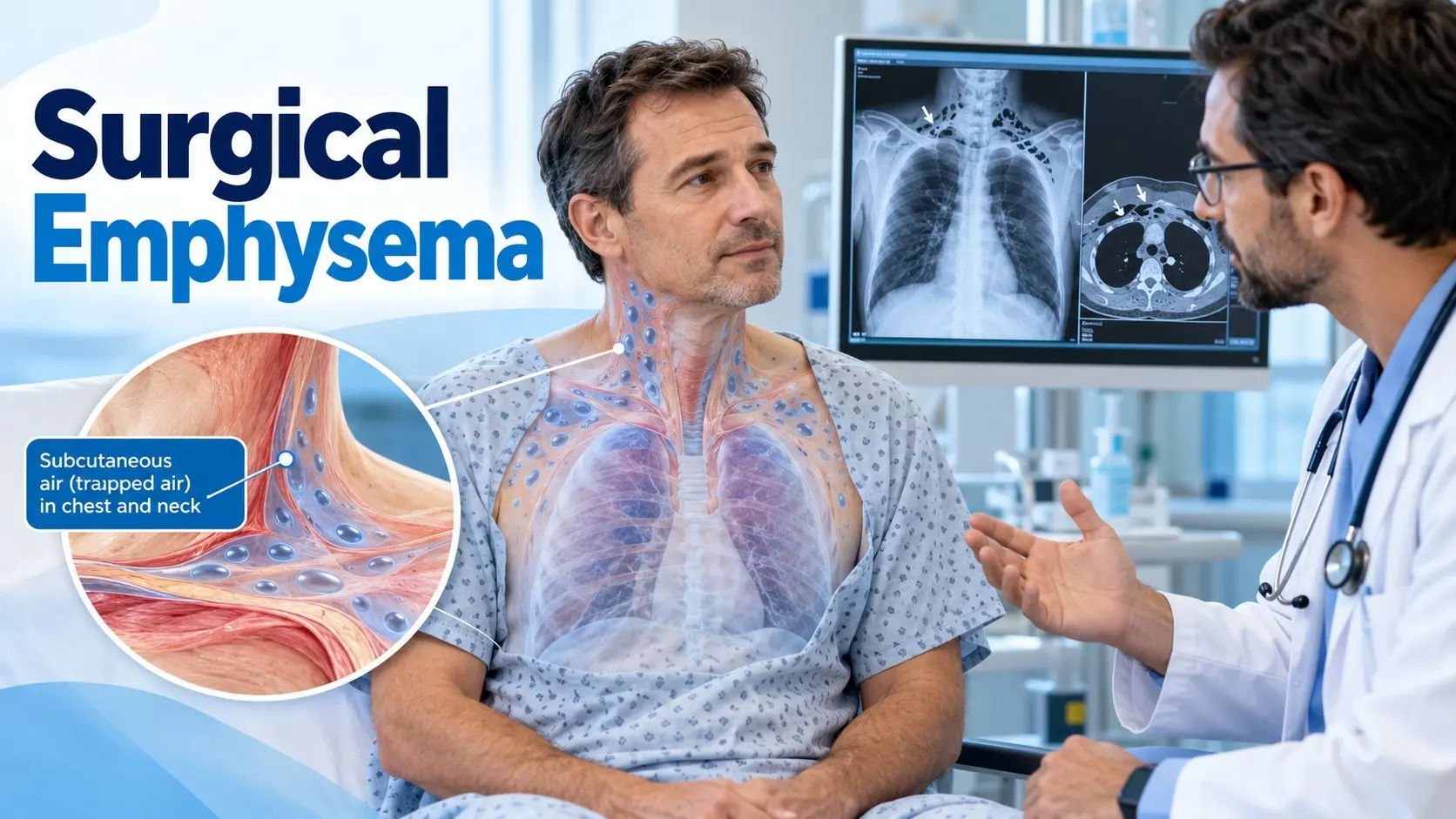
The term is another name for subcutaneous emphysema. It means air or gas has moved into the tissues beneath the skin. This most often affects the chest, neck, or face, although air can spread farther through connected tissue planes.
Some cases are small and settle after the source of the air leak is controlled. Others signal a collapsed lung, airway injury, infection, or another problem that needs fast treatment.
Quick Answer
Surgical emphysema means air is trapped under the skin. It can happen after chest surgery, trauma, chest drain problems, airway procedures, positive pressure ventilation, laparoscopy, or a collapsed lung. Mild cases may settle once the cause is treated, but rapidly spreading swelling, breathing trouble, chest pain, difficulty swallowing, or neck swelling needs urgent medical assessment.
Get Emergency Help for Severe Symptoms
Call emergency services if surgical emphysema is linked with severe breathing trouble, sudden chest pain, rapidly increasing neck or facial swelling, difficulty speaking or swallowing, blue or grey skin, confusion, collapse, or signs of severe infection.
After major chest trauma, surgical emphysema can be a clue to an underlying lung or airway injury. Do not massage the swelling, puncture it, or try to release the air yourself.
Medical notice: This content is for general educational purposes and does not replace professional medical advice, diagnosis, or treatment. Consult an appropriately qualified healthcare professional for personal medical concerns. This article explains published guidance and does not provide a personal clinical assessment. Always consult qualified medical professionals for diagnosis and treatment of any health condition.
Table of Contents
- What Surgical Emphysema Means
- How Air Gets Under the Skin
- Common Causes
- Signs and Symptoms
- 8 Critical Risks and Complications
- How Doctors Find the Cause
- How Surgical Emphysema Is Treated
- When a Chest Drain Is Involved
- When Decompression May Be Needed
- What Recovery Looks Like
- What Not to Do at Home
- When to Seek Emergency Care
- References and Sources
- Related NextFitLife Guides
- About the Author
- Frequently Asked Questions
What Does Surgical Emphysema Mean?
Surgical emphysema and subcutaneous emphysema describe the same basic problem: air has entered the tissue beneath the skin.
This is very different from the lung disease called emphysema.
Lung emphysema damages the air sacs inside the lungs and is commonly linked with COPD. Surgical emphysema involves air outside the normal airways, trapped under the skin.
| Condition | Where the Problem Is | What Happens |
|---|---|---|
| Surgical emphysema | Under the skin | Air escapes into soft tissue |
| Lung emphysema | Inside the lungs | Air sac walls are damaged |
If you meant the chronic lung disease rather than air under the skin, read our Emphysema NHS guide.
For the wider respiratory series, visit the NextFitLife Lung and Respiratory Health Hub.
How Does Air Get Under the Skin?
Air normally stays inside the lungs, airways, or other hollow organs.
If there is a tear, leak, or pressure problem, air can escape into nearby tissue. It then follows the easiest path through layers of connective tissue.
This is why subcutaneous air that starts in the chest can move upward into the neck or face.
Air may also move into the space around the lungs or into the middle of the chest.
Those conditions are called pneumothorax and pneumomediastinum.
What Causes Surgical Emphysema?
The name makes surgery sound like the only cause. It is not.
Chest Trauma
A rib fracture, blunt chest injury, penetrating injury, or lung tear can allow air to leave the lung or airway and move beneath the skin.
When surgical emphysema appears after significant trauma, doctors look for deeper injuries rather than treating the swelling alone.
Pneumothorax
A collapsed lung can produce an ongoing air leak.
Air can then move from the chest into the tissues of the chest wall, neck, or face.
A pneumothorax can occur after trauma, surgery, a medical procedure, or spontaneously.
Sudden one sided chest pain with breathlessness can be a warning sign. Our Left Side Chest Pain guide explains why sudden chest symptoms need proper assessment.
Thoracic Surgery
Operations involving the lungs, chest wall, or airways can create temporary pathways for air to escape.
A small amount of postoperative subcutaneous air may be monitored, but worsening or widespread swelling can mean that an air leak is still active.
Chest Drain Problems
A chest drain is used to remove air or fluid from the space around a lung.
If a drain becomes blocked, moves, is poorly positioned, or does not control the underlying leak, air can track into the chest wall instead.
Clinicians need to check both the drain and the reason the air is still escaping.
Intubation and Airway Procedures
Procedures involving a breathing tube, bronchoscopy, tracheostomy, or another airway device can rarely injure the airway wall.
Air escaping through a tear can enter the soft tissues of the neck and chest.
Positive Pressure Ventilation
Positive pressure ventilation pushes air into the lungs.
If pressure becomes too high or lung tissue is fragile, air can escape outside the normal air spaces. This can lead to pneumothorax, pneumomediastinum, or surgical emphysema.
Laparoscopic Procedures
Laparoscopic surgery uses gas to create working space inside the abdomen.
Some gas can occasionally move into tissue beneath the skin. Small amounts may settle without major treatment, but widespread swelling or breathing problems need medical review.
Dental, Ear, Nose, and Throat Procedures
Air driven under pressure during some dental or airway procedures can rarely enter facial or neck tissue.
A 2023 review found that surgical emphysema can occur after several ear, nose, throat, and airway procedures. Most reported cases were treated conservatively, but severe cases can progress to pneumothorax or pneumomediastinum.
Gas Producing Infection
This is a different and much more dangerous pathway.
Some severe bacterial infections produce gas inside damaged tissue. Gas gangrene and necrotising soft tissue infections can cause swelling, severe pain, skin colour change, fever, fast heart rate, and rapid illness.
This requires emergency treatment.
What Does Surgical Emphysema Feel Like?
The classic finding is swelling with a strange crackling feeling beneath the fingers.
This crackling sensation is called crepitus.
People sometimes describe it as:
- Bubble wrap under the skin
- Crackling under the fingers
- Rice cereal beneath the skin
- Soft swelling that feels full of tiny bubbles
Do not keep pressing repeatedly to test it. Once unusual swelling and crepitus are present, the cause matters more than proving the sensation again.
Other symptoms depend on where the air spreads
- Chest wall swelling
- Neck swelling
- Facial swelling
- Puffy eyelids
- Voice change
- Sore throat
- Difficulty swallowing
- Chest discomfort
- Shortness of breath
A small local area after a procedure is very different from swelling that is rapidly moving toward the neck and face.
8 Critical Risks and Complications
1. Pneumothorax
A pneumothorax means air has entered the space between the lung and chest wall.
This can partly or completely collapse the lung.
Surgical emphysema may be a clue that a pneumothorax is already present or that an air leak is still active.
Sudden chest pain and breathlessness need urgent assessment.
2. Tension Pneumothorax
A tension pneumothorax is a medical emergency.
Pressure builds inside the chest and can compress the lung, heart, and major blood vessels.
A person may become severely breathless, faint, confused, or unstable.
This condition needs immediate emergency treatment.
3. Pneumomediastinum
Pneumomediastinum means air has entered the central space in the chest around structures such as the heart, large vessels, and airways.
It can occur together with surgical emphysema because air travels through connected tissue planes.
Chest pain, neck pain, breathing trouble, or swallowing difficulty can occur.
4. Airway Compression
Extensive swelling in the neck can compress the trachea or surrounding tissues.
This can interfere with breathing.
Voice change, noisy breathing, trouble swallowing, or rapidly increasing neck swelling needs urgent medical assessment.
5. Severe Respiratory Distress
Large air leaks, pneumothorax, pneumomediastinum, or the illness that caused them can make breathing much harder.
The visible swelling is sometimes less dangerous than the problem underneath it.
That is why clinicians focus first on the airway, breathing, oxygen level, and the source of the leak.
6. Pressure on Soft Tissue and Circulation
Very extensive subcutaneous air can create high pressure inside tissue.
Rare severe cases have been linked with reduced blood flow, tissue pressure problems, and effects on implanted devices.
This is one reason rapidly expanding surgical emphysema may need active decompression rather than observation alone.
7. Infection and Sepsis
Air under the skin after surgery or trauma is not always caused by infection.
However, gas under the skin together with severe pain, fever, skin discolouration, foul drainage, low blood pressure, or rapid deterioration raises concern for a dangerous infection.
Sepsis and tissue death are possible complications of gas producing infection.
That situation is an emergency.
8. Hidden Airway or Oesophageal Injury
Surgical emphysema can be the first visible clue to a deeper tear.
Injury to the trachea, bronchus, or oesophagus can allow air to escape into the neck, chest, or mediastinum.
Depending on the situation, symptoms may include swallowing pain, voice change, chest pain, coughing blood, breathlessness, or persistent air leak.
Imaging and specialist tests may be needed to find the source.
How Do Doctors Find the Cause?
Finding air under the skin is only the first step.
The bigger job is finding where the air came from.
Physical Examination
A healthcare professional checks the chest, neck, face, breathing, pulse, oxygen level, blood pressure, and the area of swelling.
The crackling feeling of crepitus is a classic finding.
Chest X Ray
An X ray can show subcutaneous air and may reveal a pneumothorax or pneumomediastinum.
It can also help check the position of a chest drain.
CT Scan
A CT scan gives more detail.
It can show how far the air has spread and can help identify pneumothorax, pneumomediastinum, damaged lung tissue, or another source.
Bronchoscopy
If an airway tear is suspected, specialists may examine the airways with a flexible camera.
Other Tests
The situation may also require blood tests, oxygen measurements, ultrasound, ECG monitoring, or tests aimed at an oesophageal injury or infection.
The exact test depends on what happened before the swelling appeared.
How Is Surgical Emphysema Treated?
Treatment starts with the cause.
This is the most important point in the article.
Removing air from under the skin without controlling the source will not solve an active leak.
Observation
Small and stable cases can sometimes be watched while the body slowly reabsorbs the trapped air.
This is most appropriate when the patient is stable and serious causes have already been assessed.
Oxygen
Healthcare teams may use supplemental oxygen in selected cases.
Higher oxygen concentrations can help the body absorb trapped nitrogen and may speed reabsorption of subcutaneous air.
Oxygen is still a medical treatment. It should not be started or changed at home without guidance.
Treating a Pneumothorax
If a pneumothorax is driving the air leak, clinicians treat the pneumothorax.
Some cases require a chest drain so air can leave the pleural space rather than track into the tissues.
Correcting a Chest Drain Problem
If surgical emphysema appears after chest drainage, the team checks whether the drain is blocked, displaced, leaking, or failing to control the source.
A drain problem needs correction by trained clinicians.
Never adjust, clamp, move, or remove a chest drain yourself.
Treating Airway or Oesophageal Injury
A significant tear may require specialist airway, chest, or gastrointestinal treatment.
The approach depends on the size, location, symptoms, and stability of the patient.
Treating Infection
When a gas producing infection is suspected, urgent antibiotics and surgical assessment may be required.
Infected tissue sometimes needs emergency removal.
When Does the Air Itself Need to Be Released?
Most mild cases do not need the skin to be opened.
Severe cases are different.
When extensive swelling causes major discomfort, eye closure, airway pressure, breathing problems, or rapid progression, specialists may use techniques to remove subcutaneous air.
These may include:
- A subcutaneous drain
- A catheter placed by a clinician
- Small surgical release incisions
- Negative pressure wound therapy in selected severe cases
These are hospital procedures.
Do not copy drainage techniques from videos or medical case reports.
A 2024 retrospective study from UK respiratory teams reported the use of subcutaneous drains for debilitating surgical emphysema. A 2026 BMJ case report also described successful use of a subcutaneous drain with negative pressure wound therapy in a patient who developed extensive surgical emphysema after pneumothorax and chest drainage.
The evidence for these methods is still based largely on case reports and observational experience rather than one universal treatment protocol.
Can Treatment Itself Cause Complications?
Yes, which is why treatment is matched to severity.
Chest Drain Risks
Chest tubes are lifesaving when needed, but problems such as blockage, displacement, poor positioning, or side holes sitting outside the chest cavity can allow air to enter the soft tissue.
Bleeding, infection, pain, and injury to nearby structures are other known chest drain risks.
Drainage Procedure Risks
Subcutaneous drains, catheters, or release incisions can cause bleeding, infection, pain, or local tissue injury.
This is why they are usually reserved for significant cases rather than mild swelling that is already settling.
Ventilation Related Risk
People who need mechanical ventilation may have an ongoing air leak worsened by pressure.
Ventilator settings are adjusted by critical care clinicians based on lung condition and gas exchange.
This should never be viewed as a simple pressure setting that can be copied from another patient.
What Does Recovery Look Like?
Recovery depends on the cause.
When the underlying leak stops, the body can slowly absorb the air beneath the skin.
Cleveland Clinic notes that many treated cases improve over about 10 to 14 days, although severe cases and cases with ongoing lung injury can take longer.
Do not judge recovery only by the skin swelling.
Doctors also need to know that the pneumothorax, airway injury, infection, or other cause is improving.
What Should You Watch After Surgery or a Chest Procedure?
New swelling after surgery should not automatically be dismissed as normal postoperative puffiness.
Contact the treating team if you notice:
- New crackling beneath the skin
- Increasing chest or neck swelling
- Swelling moving toward the face
- New breathlessness
- Chest pain
- A new voice change
- Difficulty swallowing
- Fever
- Worsening pain
- Red or darkening skin
After thoracic surgery or chest drain treatment, the team may give you more specific warning signs. Follow those instructions first.
What Should You Not Do at Home?
- Do not puncture the skin to release air.
- Do not massage the swelling hard.
- Do not remove or reposition a chest drain.
- Do not clamp tubing unless your clinical team has specifically told you to do so.
- Do not use someone else's oxygen equipment.
- Do not assume crackling swelling is a harmless allergic reaction.
- Do not wait at home when swelling is spreading quickly toward the neck or face.
Home treatment cannot tell you whether the air came from a collapsed lung, airway tear, infection, or another serious cause.
When Is Surgical Emphysema an Emergency?
Not every small area of surgical emphysema is life threatening.
The situation becomes more concerning when symptoms suggest that the air leak is large, spreading, or affecting the chest or airway.
Seek emergency care for:
- Severe or worsening breathlessness
- Rapidly spreading chest, neck, or facial swelling
- Noisy or difficult breathing
- Difficulty speaking normally
- Difficulty swallowing
- Sudden severe chest pain
- Blue or grey lips or skin
- Fainting or collapse
- Confusion or unusual drowsiness
- Coughing blood after chest or airway injury
- Severe pain with fever or skin colour change
After major trauma, the presence of surgical emphysema itself can point to a serious hidden injury and warrants urgent assessment.
A Simple Way to Think About Severity
| Pattern | What It May Mean | Next Step |
|---|---|---|
| Small stable area after a known procedure | May settle after the leak stops | Follow the treating team's instructions |
| Swelling spreading across chest or neck | Ongoing or larger air leak | Prompt medical assessment |
| Face or neck swelling with voice change | Possible airway involvement | Urgent assessment |
| Sudden chest pain and breathlessness | Possible pneumothorax or another chest emergency | Emergency care |
| Gas under skin with fever and severe pain | Possible serious infection | Emergency care |
Conclusion
Surgical Emphysema is air trapped under the skin, not surgery for chronic lung emphysema. Small cases can settle after the source of the air leak is controlled, but rapidly spreading swelling can point to pneumothorax, airway injury, infection, or another serious problem.
The best next step is simple: if you develop new crackling swelling after trauma, surgery, chest drainage, intubation, or another procedure, contact the treating team promptly.
If breathing becomes difficult, swelling rapidly reaches the neck or face, severe chest pain develops, or you feel faint or confused, seek emergency care.
References and Sources
The following open medical sources support the definition, causes, complications, diagnosis, and management information used in this guide.
- Cleveland Clinic.
Subcutaneous Emphysema: What It Is, Causes and Treatment.
Medically reviewed. Updated March 27, 2025.
https://my.clevelandclinic.org/health/diseases/subcutaneous-emphysema - MedlinePlus, U.S. National Library of Medicine.
Subcutaneous Emphysema.
Reviewed July 12, 2024.
https://medlineplus.gov/ency/article/003286.htm - Kukuruza K, Aboeed A.
Subcutaneous Emphysema.
StatPearls. NCBI Bookshelf.
Explains air spread through tissue planes, associated pneumothorax and pneumomediastinum, severe spread, diagnosis, and management.
https://www.ncbi.nlm.nih.gov/books/NBK542192/ - Siddiqui S, Falak U, Frost N, Athar W.
Can subcutaneous drain safely counter debilitating surgical emphysema? A retrospective study in quest for an answer.
Respirology Case Reports. 2024;12(1):e01285.
Free full text: PubMed Central.
https://pmc.ncbi.nlm.nih.gov/articles/PMC10807986/ - Cook H, Ghorbanian S, Erotocritou M, Coull L, Oezdogan Y.
Surgical Emphysema Post Liposuction Overseas: A Case Report.
Aesthetic Surgery Journal Open Forum. 2025;7:ojaf085.
PMID: 40727040. PMCID: PMC12302130.
Free full text: PubMed Central.
https://pmc.ncbi.nlm.nih.gov/articles/PMC12302130/
Related NextFitLife Guides and Lung Health Hub
This article sits within the NextFitLife respiratory content cluster. Use these guides for related questions about lung disease, chest symptoms, and breathing safety.
- Lung and Respiratory Health Hub
- Emphysema NHS: Causes, Tests, and Treatment
- Left Side Chest Pain: What It Means and What to Do
- Chest Pain After Exercise: Causes and Emergency Signs
About the Author
Adel Galal is the founder and editor of NextFitLife. He writes consumer health, fitness, nutrition, sleep, and healthy aging content using recognized medical, public health, and academic sources.
This content is for general educational purposes and does not replace professional medical advice, diagnosis, or treatment. Consult an appropriately qualified healthcare professional for personal medical concerns. This article explains published guidance and does not provide a personal clinical assessment. Always consult qualified medical professionals for diagnosis and treatment of any health condition.
Learn more about Adel, NextFitLife, and the site's editorial approach on the About Us page.
Frequently Asked Questions
What is surgical emphysema?
Surgical emphysema is another name for subcutaneous emphysema. It means air or gas has entered the tissue beneath the skin. It commonly affects the chest, neck, or face.
Is surgical emphysema the same as lung emphysema?
No. Lung emphysema damages the air sacs inside the lungs and is commonly linked with COPD. Surgical emphysema means air has leaked into tissue beneath the skin.
What does surgical emphysema feel like?
The skin may look swollen and feel crackly when touched. This crackling feeling is called crepitus. Swelling can occur on the chest, neck, face, or other areas.
What causes surgical emphysema after surgery?
Possible causes include an air leak from the lung, pneumothorax, chest surgery, chest drain problems, airway injury, positive pressure ventilation, or gas moving into tissue during some laparoscopic procedures.
Is surgical emphysema dangerous?
Small cases may settle once the source of air is controlled. Extensive or rapidly spreading cases can be serious because they may be linked with pneumothorax, pneumomediastinum, airway compression, infection, or deeper injury.
Can surgical emphysema go away on its own?
Mild cases can resolve as the body reabsorbs the air after the leak stops. The cause still needs assessment because trapped air can be a sign of a more serious problem.
How is surgical emphysema treated?
Treatment focuses first on the cause. Options may include observation, oxygen, treatment of a pneumothorax, correction of a chest drain problem, treatment of infection, or specialist repair of an airway injury. Severe cases may need a subcutaneous drain or another decompression method.
When does surgical emphysema need emergency care?
Seek emergency help for severe or worsening breathlessness, rapid neck or facial swelling, difficulty speaking or swallowing, severe chest pain, blue or grey skin, fainting, confusion, collapse, or severe pain and fever suggesting infection.
Should I massage surgical emphysema?
No. Do not try to push, massage, puncture, or drain trapped air yourself. The cause may be a pneumothorax, airway injury, infection, or another condition that needs medical treatment.
Can a chest drain cause surgical emphysema?
Yes. Surgical emphysema can occur when a chest drain is blocked, displaced, poorly positioned, or unable to control an ongoing air leak. The drain should be checked by trained clinicians.

Health & wellness writer with 30+ years of experience in nutrition, fitness, and healthy aging. Founder of NextFitLife.com — evidence-based health guidance.