
Last updated: October 7, 2026
Written and edited by: Adel Galal, Founder and Editor of NextFitLife
Medical review status: This article has not been medically reviewed by a doctor, vascular specialist, neurologist, physiotherapist, or other licensed healthcare professional.
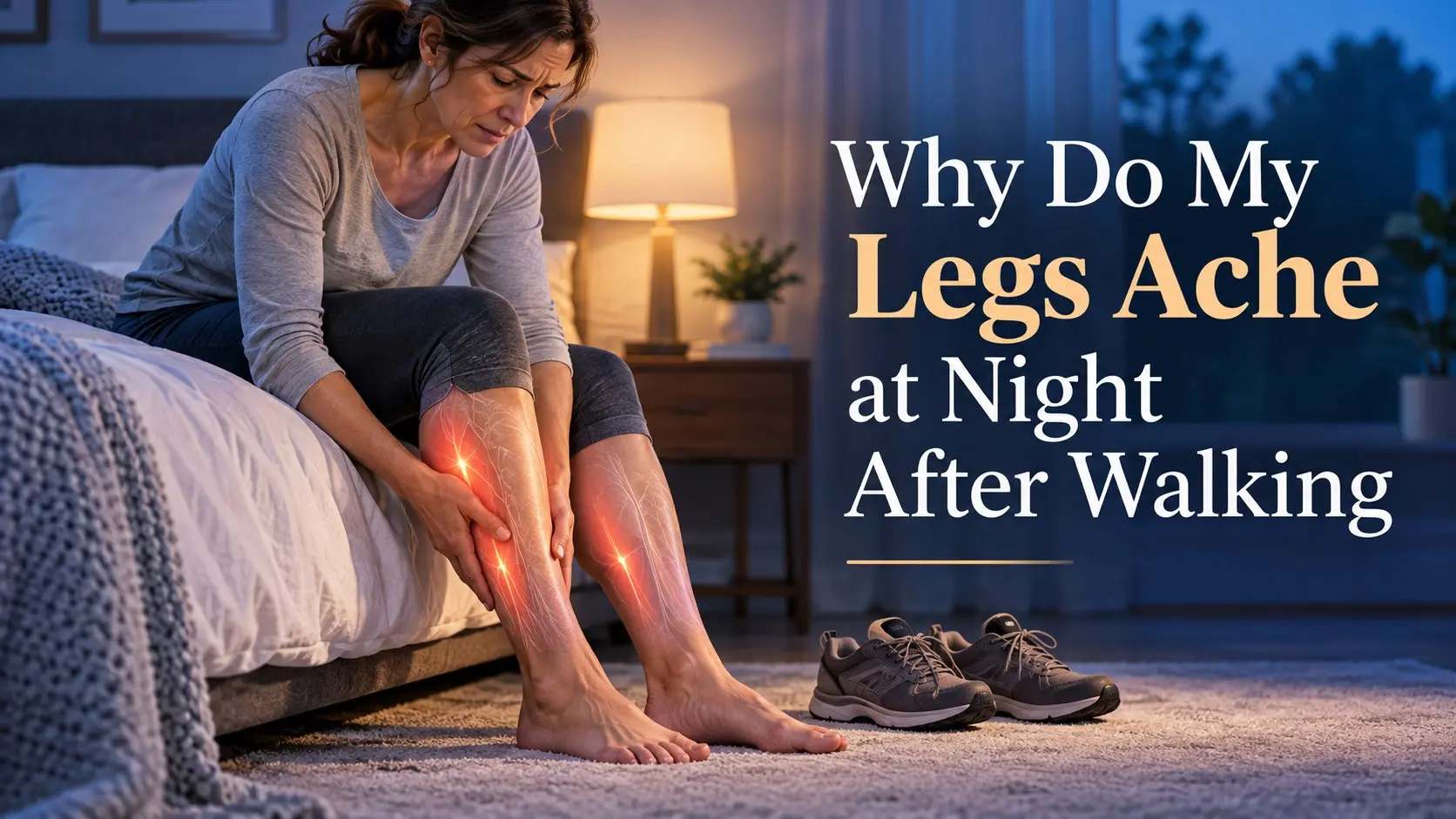
Why do my legs ache at night after walking is a common question, and the answer often depends on when the pain begins, where it is located, and whether rest makes it better.
If you are asking why do my legs ache at night after walking, common causes include tired muscles, overuse, delayed muscle soreness, nighttime cramps, arthritis, sciatica, vein problems, and poor footwear. However, pain that repeatedly starts during walking and improves after a few minutes of rest can be a sign of reduced arterial blood flow.
The pattern is often more useful than the pain alone.
This article is for general information and education. It does not replace medical advice, diagnosis, or treatment.
Get prompt medical care if one leg becomes suddenly swollen, warm, red or darker than usual, and painful.
Seek emergency help if leg symptoms come with sudden chest pain, severe shortness of breath, coughing blood, fainting, or a very fast heartbeat.
Also seek urgent assessment if a foot becomes suddenly cold, pale, blue, numb, very weak, or severely painful.
Table of Contents
- Quick Answer
- 12 Common Causes
- Muscle fatigue
- Delayed muscle soreness
- Night leg cramps
- Peripheral artery disease
- Varicose veins
- Osteoarthritis
- Sciatica
- Footwear problems
- Dehydration
- Medication effects
- Training overload
- Deep vein thrombosis
- Pain Pattern Guide
- Circulation Clues
- Safe Relief
- When to Seek Help
- Frequently Asked Questions
Why Do My Legs Ache at Night After Walking? Quick Answer
The simplest answer is that your leg muscles may have worked harder than usual during the day.
If the ache follows a long walk, affects both legs, and settles over a day or two, muscle fatigue or mild overuse is a common explanation.
Other patterns point in different directions.
- A sudden hard calf at night suggests a cramp.
- Pain that starts during walking and stops after rest suggests intermittent claudication.
- Pain around the knee or hip may suggest arthritis.
- Shooting pain from the back into the leg may suggest sciatica.
- Heavy aching with ankle swelling may suggest venous problems.
12 Causes of Leg Aches at Night After Walking
1. Muscle Fatigue
Walking uses the calves, thighs, hips, feet, and core muscles.
A longer or faster walk than usual can leave these muscles tired later in the day.
Muscle fatigue is more likely when:
- You walked farther than usual
- You walked uphill
- You walked on uneven ground
- You recently became more active
- You wore heavy shoes
The ache is usually dull rather than sharp and often affects both legs.
2. Delayed Muscle Soreness
New or harder activity can produce delayed muscle soreness.
The discomfort may become more noticeable several hours after exercise and can feel worse the next day.
It commonly causes:
- Tender muscles
- Stiffness
- Aching
- Pain when using the muscle
This is especially common after hills, stairs, or a sudden increase in walking distance.
3. Night Leg Cramps
Leg cramps cause a sudden painful tightening of a muscle, usually the calf.
NHS guidance notes that cramps often happen at night or while resting and may follow excessive muscle strain, dehydration, pregnancy, ageing, or some medicines.
The muscle may remain sore for up to a day after the cramp.
4. Peripheral Artery Disease
Peripheral artery disease, or PAD, reduces blood flow to the legs.
The classic symptom is intermittent claudication.
This usually causes:
- Calf aching
- Cramping
- Heaviness
- Fatigue
The key clue is that the pain starts during walking and improves after a few minutes of rest.
Walking faster or uphill may make it appear sooner.
Advanced PAD can eventually cause pain even while resting or sleeping.
5. Varicose Veins and Venous Problems
Varicose veins can cause:
- Aching
- Heaviness
- Throbbing
- Swelling
- Itching
Symptoms are often worse after spending many hours standing.
They may improve when you rest with the legs raised.
6. Knee or Hip Osteoarthritis
Osteoarthritis can make walking painful, especially in the knees and hips.
Knee osteoarthritis may hurt more when:
- Walking uphill
- Walking downhill
- Using stairs
- Standing for long periods
Hip arthritis can also cause pain during movement and sometimes while resting or sleeping.
7. Sciatica
Sciatica is pain caused by irritation of the sciatic nerve.
It can travel from the lower back or buttock down the leg.
The pain may feel:
- Shooting
- Burning
- Electric
- Sharp
Numbness or tingling may occur too.
Walking can sometimes make symptoms more noticeable, depending on the cause.
8. Poor Footwear
Shoes that fit badly can change how your feet, ankles, knees, and hips move.
Problems include:
- Worn soles
- Poor cushioning
- Too little support
- Shoes that are too tight
- A sudden switch to very different footwear
The result can be muscle fatigue and joint pain later in the day.
9. Dehydration
Not drinking enough fluid can contribute to muscle cramping in some people, especially after exercise in hot weather.
However, dehydration should not be used to explain every case of nighttime leg pain.
10. Medication Effects
Some medicines can contribute to muscle pain or cramps.
Examples can include certain:
- Statins
- Diuretics
- Hormonal medicines
- Other prescription drugs
Do not stop medication on your own.
Ask your prescriber or pharmacist if symptoms appeared after starting or changing a medicine.
11. Training Overload
Your muscles need time to adapt when walking distance or intensity increases.
Increasing too quickly can lead to:
- Muscle soreness
- Tendon irritation
- Foot pain
- Shin discomfort
- Joint pain
A gradual increase in distance is usually easier on the body than making a sudden jump.
12. Deep Vein Thrombosis
Deep vein thrombosis, or DVT, is a blood clot in a deep vein.
Possible signs include:
- Swelling
- Pain
- Tenderness
- Warmth
- Redness or discolouration
It usually affects one leg.
A DVT can travel to the lungs and cause pulmonary embolism.
Pain Pattern Guide
| Pattern | Possible Cause | Useful Clue |
|---|---|---|
| Dull ache after long walk | Muscle fatigue | Usually improves with recovery |
| Hard calf spasm at night | Leg cramp | Sudden tight muscle |
| Pain starts after similar walking distance | PAD | Improves after a few minutes of rest |
| Heavy aching with swollen ankles | Venous disease | Worse after prolonged standing |
| Knee pain after hills or stairs | Osteoarthritis | Joint stiffness may be present |
| Shooting pain from back | Sciatica | May include tingling or numbness |
| One swollen warm painful leg | Possible DVT | Needs prompt medical assessment |
How to Tell Muscle Fatigue From Poor Circulation
This distinction matters.
Muscle Fatigue
More likely when:
- You walked farther than usual
- Both legs ache
- Pain is not triggered at the same distance every time
- The discomfort improves over a day or two
Peripheral Artery Disease
More likely when:
- The pain starts predictably while walking
- The calf is often affected
- It improves after a few minutes of rest
- It returns when walking resumes
- Walking uphill brings it on faster
This pattern deserves medical assessment.
Can PAD Cause Pain at Night?
Yes, but this usually suggests more advanced disease.
NHS guidance notes that severe restriction of blood flow can cause burning pain even while resting.
Other warning signs include:
- Cold feet
- Numbness
- Pale or blue skin
- Slow healing wounds
- Black skin or tissue
Rest pain should not be ignored.
How Is PAD Diagnosed?
A clinician may check:
- Your symptoms
- Pulses in your feet
- Skin changes
- Blood pressure in the arm and ankle
The ankle brachial pressure index, or ABPI, compares blood pressure at the ankle with blood pressure in the arm.
Sometimes the measurement is repeated after exercise.
Why Do My Calves Hurt After Walking?
Calf pain after walking can come from:
- Muscle overuse
- Leg cramps
- PAD
- Varicose veins
- Footwear
- Nerve problems
The timing is important.
Pain that starts only later that evening is different from pain that begins while you walk and disappears when you stop.
Why Do My Knees Ache at Night After Walking?
Knee pain after walking can occur with osteoarthritis, tendon irritation, muscle fatigue, or overuse.
Osteoarthritis pain is often worse with:
- Walking
- Hills
- Stairs
- Long periods of activity
Persistent knee swelling, locking, instability, or pain affecting sleep deserves assessment.
Why Do My Hips Ache After Walking?
Hip pain may come from:
- Osteoarthritis
- Tendon irritation
- Bursitis
- Muscle strain
- Back problems
Hip osteoarthritis can also hurt during rest or sleep.
Can Varicose Veins Cause Pain After Walking?
Yes.
Varicose veins may cause:
- Aching
- Heaviness
- Throbbing
- Itching
- Ankle swelling
Symptoms are often worse after being upright for a long time.
Can Sciatica Get Worse After Walking?
Yes.
Walking can increase symptoms in some people with spinal or nerve problems.
Typical sciatica pain:
- Starts in the lower back or buttock
- Travels down one leg
- Feels burning or shooting
- May cause tingling or numbness
Could My Walking Shoes Be Causing the Pain?
Yes.
Shoes affect how force travels through your feet, ankles, knees, and hips.
Replace footwear when:
- The soles are badly worn
- The cushioning is compressed
- Your toes are cramped
- Your heel slips excessively
Does Walking Too Much Cause Night Leg Pain?
It can.
A sudden increase in distance is a common reason for muscle soreness.
Increase your walking gradually, especially if you have been inactive.
Can Dehydration Cause the Pain?
Dehydration can contribute to muscle cramping, especially after exercise in heat.
Signs include:
- Thirst
- Dark urine
- Dry mouth
- Dizziness
However, drinking more water will not fix PAD, arthritis, DVT, or sciatica.
Do I Need Magnesium?
Not automatically.
Magnesium deficiency can affect muscle function, but routine nighttime cramps do not always come from low magnesium.
Supplementation does not help every person with ordinary leg cramps.
Read our Benefits of Magnesium and Zinc Guide for a broader look at supplementation.
What Helps Ordinary Muscle Aches?
If the pain appears to be ordinary muscle fatigue, you can try:
- Gentle movement
- Light stretching
- A warm shower
- Rest from unusually hard activity
- Adequate fluids
- Comfortable footwear
Avoid aggressive stretching when pain is sharp or severe.
What Helps a Night Calf Cramp?
NHS guidance recommends stretching and massaging the cramped muscle.
You can try:
- Straighten your leg.
- Pull your toes gently toward the shin.
- Massage the calf.
- Stand carefully if safe.
- Walk slowly for a short time.
Should I Walk Again the Next Day?
If the discomfort is mild muscle soreness, easy walking may help loosen the legs.
Reduce the distance or pace if needed.
Do not push through:
- Severe pain
- Major swelling
- New weakness
- Chest symptoms
- Sudden one sided calf pain
Can Walking Actually Help PAD?
Yes.
This seems surprising because walking can trigger claudication pain.
However, structured walking exercise is an important treatment for diagnosed PAD.
NHS guidance recommends supervised exercise in many cases, often using repeated walking followed by rest.
This should be part of a proper treatment plan rather than self diagnosing PAD and pushing through unexplained pain.
When Should You See a Doctor?
Arrange an assessment if:
- Pain happens every time you walk
- Pain begins after a predictable distance
- The walking distance before pain is getting shorter
- The pain wakes you at night
- You have numbness or weakness
- You have persistent ankle swelling
- You develop nonhealing sores
- The pain keeps returning
When Is It Urgent?
Get prompt medical help for:
- One swollen, warm, painful leg
- Sudden severe leg pain
- A cold or blue foot
- New numbness or weakness
- Wounds that become black
- Rapidly worsening symptoms
Seek emergency care for:
- Sudden shortness of breath
- Chest pain
- Coughing blood
- Fainting
A 7 Day Walking Pain Diary
Before the Walk
Record:
- Your planned distance
- Your shoes
- Whether pain is already present
During the Walk
Record:
- When pain starts
- Which leg hurts
- Calf, thigh, hip, knee, or foot
- Whether slowing down helps
- Whether stopping helps
At Night
Record:
- Ache versus cramp
- Swelling
- Burning or tingling
- Joint stiffness
- Whether elevation helps
This information can help a clinician separate muscle, joint, nerve, vein, and arterial causes.
Common Myths About Leg Pain After Walking
Myth 1: Leg Pain After Walking Is Always Normal
False.
Recurring exercise induced leg pain can be a sign of PAD.
Myth 2: PAD Only Affects Older People
False.
Risk increases with age, but smoking, diabetes, high blood pressure, and high cholesterol also matter.
Myth 3: If Pain Improves With Rest, It Cannot Be Serious
False.
Claudication classically improves with rest.
Myth 4: Every Calf Pain Is a Blood Clot
False.
Muscle strain and cramps are much more common, but swelling, warmth, redness, and unexplained tenderness need assessment.
Myth 5: Magnesium Fixes Every Walking Related Leg Ache
False.
Muscle pain can come from overuse, circulation, joints, nerves, footwear, or other causes.
Myth 6: Walking Is Bad if You Have PAD
False.
Structured walking is often part of PAD treatment after diagnosis.
Conclusion
If you are asking why do my legs ache at night after walking, the pattern can help reveal the cause.
A dull ache after an unusually long walk often points to muscle fatigue, while nighttime tightening may be a leg cramp. Knee or hip pain can come from osteoarthritis, and heavy swollen legs may suggest venous disease.
The most important pattern not to miss is pain that repeatedly begins during walking and improves within minutes of rest. This is classic for intermittent claudication and should be assessed for peripheral artery disease.
Your next step is simple: record when the pain starts, where it occurs, whether rest relieves it, and whether there is swelling, numbness, skin change, or weakness.
If one leg suddenly becomes swollen, warm, or painful, or if leg symptoms come with chest pain or breathlessness, seek prompt medical care.
References and Sources
- NHS. Peripheral Arterial Disease.
https://www.nhs.uk/conditions/peripheral-arterial-disease-pad/ - NHS. Diagnosis of Peripheral Arterial Disease.
https://www.nhs.uk/conditions/peripheral-arterial-disease-pad/diagnosis/ - NHS. Leg Cramps.
https://www.nhs.uk/conditions/leg-cramps/ - NHS. Varicose Veins.
https://www.nhs.uk/conditions/varicose-veins/ - NHS. Osteoarthritis Symptoms.
https://www.nhs.uk/conditions/osteoarthritis/symptoms/ - Centers for Disease Control and Prevention. About Venous Thromboembolism.
https://www.cdc.gov/blood-clots/about/ - NHS. Peripheral Arterial Disease Treatment.
https://www.nhs.uk/conditions/peripheral-arterial-disease-pad/treatment/
Internal Links + Hub
- NextFitLife Health Articles Hub
- Why Do My Legs Ache at Night?
- What Causes Itchy Legs Below the Knee?
- Benefits of Magnesium and Zinc
- Normal Calcium Levels UK
- How to Keep Diabetes Under Control
- Healthy Eating for Older Adults
About the Author
Adel Galal is the founder and editor of NextFitLife. He writes practical consumer health, fitness, mobility, nutrition, and healthy ageing content using information from recognized medical, public health, and academic sources.
I am not a doctor, vascular specialist, neurologist, physiotherapist, pharmacist, or other licensed healthcare professional. This content does not replace professional medical advice. What I share comes from real life experience, extensive research, and consultation with healthcare providers. Always consult qualified medical professionals for diagnosis and treatment of any health condition.
Learn more about NextFitLife, the author, and the site's editorial approach on the About Us page.
Frequently Asked Questions
Why do my legs ache at night after walking?
Common causes include muscle fatigue, overuse, leg cramps, arthritis, sciatica, vein problems, and poor footwear. Pain that repeatedly starts during walking and improves after rest may suggest peripheral artery disease.
Why do my calves hurt after walking?
Calf pain can come from muscle overuse, cramps, circulation problems, varicose veins, nerve problems, or footwear. Pain that starts after a predictable walking distance and eases with rest deserves medical assessment.
How do I know if my leg pain is from poor circulation?
Peripheral artery disease often causes aching or cramping during walking that improves within a few minutes of rest and returns when walking resumes.
Can peripheral artery disease cause pain at night?
Yes. More severe PAD can cause rest pain, often described as burning pain in the foot or leg, and it may wake a person at night.
Can varicose veins make my legs ache after walking?
Yes. Varicose veins can cause aching, heaviness, throbbing, swelling, and itching, especially after long periods of standing or activity.
Can arthritis cause nighttime leg pain after walking?
Yes. Knee and hip osteoarthritis can become more painful after activity, and hip arthritis can also cause pain during rest or sleep.
Can sciatica cause leg pain after walking?
Yes. Sciatica can cause shooting, burning, or electric pain from the lower back or buttock into the leg, sometimes with numbness or tingling.
Can dehydration cause nighttime leg pain?
Dehydration can contribute to muscle cramps in some people, especially after heat or heavy exercise, but it does not explain every type of leg pain.
Does magnesium help leg pain after walking?
Magnesium may help if a true deficiency exists, but routine walking related leg pain is often caused by muscle overuse, joints, nerves, veins, or arterial circulation rather than low magnesium.
When should I see a doctor for leg pain after walking?
See a doctor if pain happens repeatedly during walking, begins after a predictable distance, affects sleep, or comes with numbness, weakness, skin changes, swelling, or nonhealing wounds.
What are warning signs of a DVT?
DVT may cause swelling, pain or tenderness, warmth, and redness or discoloration, usually in one leg. Prompt medical assessment is important.
When is leg pain after walking an emergency?
Seek urgent help for a suddenly cold, blue, numb, or severely painful foot, or one swollen hot painful leg. Seek emergency care for leg symptoms with chest pain, severe breathlessness, coughing blood, or fainting.

Health & wellness writer with 30+ years of experience in nutrition, fitness, and healthy aging. Founder of NextFitLife.com — evidence-based health guidance.