
Last updated: October 8, 2026
Written and edited by: Adel Galal, Founder and Editor of NextFitLife
Medical review status: This article has not been medically reviewed by a dentist, doctor, gastroenterologist, ENT specialist, pharmacist, or other licensed healthcare professional.
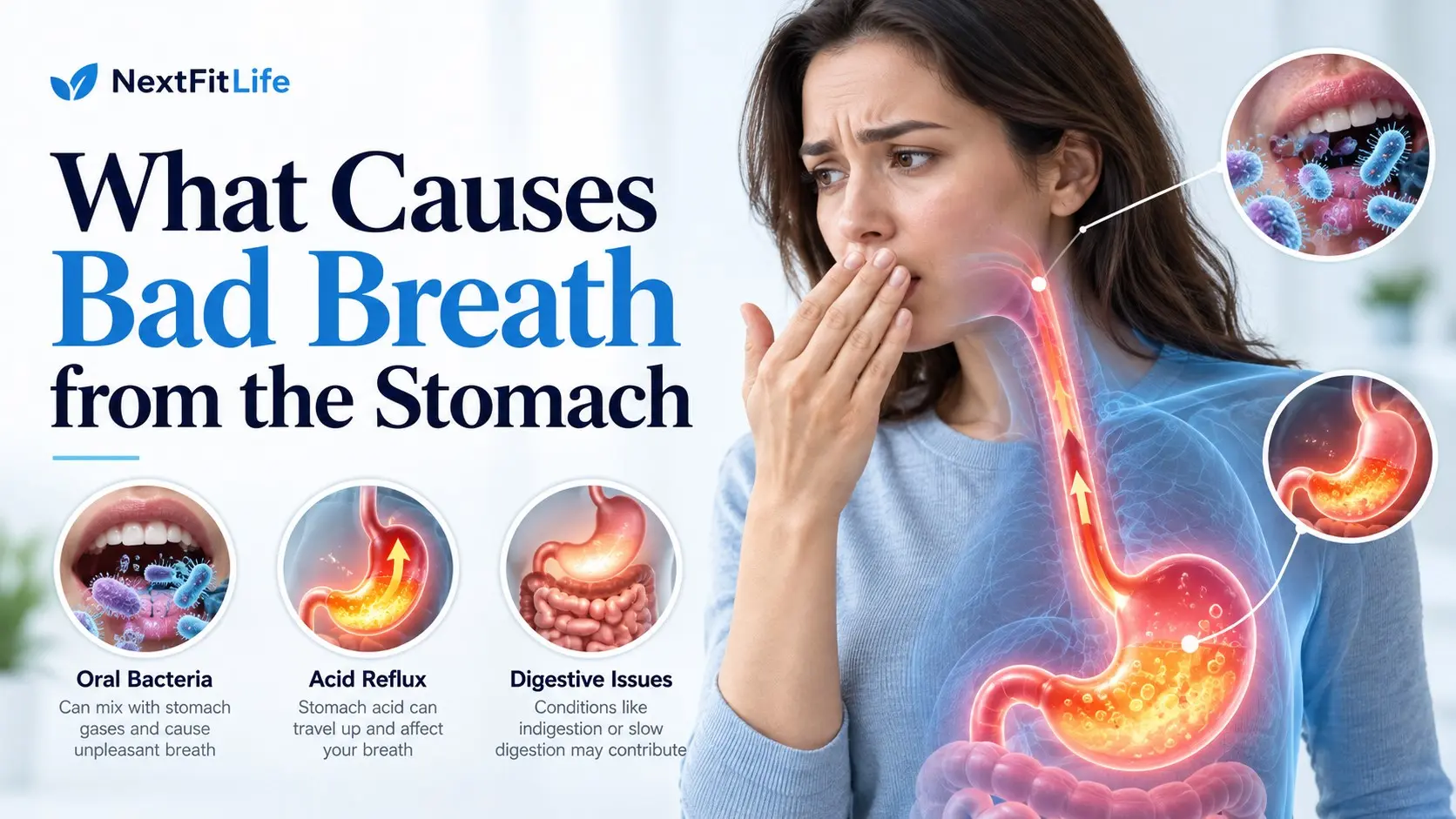
What causes bad breath from the stomach is a common question, but the most important fact comes first: most persistent bad breath does not actually begin in the stomach.
Most halitosis starts in the mouth. Common causes include tongue coating, gum disease, plaque, cavities, food trapped between teeth, and dry mouth.
Digestive problems can contribute in some people. Possible examples include acid reflux, H. pylori infection, repeated regurgitation, and rare conditions that allow food or fluid to remain in the upper digestive tract.
The best approach is therefore to check the mouth first, then look deeper when dental care does not solve the problem or when clear digestive symptoms are present.
This article is for general information and education. It does not replace medical advice, diagnosis, or treatment.
Seek medical care promptly if persistent bad breath comes with trouble swallowing, repeated vomiting, vomiting blood, black stools, severe abdominal pain, unexplained weight loss, persistent loss of appetite, or food repeatedly getting stuck.
These symptoms need proper investigation rather than breath remedies alone.
Table of Contents
- Quick Answer
- Does bad breath really come from the stomach?
- Why the mouth usually comes first
- 11 Possible Causes
- Tongue bacteria
- Gum disease
- Dry mouth
- Acid reflux
- H. pylori infection
- Regurgitation
- Delayed stomach emptying
- Hiatus hernia
- Food retention in the oesophagus
- Fasting and ketosis
- Rare digestive obstruction
- How to Tell the Source
- Testing
- Safe Treatment
- What Does Not Work
- Warning Signs
- Frequently Asked Questions
What Causes Bad Breath from the Stomach? Quick Answer
If you are searching for what causes bad breath from the stomach, start with this rule: stomach causes are possible, but oral causes are much more common.
Research suggests that about 80 to 90 percent of halitosis comes from inside the mouth.
The most common sources include:
- Tongue coating
- Dental plaque
- Gum disease
- Tooth decay
- Food debris
- Dry mouth
A digestive cause becomes more likely when bad breath occurs with symptoms such as:
- Heartburn
- Sour liquid coming into the mouth
- Frequent belching
- Upper abdominal pain
- Nausea
- Regurgitation
- Problems swallowing
Does Bad Breath Really Come From the Stomach?
Sometimes.
It is simply much less common than many people think.
Your stomach is separated from the mouth by the oesophagus and several protective mechanisms.
Odours do not normally travel freely upward all day.
When gastrointestinal disease causes halitosis, there is often another problem that allows stomach contents, gas, or volatile compounds to influence the breath.
Why Most Bad Breath Starts in the Mouth
Bacteria living on the tongue, teeth, gums, and other oral surfaces break down proteins.
This can produce volatile sulfur compounds.
These compounds are major contributors to the classic unpleasant smell of halitosis.
Important oral sources include:
- A coated tongue
- Gingivitis
- Periodontitis
- Plaque
- Deep cavities
- Food trapped around teeth
- Poorly cleaned dentures
This is why a dental check is usually a better first step than assuming your stomach is the problem.
11 Reasons Bad Breath May Seem to Come From the Stomach
1. Tongue Bacteria Can Be Mistaken for a Stomach Problem
The tongue is one of the most important sources of oral malodour.
Its rough surface gives bacteria, food debris, and dead cells many places to collect.
The back of the tongue is especially important.
If bad breath improves after cleaning your tongue, the stomach was probably not the main problem.
2. Gum Disease Can Cause Persistent Bad Breath
Gum disease can create deep spaces around teeth where bacteria collect.
Possible signs include:
- Bleeding gums
- Swollen gums
- Gum recession
- Loose teeth
- Persistent bad breath
NIDCR lists persistent bad breath as one possible symptom of periodontal disease.
If gum symptoms are present, read our guide to gum disease and safe home care.
3. Dry Mouth Can Create Strong Breath Odour
Dry mouth, also called xerostomia, is another major cause that people may mistake for a digestive problem.
Saliva helps:
- Wash food away
- Control microorganisms
- Keep oral tissues moist
- Protect teeth
When saliva falls, odour producing bacteria can become harder to control.
Dry mouth can come from:
- Medicines
- Dehydration
- Smoking
- Alcohol
- Sjögren's disease
- Diabetes
- Radiation treatment
4. Acid Reflux Can Contribute to Bad Breath
Acid reflux happens when stomach contents travel upward into the oesophagus.
If reflux keeps happening, it may be called gastro oesophageal reflux disease, or GORD in the UK.
NHS lists possible reflux symptoms including:
- Heartburn
- Sour taste
- Regurgitation
- Cough
- Hoarse voice
- Bloating
- Bad breath
This makes reflux a genuine possible digestive cause.
However, it should not be labelled the cause of every case of halitosis.
5. H. pylori Infection May Be Associated With Halitosis
Helicobacter pylori, usually called H. pylori, is a bacterium that can infect the stomach.
It is a major cause of stomach and duodenal ulcers.
Research has also found an association between H. pylori infection and halitosis.
A meta analysis found that bad breath was more common in people with H. pylori and often improved after successful eradication.
However, newer research shows that results vary and H. pylori can also be found in oral plaque and saliva.
Bad breath alone is therefore not enough to diagnose H. pylori.
6. Regurgitation Can Bring Odour Into the Mouth
Regurgitation means stomach or oesophageal contents move back upward into the throat or mouth.
This can create:
- A sour taste
- A bitter taste
- Food taste after eating
- Unpleasant breath
Repeated regurgitation deserves medical assessment, especially when it comes with swallowing difficulty or weight loss.
7. Delayed Stomach Emptying May Contribute in Selected Cases
Gastroparesis means the stomach empties more slowly than normal.
Possible symptoms include:
- Feeling full quickly
- Nausea
- Vomiting
- Bloating
- Upper abdominal discomfort
Bad breath is not the main symptom of gastroparesis.
However, repeated vomiting or regurgitation can influence breath odour.
8. A Hiatus Hernia Can Promote Reflux
A hiatus hernia occurs when part of the stomach moves upward through the diaphragm.
It does not automatically cause bad breath.
However, it can make reflux easier in some people.
If reflux then becomes frequent, sour taste and unpleasant breath may follow.
9. Food Can Remain in the Oesophagus
Some conditions prevent food from moving normally through the oesophagus.
One example is achalasia.
Another is a pouch called Zenker's diverticulum.
Food can remain trapped and later come back upward.
Possible clues include:
- Difficulty swallowing
- Regurgitating undigested food
- Coughing during meals
- Food sticking
- Unpleasant breath
These are not stomach disorders in the strict sense, but people often describe the resulting smell as “coming from the stomach.”
10. Fasting and Ketosis Can Change Breath Odour
Fasting, very low carbohydrate diets, or prolonged periods without food can change the smell of the breath.
When the body produces more ketones, acetone can be released through the lungs.
The breath may smell:
- Fruity
- Sweet
- Solvent like
This is not rotten food sitting in your stomach.
It is a metabolic process.
11. Rare Digestive Obstruction Can Cause Strong Odour
Rare conditions that prevent normal passage of food or stomach contents may contribute to foul breath.
These conditions are usually accompanied by much more serious symptoms, such as:
- Persistent vomiting
- Abdominal swelling
- Severe pain
- Failure to pass stool or gas
- Weight loss
Bad breath would not be the main concern in this situation.
Oral Bad Breath Versus Digestive Bad Breath
| Clue | Oral Cause More Likely | Digestive Cause More Likely |
|---|---|---|
| Tongue coating | Common clue | Not specific |
| Bleeding gums | Strong oral clue | Usually unrelated |
| Dry mouth | Common cause | Not usually stomach based |
| Heartburn | May coexist | Supports reflux |
| Sour liquid in mouth | Less typical | Supports reflux or regurgitation |
| Food sticking | Not typical | Needs medical assessment |
What Does Stomach Related Bad Breath Smell Like?
There is no single reliable “stomach breath” smell.
This is important because smell alone cannot diagnose the cause.
Different situations can create different odours.
Sour or Acidic
This may occur with reflux or regurgitation.
Food Like
Regurgitated food can leave an odour similar to a recent meal.
Fruity or Sweet
Ketones can create a fruity or solvent like smell.
In a person with diabetes who feels unwell, fruity breath with vomiting, deep breathing, severe thirst, or confusion can be a sign of diabetic ketoacidosis and requires urgent medical care.
Foul or Rotten
This description is not specific.
Oral bacterial activity is actually one of the most common reasons breath smells foul.
Can GERD Cause Bad Breath?
Yes.
NHS includes bad breath among possible symptoms of acid reflux.
Reflux becomes more likely when bad breath appears with:
- Heartburn
- Sour taste
- Regurgitation
- Symptoms after meals
- Symptoms when lying down
- Symptoms when bending over
Reflux may expose the mouth and throat to stomach contents and may also influence oral health.
Can H. pylori Cause Bad Breath?
Possibly.
Research supports an association between H. pylori and halitosis.
However, this does not mean everyone with bad breath should take H. pylori treatment.
H. pylori testing may be considered when symptoms or medical history support it.
How Is H. pylori Tested?
NHS guidance notes that testing can include:
- A urea breath test
- A stool antigen test
- Blood testing in some situations
- Testing during gastroscopy when needed
The exact test depends on the clinical situation.
Do Not Treat H. pylori Yourself
H. pylori treatment usually requires a carefully selected combination of medicines.
This may include antibiotics and acid reducing medicines.
Antibiotic resistance matters.
Do not use leftover antibiotics or start treatment only because your breath smells unpleasant.
Can a Stomach Ulcer Cause Bad Breath?
A stomach ulcer itself is not a common direct cause of bad breath.
However, H. pylori can cause ulcers and has also been associated with halitosis.
Ulcer symptoms can include:
- Upper abdominal pain
- Indigestion
- Heartburn
- Bloating
- Nausea
Vomiting blood or passing black stool requires urgent medical care.
Can IBS Cause Bad Breath?
Some research has reported an association between digestive disorders and halitosis, but evidence does not show that IBS is a common direct cause of bad breath.
People with IBS can also have ordinary oral causes of halitosis.
Do not assume bloating plus bad breath means the bowel is producing the smell.
Can Constipation Cause Bad Breath?
Constipation is often blamed for bad breath online.
There is not strong evidence that ordinary constipation is a common direct source of halitosis.
Persistent bad breath still deserves an oral assessment first.
Can Probiotics Cure Bad Breath From the Stomach?
No probiotic has been proven to cure all stomach related bad breath.
Some studies are investigating oral and gut microbiota, but products vary greatly and evidence is not strong enough to replace diagnosis and established treatment.
The original cause matters more than simply adding “good bacteria.”
Does Drinking Water Help Bad Breath?
Yes, especially when dry mouth is contributing.
Water can help keep the mouth moist.
However, water will not treat:
- Periodontitis
- Untreated cavities
- H. pylori infection
- Severe reflux
- Oesophageal obstruction
Does Mouthwash Help?
It depends on the cause and the product.
Cosmetic mouthwash may only mask an odour for a short time.
ADA notes that therapeutic mouthwashes containing antimicrobial ingredients may help reduce oral malodour.
They do not treat a true gastrointestinal cause.
Can Chlorhexidine Help Bad Breath?
Chlorhexidine can reduce bacteria and oral malodour in selected situations.
However, it can cause:
- Tooth staining
- Tongue staining
- Taste changes
It should not become an indefinite self treatment for unexplained halitosis.
Does Cleaning the Tongue Help?
Yes.
NHS recommends cleaning the tongue daily as part of bad breath care.
Use gentle pressure.
Do not scrape hard enough to cause bleeding.
How to Improve Bad Breath Safely
1. Brush Twice Daily
Brush teeth and gums for about two minutes with fluoride toothpaste.
2. Clean Between Teeth Daily
Use floss or interdental brushes.
3. Clean Your Tongue
A tongue cleaner can remove coating from the tongue surface.
4. Keep Your Mouth Moist
Sip water regularly if dry mouth is an issue.
Sugar free gum can stimulate saliva in suitable people.
5. Stop Smoking
Smoking contributes to dry mouth, gum disease, and unpleasant breath.
6. Do Not Overuse Alcohol
Alcohol can contribute to dry mouth and reflux.
7. Treat Gum Disease
Persistent bleeding, swelling, recession, or loose teeth needs dental care.
8. Address Reflux When Present
If heartburn and regurgitation occur regularly, speak with a pharmacist or healthcare professional.
9. Test for H. pylori Only When Appropriate
Testing makes more sense than taking antibiotics blindly.
Simple Reflux Measures
NHS recommends lifestyle changes that may help reflux symptoms.
Useful measures can include:
- Avoiding foods that clearly trigger symptoms
- Eating smaller meals
- Avoiding eating close to bedtime
- Reducing alcohol when it triggers symptoms
- Stopping smoking
- Managing excess weight when relevant
Do not create an extreme elimination diet unless there is a reason.
Which Foods Cause Bad Breath?
Garlic and onions are well known examples.
Some of their compounds enter the bloodstream after digestion and are later released through the lungs.
This means brushing cannot completely remove the smell until the compounds leave the body.
This is different from food rotting in the stomach.
Why Does Fasting Cause Bad Breath?
Fasting can affect breath in more than one way.
Eating less may reduce saliva stimulation.
Ketone production can also increase during prolonged fasting or very low carbohydrate diets.
Together, these changes can alter breath odour.
Can Diabetes Cause Unusual Breath?
Diabetes can increase the risk of:
- Dry mouth
- Gum disease
- Oral infections
All of these can contribute to bad breath.
In addition, diabetic ketoacidosis can create fruity smelling breath.
Fruity breath with vomiting, severe thirst, deep rapid breathing, abdominal pain, or confusion requires urgent care.
Read our How to Keep Diabetes Under Control Guide for broader diabetes information.
How Do Doctors Find the Cause?
The investigation should follow the most likely cause first.
Step 1: Dental Assessment
A dentist can look for:
- Gum disease
- Cavities
- Plaque
- Tongue coating
- Dry mouth
- Dental infections
- Problems with dentures
Step 2: Review Nose and Throat Symptoms
Sinus disease, tonsillitis, tonsil stones, and other ENT conditions can contribute to halitosis.
Step 3: Consider Digestive Causes
A digestive evaluation becomes more useful when oral causes have been treated or excluded and symptoms suggest:
- Reflux
- H. pylori
- Swallowing problems
- Persistent regurgitation
- Upper abdominal disease
When Might Gastroscopy Be Needed?
A gastroscopy uses a thin flexible camera to examine the oesophagus and stomach.
It may be considered when symptoms include:
- Persistent swallowing difficulty
- Unexplained weight loss
- Persistent vomiting
- Upper digestive bleeding
- Other concerning upper digestive symptoms
Bad breath alone does not usually mean you need gastroscopy.
A Practical 14 Day Bad Breath Check
Days 1 to 7: Focus on the Mouth
- Brush twice each day.
- Clean between the teeth daily.
- Clean the tongue gently.
- Keep the mouth moist.
- Stop smoking.
- Clean dentures correctly.
- Notice gum bleeding or tooth pain.
Days 8 to 14: Look for a Pattern
Record whether bad breath happens with:
- Heartburn
- Sour taste
- Regurgitation
- Upper abdominal pain
- Meals
- Fasting
- Dry mouth
If bad breath continues despite strong oral care, book a dental assessment.
If dental causes are excluded and digestive symptoms are present, speak with a doctor.
What Not to Do
Do Not Keep Taking Mints All Day
Mints can hide the smell temporarily without fixing the cause.
Sugary mints can also increase cavity risk.
Do Not Start Antibiotics Yourself
Bad breath is not a reason to take antibiotics without a diagnosis.
Do Not Assume You Need a PPI
Acid reducing medicines are useful for appropriate reflux conditions but should not become a treatment for unexplained bad breath without evidence of reflux.
Do Not Rely on Probiotics Alone
They are not a universal treatment for halitosis.
Do Not Ignore Gum Disease
Persistent gum inflammation can keep producing bad breath even if you change your diet.
Common Myths About Bad Breath From the Stomach
Myth 1: Most Bad Breath Comes From the Stomach
False.
Most persistent halitosis starts inside the mouth.
Myth 2: A Foul Smell Proves You Have H. pylori
False.
Bad breath is not specific enough to diagnose H. pylori.
Myth 3: Reflux Always Causes Bad Breath
False.
Bad breath can occur with reflux, but many people with reflux do not have persistent halitosis.
Myth 4: Probiotics Cure Stomach Breath
False.
The evidence is not strong enough to use probiotics as a universal treatment.
Myth 5: Mouthwash Fixes Every Type of Bad Breath
False.
Mouthwash cannot treat H. pylori, reflux, or an oesophageal problem.
Myth 6: Constipation Is Usually the Cause
False.
Ordinary constipation is not considered a common direct cause of halitosis.
Myth 7: If Your Teeth Look Clean, Your Mouth Cannot Be the Cause
False.
Tongue coating, dry mouth, gum pockets, hidden cavities, and dental infections may not be obvious in a mirror.
When Should You See a Dentist?
NHS advises seeing a dentist when bad breath does not improve after several weeks of self care.
Also arrange dental care for:
- Bleeding gums
- Swollen gums
- Toothache
- Loose adult teeth
- Persistent dry mouth
When Should You See a Doctor?
Talk with a healthcare professional when persistent halitosis occurs with:
- Frequent heartburn
- Repeated regurgitation
- Persistent upper abdominal pain
- Repeated nausea
- Difficulty swallowing
- Unexplained weight loss
When Is It Urgent?
Seek urgent medical care for:
- Vomiting blood
- Black tarry stools
- Severe abdominal pain
- Persistent vomiting
- Inability to swallow
- Signs of severe dehydration
- Fruity breath with severe diabetes symptoms
Conclusion
If you are wondering what causes bad breath from the stomach, the most useful answer is that the stomach is only one possible source and is not the place to start in most cases.
Most halitosis comes from the mouth, especially the tongue, dental plaque, gum disease, cavities, and dry mouth.
Digestive conditions can still matter. Acid reflux can cause bad breath in some people, while H. pylori has been associated with halitosis. Regurgitation and rare disorders that retain food in the upper digestive tract can also contribute.
Your next step is practical: improve oral care, clean the tongue, address dry mouth, and book a dental examination if the problem persists. If dental causes are excluded and you also have reflux, abdominal pain, regurgitation, or swallowing problems, speak with a healthcare professional about digestive evaluation.
References and Sources
- NHS. Bad Breath.
https://www.nhs.uk/symptoms/bad-breath/ - American Dental Association. Mouthrinse and Oral Malodor.
https://www.ada.org/resources/ada-library/oral-health-topics/mouthrinse-mouthwash - National Institute of Dental and Craniofacial Research. Dry Mouth.
https://www.nidcr.nih.gov/health-info/dry-mouth - National Institute of Dental and Craniofacial Research. Periodontal Gum Disease.
https://www.nidcr.nih.gov/health-info/gum-disease - NHS. Heartburn and Acid Reflux.
https://www.nhs.uk/conditions/heartburn-and-acid-reflux/ - NHS. Stomach Ulcer.
https://www.nhs.uk/conditions/stomach-ulcer/ - Dou W, et al. Halitosis and Helicobacter pylori Infection: A Meta Analysis.
https://pubmed.ncbi.nlm.nih.gov/27684792/ - Memon MA, et al. Aetiology and Associations of Halitosis: A Systematic Review.
https://pubmed.ncbi.nlm.nih.gov/35212093/
Internal Links + Hub
- NextFitLife Health Articles Hub
- How to Get Rid of Smelly Gums
- How to Cure Gum Disease Without a Dentist
- Calcium Deficiency Teeth
- How to Keep Diabetes Under Control
- Eating Lifestyle Guide
About the Author
Adel Galal is the founder and editor of NextFitLife. He writes practical consumer health, oral health, nutrition, digestive health, fitness, and healthy ageing content using information from recognized medical, dental, public health, and academic sources.
I am not a dermatologist, dentist, doctor, gastroenterologist, dietitian, pharmacist, or other licensed healthcare professional. This content does not replace professional medical or dental advice. What I share comes from real life experience, extensive research, and consultation with healthcare providers. Always consult qualified medical and dental professionals for diagnosis and treatment of any health condition.
Learn more about NextFitLife, the author, and the site's editorial approach on the About Us page.
Frequently Asked Questions
What causes bad breath from the stomach?
Most bad breath actually starts in the mouth. Possible digestive causes include acid reflux, H. pylori infection, repeated regurgitation, and rare disorders that allow food or fluid to remain in the upper digestive tract.
How do I know if bad breath comes from my stomach?
A digestive cause becomes more likely when persistent bad breath occurs with heartburn, sour taste, regurgitation, upper abdominal symptoms, or swallowing problems, especially after dental causes have been treated or excluded.
Can acid reflux cause bad breath?
Yes. NHS lists bad breath as one possible symptom of acid reflux. Reflux is more likely when you also have heartburn, sour taste, regurgitation, cough, or symptoms that worsen after meals or when lying down.
Can H. pylori cause bad breath?
Research has found an association between H. pylori infection and halitosis, and some studies show improvement after successful eradication. Bad breath alone cannot diagnose H. pylori.
What does stomach related bad breath smell like?
There is no reliable single smell. Reflux may leave a sour or food like odour, while metabolic ketones may smell fruity. Smell alone cannot identify the cause.
Can a stomach ulcer cause bad breath?
A stomach ulcer is not considered a common direct cause. However, H. pylori can cause ulcers and has also been associated with halitosis.
Can constipation cause bad breath?
Ordinary constipation is not considered a common direct cause of persistent halitosis. Oral causes should usually be investigated first.
Can probiotics cure bad breath from the stomach?
No. Research on probiotics and the oral gut microbiome is developing, but probiotics are not a proven universal cure for halitosis.
Does drinking water help bad breath?
Water can help when dry mouth contributes to bad breath because saliva normally helps wash away food particles and control oral microorganisms. Water cannot treat gum disease, H. pylori, or significant reflux.
Should I use mouthwash for bad breath?
Some therapeutic mouthwashes can reduce oral malodour, but cosmetic rinses mainly mask smell. Mouthwash cannot treat a true gastrointestinal cause.
Should I see a dentist or doctor first?
For persistent bad breath without major digestive symptoms, a dentist is usually a sensible first step because most halitosis originates inside the mouth. A doctor may be needed when digestive or systemic symptoms are also present.
When is bad breath a warning sign?
Seek medical care when bad breath occurs with trouble swallowing, unexplained weight loss, persistent vomiting, vomiting blood, black stools, severe abdominal pain, or other significant symptoms.

Health & wellness writer with 30+ years of experience in nutrition, fitness, and healthy aging. Founder of NextFitLife.com — evidence-based health guidance.