
Published: Jul 12, 2023
Last updated: October 4, 2026
Written by: Adel Galal, Founder and Lead Writer at NextFitLife
Medical review status: This article has not been medically reviewed by a doctor, dermatologist, infectious disease specialist, public health physician, or other licensed healthcare professional.
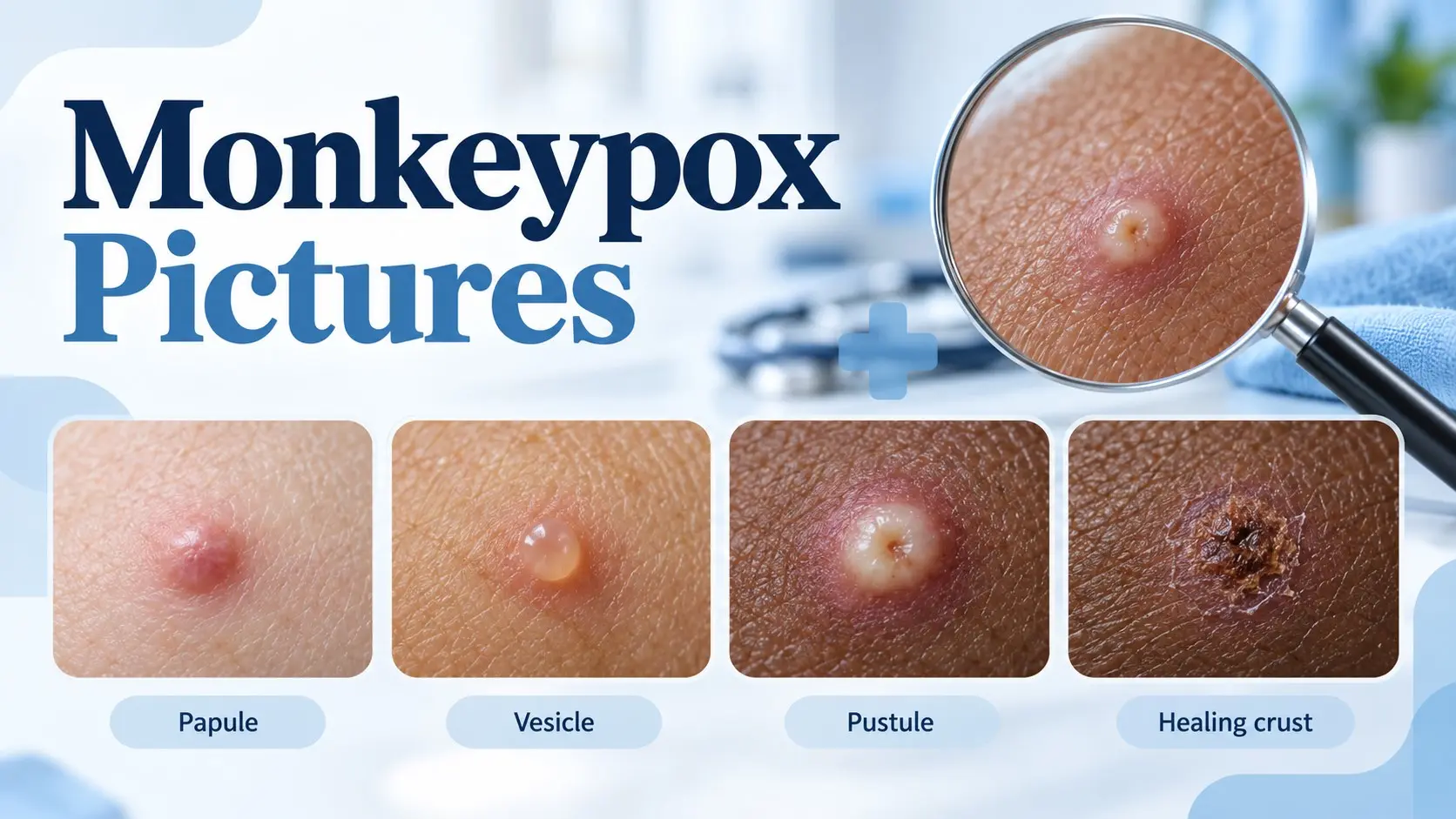
Monkeypox pictures can help you understand what an mpox rash may look like, but they cannot tell you for sure whether a spot, blister, or sore is mpox.
The disease is now widely called mpox. It is caused by monkeypox virus, and the rash can look very different from one person to another.
Some people develop many lesions. Others have only one or a few.
Quick answer: Monkeypox pictures commonly show firm, round, deep skin lesions that may develop a small central indentation. The rash can move through flat spots, raised bumps, fluid filled lesions, pustules, and scabs. Modern mpox can also cause only one or a few sores, including lesions around the mouth, genitals, or anus. A picture cannot confirm mpox. PCR testing from a lesion is used to diagnose it.
For broader information on rashes and skin warning signs, visit the NextFitLife Skin Health Guide.
Medical note: This content is for general educational purposes and does not replace professional medical advice, diagnosis, or treatment. Consult an appropriately qualified healthcare professional for personal medical concerns. This article explains published guidance and does not provide a personal clinical assessment. Always consult qualified medical professionals for diagnosis and treatment of any health condition.
Do not diagnose mpox from an online photograph. Herpes, chickenpox, syphilis, shingles, molluscum contagiosum, acne, bacterial infection, and other skin conditions can look similar.
Table of Contents
- What monkeypox pictures can show
- 7 important visual clues
- Firm and deep lesions
- Clear borders
- Central indentation
- Changing rash stages
- Pain and later itching
- Only one or a few lesions
- Skin color changes after healing
- Mpox rash stages
- Where lesions can appear
- Mpox on different skin tones
- What can look like mpox
- Symptoms beyond the rash
- How mpox spreads
- How testing works
- What to do while waiting for testing
- Treatment and pain control
- Mpox vaccination
- Who has higher risk of severe illness
- Eye symptoms and urgent warning signs
- References and Sources
- Related NextFitLife guides
- About the author
- Frequently asked questions
What Can Monkeypox Pictures Actually Tell You?
Monkeypox pictures are useful for learning patterns.
They can show what a firm lesion looks like, how a central dip may form, where lesions can occur, and how the rash changes as it heals.
What they cannot do is confirm your diagnosis.
The CDC says mpox lesions have a distinct appearance in many cases, but other diseases can look similar.
This matters because people sometimes compare one skin spot with a photograph online and decide they either definitely have mpox or definitely do not.
Both conclusions can be wrong.
7 Critical Visual Signs in Monkeypox Pictures
1. Mpox Lesions Can Feel Firm and Deep
A typical mpox lesion is often more solid than an ordinary thin blister.
CDC describes the lesions as firm or rubbery, well defined, and deep in the skin.
This can give them a rounded, structured appearance rather than a soft surface blister.
Still, texture cannot be judged reliably from a photograph.
2. The Lesions Often Have Clear Borders
Many monkeypox pictures show individual lesions with fairly clear edges.
The lesions may look round and separate from nearby normal skin.
They can appear alone or in groups.
Severe cases can have many lesions that begin to join together.
3. Some Develop a Central Indentation
One classic feature is a small depression in the center.
This is called umbilication.
It can become especially clear when lesions reach the pustular stage.
Not every lesion will show an obvious central dip, so its absence does not rule out mpox.
4. The Rash Changes Through Several Forms
Mpox does not create one fixed type of spot.
CDC describes four main visible stages before crusting:
- Macule
- Papule
- Vesicle
- Pustule
The lesion then crusts and the scab eventually falls away.
This progression is one reason a single picture from one day cannot show the entire illness.
5. Lesions Can Be Painful Before They Become Itchy
Mpox sores are often painful during active stages.
As they crust and heal, itching can become more noticeable.
Pain can be severe in lesions involving the mouth, anus, rectum, or genital area.
6. Modern Mpox May Cause Only One or a Few Lesions
This is one of the most useful updates to older monkeypox pictures.
Classic teaching often showed widespread lesions over the face, hands, arms, and body.
Current CDC guidance says a person may have only a single lesion or a few lesions.
The rash may also stay mainly in the genital, anal, or oral area.
A limited rash does not rule out mpox.
7. Healing Can Leave Lighter, Darker, or Scarred Skin
After the scab falls away, the new skin may not immediately match the surrounding skin tone.
Some people develop:
- Darker marks
- Lighter marks
- Pitted scars
- Changes in skin texture
The appearance varies with the depth of the lesion, skin tone, secondary infection, scratching, and individual healing.
Monkeypox Pictures by Rash Stage
A rash picture shows visible lesions rather than the incubation period. A visual guide can explain lesion stages but cannot confirm a diagnosis.
| Stage | What It May Look Like | Typical Pattern |
|---|---|---|
| Macule | Flat skin color change | Early visible lesion |
| Papule | Raised, solid bump | Often feels firm |
| Vesicle | Raised lesion containing clear fluid | Can resemble a blister |
| Pustule | Deep round lesion containing opaque material | Central indentation may appear |
| Crust | Dry scab over the lesion | Healing phase |
| New skin | Fresh intact skin after the scab falls | Marks or scars may remain |
CDC notes that on a given area of the body, lesions often develop at about the same time and evolve together.
The exact timeline varies.
Where Can Mpox Lesions Appear?
Old textbook images can create the impression that mpox always starts on the face and covers the body.
That is not how every modern case looks.
Mpox lesions can occur on:
- Face
- Mouth
- Throat
- Hands
- Feet
- Chest
- Arms
- Legs
- Palms
- Soles
- Genitals
- Groin
- Anal area
- Rectum
Some lesions can occur inside the body, which means they may not be visible in a normal photograph.
Can Monkeypox Pictures Look Different on Dark Skin?
Yes.
Monkeypox pictures should be viewed across many skin tones.
Inflammation on light skin may look pink or red.
On darker skin, the surrounding color may appear darker, purple, gray, brown, or simply different from nearby skin.
The lesion itself can still become firm, blistered, pustular, centrally indented, or crusted.
This is why relying on redness alone can make visual recognition less accurate.
What Conditions Can Look Like Mpox?
This section matters as much as the image guide.
A rash that resembles mpox can have a completely different cause.
| Condition | Possible Similarity | Useful Difference |
|---|---|---|
| Herpes simplex | Painful blisters or sores | Often grouped shallow blisters and recurrent in the same area |
| Chickenpox | Blisters and crusts | Often very itchy with lesions in several stages at once |
| Shingles | Painful blistering rash | Often follows a band on one side of the body |
| Syphilis | Genital or body lesions | Needs blood or lesion testing because appearance varies widely |
| Molluscum contagiosum | Round bumps with central dip | Usually smaller and less acutely painful |
| Acne or folliculitis | Pimple like bumps or pustules | Usually linked to hair follicles or acne prone areas |
CDC specifically lists herpes simplex, syphilis, shingles, chickenpox, molluscum contagiosum, scabies, and drug eruptions among conditions that clinicians may need to distinguish from mpox.
Our Herpes Skin Rash Guide explains one of the most common blistering lookalikes.
Monkeypox Pictures Are Not Enough for Diagnosis
This point should be clear.
Monkeypox pictures can raise suspicion.
They cannot confirm infection.
CDC recommends real time PCR testing to diagnose mpox.
A clinician usually swabs material directly from one or more lesions.
The laboratory looks for monkeypox virus genetic material.
Do not deliberately pop a lesion at home to obtain a sample.
What Other Mpox Symptoms Can Occur?
The rash is only part of the illness.
Other mpox symptoms can include:
- Fever
- Chills
- Headache
- Muscle aches
- Back pain
- Sore throat
- Low energy
- Swollen lymph nodes
Swollen lymph nodes are a classic feature, although not everyone develops obvious swelling.
The symptoms do not always follow the old textbook order.
Some people develop a rash first.
Others have fever or body symptoms first.
Some have only skin lesions.
How Soon Does Mpox Appear After Exposure?
WHO says symptoms can begin from 1 to 21 days after exposure.
CDC describes a typical incubation period of roughly one to two weeks.
A person may feel well during that time.
If you know you had a significant exposure, follow the advice of your local health authority or healthcare professional for symptom monitoring.
How Does Mpox Spread?
Transmission patterns vary by setting. During many recent outbreaks, close contact between people has been central to spread.
WHO says mpox spreads mainly through close contact with someone who has mpox.
This can include:
- Direct skin contact with lesions
- Intimate or sexual contact
- Contact with body fluids
- Contact with lesions inside the mouth or other mucosal surfaces
- Respiratory particles during close contact
- Contact with contaminated clothing, bedding, towels, or other items
In regions where infected animals carry the virus, animal to human transmission can also occur.
Mpox is not limited to one sex, gender, or sexual orientation.
Anyone can become infected when the right exposure occurs.
How Long Is Someone With Mpox Contagious?
A person with mpox can spread the virus while they are infectious.
CDC and WHO advise that a person remains contagious until all lesions have healed, every scab has fallen off, and a fresh layer of intact skin has formed.
This process often takes several weeks.
Do not pick scabs to make this happen faster.
What Should You Do if Your Rash Looks Like Monkeypox Pictures?
If your rash resembles monkeypox pictures, do not panic and do not diagnose yourself.
Take practical steps.
Contact a Healthcare Professional
Tell them you have a new unexplained rash and whether you know of a possible exposure.
Call before arriving when possible so the clinic can give you instructions.
Cover Visible Lesions
Use clean clothing or a clean dressing when practical.
Do not tightly wrap irritated skin without professional guidance.
Avoid Close Skin Contact
Until you know what the rash is, avoid close direct contact with other people.
Do Not Share Personal Items
Avoid sharing:
- Towels
- Bedding
- Clothing
- Razors
- Sex toys
- Other items that contact lesions
Wash Your Hands
Wash with soap and water after touching the rash or changing a dressing.
An alcohol based hand sanitizer can also be used when appropriate.
Do Not Shave Over the Lesions
Shaving can injure sores and potentially spread material to nearby skin.
Should You Pop an Mpox Blister?
No.
Do not intentionally pop, cut, puncture, or squeeze a suspected mpox lesion.
Damaging the skin can increase pain and create another route for bacterial infection.
Keep lesions clean and follow the care plan from your healthcare professional.
How Is Mpox Treated?
Most people without severe disease or major immune suppression recover with supportive care.
That includes:
- Pain control
- Fluids
- Nutrition
- Skin care
- Care for lesions in sensitive areas
Pain control should not be treated as a minor issue.
Genital, anal, rectal, mouth, or throat lesions can cause severe pain.
People with severe disease or a high risk of complications may need specialist treatment.
What About Tecovirimat?
Tecovirimat is an antiviral medicine originally developed for smallpox preparedness.
In the United States, CDC states that its use for mpox remains investigational.
Early results from randomized trials found that the drug was safe but did not shorten the time until mpox skin lesions resolved.
It remains available in selected circumstances for eligible patients through specific clinical pathways.
This is not a medicine to self treat with.
Is There a Vaccine for Mpox?
Yes.
Vaccines are available for eligible people; availability and recommendations depend on local public health guidance.
CDC recommends the JYNNEOS vaccine for people who meet current risk based eligibility criteria.
JYNNEOS is given as a two dose series.
CDC recommends the second dose four weeks after the first, although a delayed second dose should still be given.
Vaccination can also be used after some exposures.
Eligibility differs by country, so check current local public health guidance.
Can Vaccinated People Still Get Mpox?
Yes.
No vaccine prevents every infection.
Vaccination reduces risk, but CDC still advises vaccinated people to take steps to avoid close contact with someone who has active mpox.
Complete the recommended vaccine series for the best protection if you are eligible.
Are Clade I and Clade II Mpox Rashes Different?
There are two main genetic groups of monkeypox virus, called clade I and clade II, with known subclades.
You cannot reliably determine the clade by comparing your rash with monkeypox pictures.
CDC says lesions from both clades present similarly.
Laboratory testing and public health investigation are used when clade information is needed.
Who Has a Higher Risk of Severe Mpox?
Anyone can develop complications, but some people have greater risk.
WHO and CDC identify groups that include:
- People with major immune suppression
- People with poorly controlled HIV
- Pregnant people
- Children and younger people in some risk groups
- People with severe or complicated disease
If you fall into a higher risk group and think you may have mpox, contact a healthcare professional promptly.
Why Do Eye Symptoms Need Fast Care?
Mpox can affect the eye.
CDC warns that ocular mpox can threaten vision.
Possible problems include conjunctivitis, inflammation of the eyelids, keratitis, corneal ulcer, corneal scarring, and rarely vision loss.
Eye warning: Seek urgent medical care if a suspected or confirmed mpox infection is followed by eye pain, eye redness, light sensitivity, blurred vision, a lesion close to the eye, or another new eye symptom.
Wash your hands before touching your face and avoid touching lesions and then rubbing your eyes.
When Does Mpox Need Urgent Medical Care?
Seek prompt or urgent care for:
- Eye symptoms
- Severe uncontrolled pain
- Trouble swallowing
- Trouble drinking enough fluid
- Signs of dehydration
- Confusion
- Seizures
- Severe breathing symptoms
- Rapidly spreading skin damage
- Signs of bacterial infection in lesions
- Severe rectal pain or bleeding
- Severe disease during pregnancy
- Severe symptoms in a child
- Severe symptoms in someone with a weakened immune system
Where Can You See Reliable Monkeypox Pictures?
If you want to compare educational images, use trusted clinical sources rather than random social media photos.
The CDC Clinical Signs and Symptoms page includes verified clinical monkeypox pictures showing lesions on different body sites and skin tones:
CDC Clinical Signs and Symptoms of Monkeypox
These images are still examples.
Your rash may look different.
Conclusion
Monkeypox pictures can teach you what firm lesions, central indentation, vesicles, pustules, crusts, and healing skin may look like, but they should never be used as a home diagnostic test.
Modern mpox can cause one lesion, a few localized sores, or a wider rash. Lesions can occur on the face, hands, feet, mouth, genitals, anus, or other body sites, and appearance varies across skin tones.
If you develop a new unexplained rash that resembles monkeypox pictures, especially after possible exposure, avoid close skin contact and contact a healthcare professional about testing. Seek urgent care for eye symptoms, severe pain, dehydration, serious illness, or complications in a higher risk person.
References and Sources
- Centers for Disease Control and Prevention. Clinical Signs and Symptoms of Monkeypox.
Updated January 14, 2026.
https://www.cdc.gov/monkeypox/hcp/clinical-signs/index.html - World Health Organization. Mpox.
Current WHO overview of symptoms, transmission, complications, and prevention.
https://www.who.int/health-topics/mpox - Centers for Disease Control and Prevention. Diagnostic Testing for Monkeypox.
Updated February 6, 2026.
https://www.cdc.gov/monkeypox/hcp/diagnosis-testing/index.html - Centers for Disease Control and Prevention. Preventing Monkeypox.
Updated January 22, 2026.
https://www.cdc.gov/monkeypox/prevention/ - Centers for Disease Control and Prevention. Monkeypox Vaccination.
Current guidance on the JYNNEOS vaccine and two dose schedule.
https://www.cdc.gov/monkeypox/vaccines/
Continue Reading on NextFitLife
Use these related NextFitLife guides for skin rashes, viral lesions, and skin health:
About the Author
Adel Galal is the founder and lead writer of NextFitLife. His work focuses on health, fitness, nutrition, wellness, skin care, and healthy aging, with an emphasis on checking health claims against recognized medical and public health sources.
For visual health topics, his editorial approach is simple: photographs can teach patterns, but they should not replace testing or diagnosis when several conditions can look alike.
This content is for general educational purposes and does not replace professional medical advice, diagnosis, or treatment. Consult an appropriately qualified healthcare professional for personal medical concerns. This article explains published guidance and does not provide a personal clinical assessment. Always consult qualified medical professionals for diagnosis and treatment of any health condition.
Learn more about Adel Galal, NextFitLife, and the site's editorial approach on the About Us page.
Frequently Asked Questions About Monkeypox Pictures
What Do Monkeypox Pictures Look Like?
Monkeypox pictures often show round, firm, deep lesions that can change from flat spots to raised bumps, fluid filled vesicles, pustules, and scabs. Some lesions develop a central indentation.
Can Monkeypox Look Like a Pimple?
Yes. Early mpox lesions can resemble pimples or other small bumps. A photograph alone cannot reliably separate mpox from acne, folliculitis, herpes, molluscum, or other conditions.
Can You Have Mpox With Only One Lesion?
Yes. CDC notes that modern mpox can cause only one lesion or a few localized lesions. A widespread rash is not required.
Do Mpox Lesions Always Start on the Face?
No. Lesions can occur on the face, hands, feet, mouth, genitals, anus, groin, chest, or other areas. Some outbreaks have included localized genital or anal lesions without a widespread facial rash.
Are Mpox Lesions Painful or Itchy?
They can be both. Active lesions are often painful. Itching may become more noticeable as lesions crust and heal.
What Is the Dip in the Middle of an Mpox Lesion?
The central dip is called umbilication. It is a classic feature of some mpox pustules, but not every lesion has a clear central indentation.
How Long Does the Mpox Rash Last?
WHO says symptoms usually last about two to four weeks, although illness can last longer in some people with weakened immune systems.
Can Monkeypox Pictures Diagnose Mpox?
No. Monkeypox pictures can help recognize possible patterns, but laboratory testing is needed for confirmation. CDC uses real time PCR testing from lesion samples.
What Can Be Mistaken for Mpox?
Herpes simplex, chickenpox, shingles, syphilis, molluscum contagiosum, acne, folliculitis, scabies, and some drug reactions can resemble mpox.
Can Mpox Affect Darker Skin?
Yes. Mpox affects people of every skin tone. Redness may look less obvious on darker skin, and surrounding inflammation may appear brown, purple, gray, or simply darker than nearby skin.
Can Mpox Affect the Eyes?
Yes. Mpox can cause eye and corneal disease. Eye pain, redness, blurred vision, light sensitivity, or lesions near an eye need urgent professional care.
Is Mpox the Same as Monkeypox?
Yes. Mpox is the name now widely used for the disease previously called monkeypox. It is caused by monkeypox virus.
How Is Mpox Spread?
Mpox spreads mainly through close contact with an infected person. Direct skin contact, intimate contact, body fluids, lesions, contaminated objects, and respiratory particles during close contact can transmit the virus.
When Is a Person With Mpox No Longer Contagious?
A person is generally no longer considered contagious once all lesions have healed, every scab has fallen away, and a new layer of intact skin has formed.
Is There an Mpox Vaccine?
Yes. JYNNEOS is used for mpox prevention in eligible people. CDC recommends two doses for best protection, with the second dose normally given four weeks after the first.

Health & wellness writer with 30+ years of experience in nutrition, fitness, and healthy aging. Founder of NextFitLife.com — evidence-based health guidance.